
As almost all cat owners know, cats are fairly solitary creatures. Originally, cats preferred to live and hunt alone, and their social interactions were very limited. As cats became more and more domesticated, these dynamics changed, and cats began to develop sophisticated vocalizations to communicate more effectively. One of these was meowing.
Cats altered their vocalizations to take advantage of the innate need in humans to care for and pay attention to distress calls, an instinct in us brought about from a baby’s complete dependence on their parents.
Cat Communication
Cats have distinct differences in their purrs, but almost all of these grab our attention almost immediately. So-called solicitation purrs—when your cat wants you to feed or pet them—have a pitch component that resembles a cry, tapping into our innate sensitivity. Meows from our cats can have a similar effect.
In-house veterinarian at Catster.com, Dr. Karyn Kanowski, BVSc, MRCVS, knows this all too well.
“The ability to more accurately decipher the meaning behind feline vocalizations (or of any animal, for that matter) would be groundbreaking. Even with my own cats, I sometimes sense an air of frustration when I am being incessantly bombarded with demanding ‘meows’, as though they are simultaneously furious at my inability to follow orders and disappointed in my lack of intelligence!”
What’s in a Meow? What Science Says
A 2020 study on the interpretation of domestic cat vocalizations aimed to investigate our capacity to recognize meows from cats while waiting for food, in isolation, and during brushing.
The participants were asked to fill in an online questionnaire to assess their knowledge of cats and their general attitude toward animals. They also listened to cat meows recorded in different situations and were asked to try to identify the context in which they were made and their emotional impact.
In all instances, more than 50% of the participants were incorrect. In fact, the best case was with identifying the “waiting for food meow”, which participants only got correct 40% of the time for “standard” meows (the most representative sound of the specific situation) and 27% for the “outlier” meows—the most different sound with respect to the typical one emitted in the specific situation.
However, standard meows were much more likely to be chosen for the correct context than outlier meows. The accuracy ratio was still low, though, and never much higher than the statistical level of chance (33%). Females in the study showed a higher accuracy rate, and the level of experience with cats also made a big difference—cat owners had a higher accuracy rate than nonowners in all contexts.
Dr. Kanowski adds,
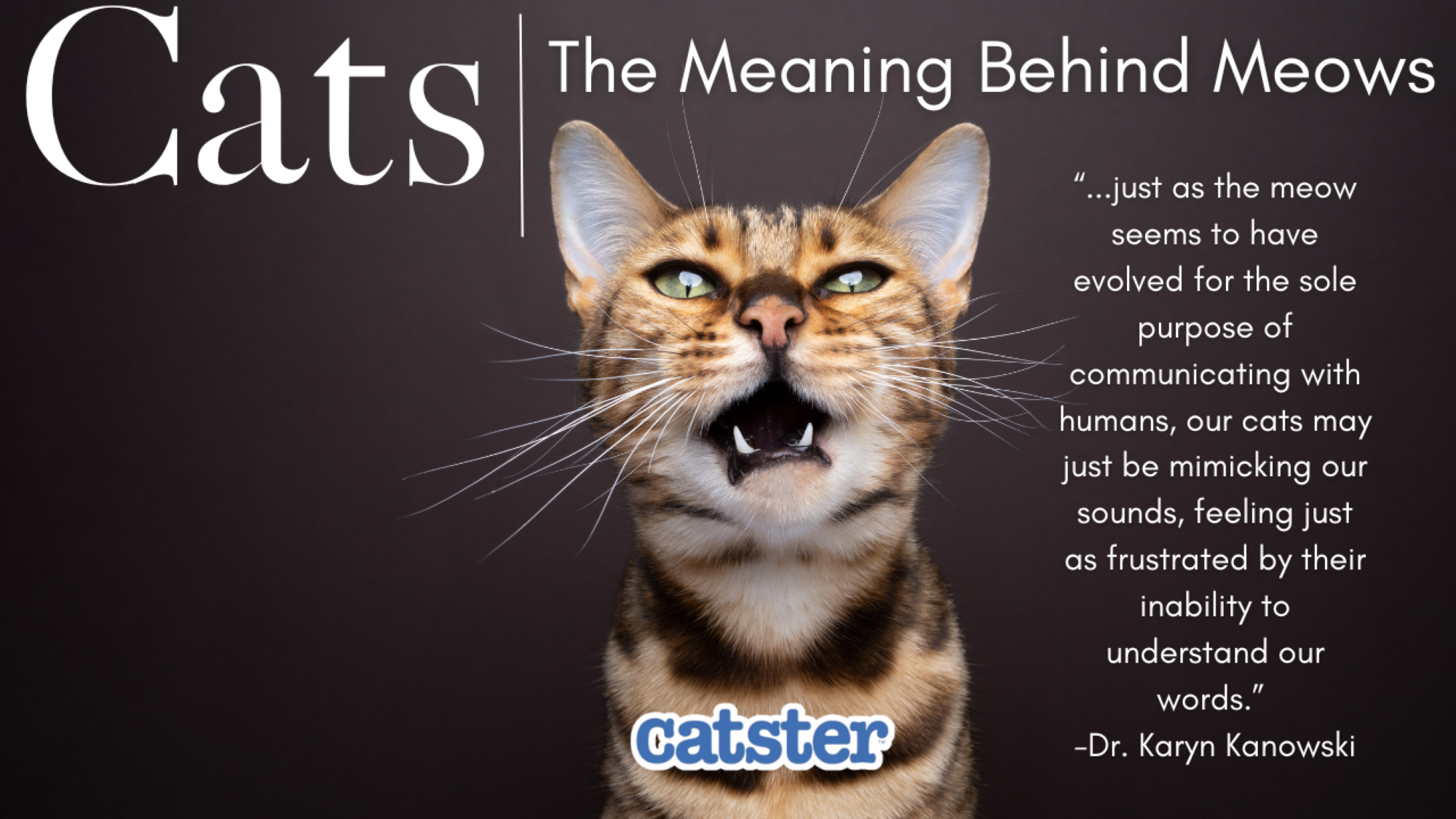
“In all my years of living and working with cats, I have never had a negative reaction to the meows I direct towards them, and I would think it a statistical impossibility that I have never managed to say something insulting in ‘cat’! This leads me to believe that, just as the meow seems to have evolved for the sole purpose of communicating with humans, our cats may just be mimicking our sounds, feeling just as frustrated by their inability to understand our words.”
“Perhaps we are putting too much emphasis on trying to understand the meow when our focus ought to be on the grumbles, chirps, hisses, and body language that form inter-feline communication rather than the sounds they make to placate us, which are likely to be as nonsensical to us as our words are to them.”
Of course, this study was lacking in several key areas, most importantly, the way that owners bond with their cats and are thus able to decipher what they need far more accurately. Still, it’s a fascinating look at how far humans have to go in terms of understanding the needs of their feline counterparts.
About Catster.com
Catster.com has long been the go-to source for all things cat-related. With a dedicated team of experienced writers and vets, the website is a treasure trove of up-to-date information and tips on how to properly care for your cat, plus fascinating facts about cat vocalization. For more information on everything in the world of cats, be sure to check out Catster.com!
Feature Image by billywatsrong from Pixabay