

- Over half (53%) of the workforce find the use of acronyms (such as ‘COP’ and ‘DND’) in the office setting confusing
- In London, 41% reveal that using linguistic shortcuts adds time to the jobs they are undertaking
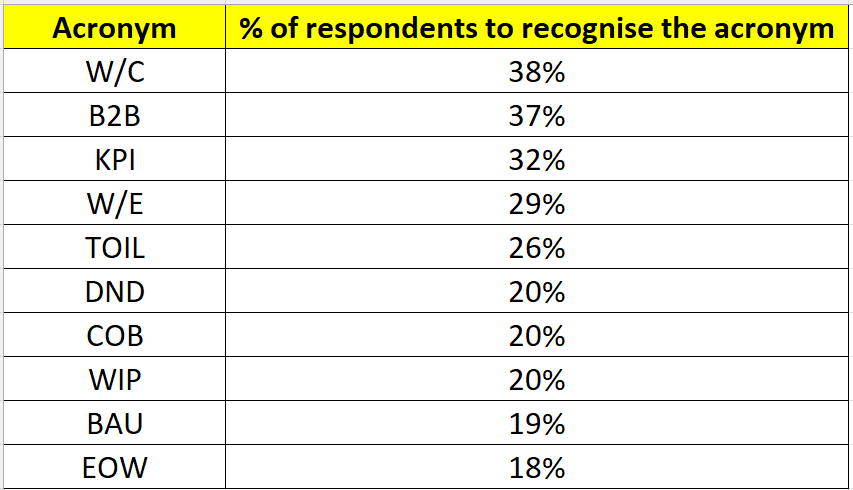
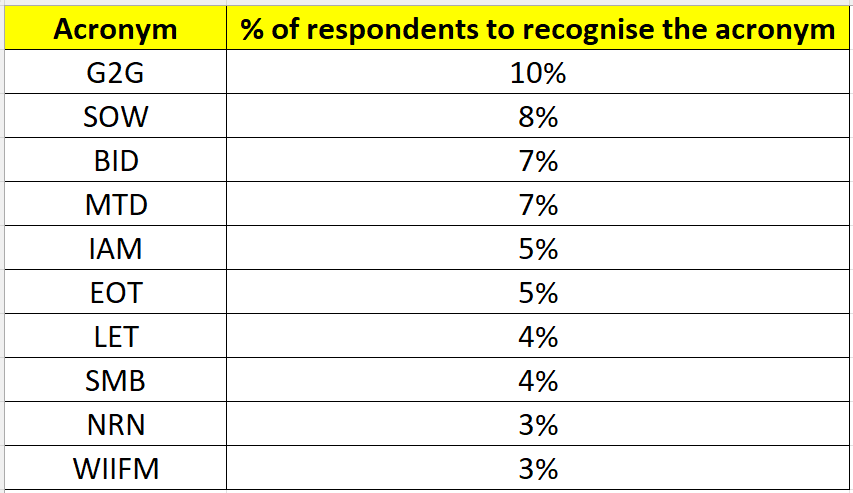
- ‘W/C’, ‘B2B’ and ‘KPI’ were the most widely recognised acronyms, whereas only a minority had come across newer additions to the lexicon such as ‘SMB, ‘NRN’ and ‘WIIFM’
- Nearly a fifth (19%) of respondents didn’t recognise any of the acronyms asked about
- Looking at age, 25% of Gen Z 18-24-year olds were not familiar with any of the shorthand, compared to just 15% of older millennials (35-44-year-olds) who reported the same
- More than one in 10 (12%) think acronyms can cause workplace exclusion
- That being said, 10% of people nationally still feel that the use of shorthand creates a sense of team spirit. This increases to nearly a fifth (18%) when looking at London-based respondents.
- 45% of office-goers see social interactions with colleagues as the most beneficial aspect of going into the office
Provider of flexible workspaces, Landmark, launches its first Business Style Barometer, revealing some of the key changes to modern office workplace culture in recent years. The office has undergone a remarkable transformation with staff navigating a delicate balance between the familiar rhythms of traditional working life, whilst simultaneously seeking flexibility.
Findings from the Business Style Barometer are built from a survey of 2,000 respondents, all of whom work in an office, either part- or full-time.
DND, I’m LET: are you fluent in acronyms?
The Barometer reveals the nuanced role acronyms play in the office, from fostering camaraderie to potentially leaving colleagues out in the cold.
Over half of respondents felt the use of acronyms in the office setting can sometimes cause confusion (53%), meaning their use may not be the most inclusive form of expression. Further, more than one in 10 (12%) feel the use of shorthand phrases can cause workplace exclusion. Nearly a quarter of people (24%) report that using acronyms adds time to communications in the workplace. In London, this number is even more compelling with 41% agreeing that using linguistic shortcuts adds time to the jobs they are undertaking.
Despite this, 10% of people nationally still feel that the use of shorthand creates a sense of team spirit. This increases to nearly a fifth (18%) when looking at London-based respondents.
Landmark also analysed the most and least commonly identified acronyms. ‘W/c’ comes top of the leaderboard with 38% of respondents recognising this shorthand. This is closely followed by ‘B2B’, which is recognised by 37% of respondents. On the other hand, the least commonly recognised acronyms are ‘WIFIM’ and ‘NRN’, with just 3% saying they know what these abbreviations mean. Surprisingly, nearly a fifth of respondents did not recognise any of the acronyms.
Top 10 most recognised acronyms
Top 10 least recognised acronyms
Age-centric analysis also illuminates the communication preferences of different generations. A quarter of 18-24-year-olds (25%) reported not knowing any of the acronyms asked about, very similar to older colleagues, with 24% of 55-64-year-olds reporting the same. Only 15% of 35-44-year-olds had the same response, the group least likely to report being out in the cold on all the acronyms, suggesting older millennials are savviest here. Officer workers aged 65-and-over were most likely to be in the dark on this office jargon with 41% stating they didn’t know any of the short-hand.
Upon closer inspection, there were some differences between what people thought each acronym represented, corroborating the idea that the use of some of these terms might cause some confusion in the workplace. For example, some people with their ‘nautical hat’ on thought that ‘COB’ stands for ‘caution on board’, whilst others believe it to mean ‘close of business’ or ‘cost of business’. ‘PO’ also confuses respondents, with mixed feelings as to whether it means ‘purchase order’ or ‘post office’.
Where a lack of understanding did occur, most said they would Google the meaning (64%), though over half (55%) said they would ask a colleague, potentially stirring discussion and an opportunity for bonding between them.
Sam Mardon, Chief Customer Officer, commented: “We often hear and see abbreviations used throughout the workplace, but use of acronyms and their primary meaning can differ between offices, workspaces, industries, and even between departments! I have certainly learnt a new acronym or two from our research and it is interesting to see how others interact with the use of acronyms in an office setting.
“For the word nerds among us, acronyms in the office can streamline and speed up conversations and communication with colleagues. Yet, for others, employees can find themselves surrounded by unfamiliar jargon, which can inadvertently cause confusion or miscommunication within the workspace.
“Reflecting on this, it is evident that acronyms are very personal, with individuals attributing a variety of meanings to some of the jargon we asked them about. Office-goers should therefore be cautious not to create barrier to others spending time in the office by minimising ambiguity.”
The shifting contours of office life
When looking at what drives employees into the office, the social value that the workplace offers comes out on top. 45% of respondents revealed that social interactions with colleagues is the most beneficial aspect of the office. This is closely followed by collaboration with colleagues on work projects (43%) and face-to-face meetings (36%).
When employees are in the office, more than half of respondents (51%) see a personal workstation as most important to them in terms of creating an environment they enjoy working in. This is significantly higher than access to a meeting room, which comes in second at 27%.
According to age, a personal workspace is more important for those aged 55-64 (61%), compared to just 37% of 18–24-year-olds. Comparatively, lifestyle amenities, such as a games room, theatre room, and a selection of drinks, including soft drinks or alcoholic drinks, are more important to 18-24 year olds (32%), compared to just 6% of 55-64-year-olds. This is true for sporting amenities, including bike storage, too with 25% of 18-24-year-olds saying this is important compared to just 2% of 55–64-year-olds.
The survey further revealed that the non-linear working day and week is still disrupting the status quo.
When office-goers aren’t working traditional hours, defined as 9am – 5:30pm, an early morning stint is the most popular alternative, with 27% of respondents stating that they generally start work before 9am, compared to only 7% who say they work beyond 5.30pm. According to age, 18-24-year-olds are the night owls, being the most likely to stay late and work after 5.30pm (16%).
Working a five-day week in the office is also starting to feel like a distant memory for most, with Tuesday (65%), Wednesday (65%) and Thursday (59%) being the most popular days for office-goers, often referred to as TWATs, (those who go in on Tuesday, Wednesday and Thursday).
Ed Cowell, Chief Executive Officer, commented: “In the last three years, we’ve seen hybrid working boom in popularity. Given this demand, at Landmark, we have an ambitious investment target for two to three new building openings per year.
“This reflects the fact that it is increasingly becoming the norm as members of the workforce weave adaptability and balance into their working lives more than ever before. While the traditional five-day work week in the physical office may be fading, Tuesday, Wednesday, and Thursday have emerged as the champions of the office rendezvous, redefining the midweek hustle.
“As our research further shows, for office-goers, the office continues to be an important ecosystem that enables connection, collaboration, and creativity. Gen Z’s in particular are keen to benefit from all the advantages that office life offers.
“While technology has undeniably changed our working patterns, the office continues to have significant momentum behind it with a physical presence in the office remaining crucial for many. For employers, flexibility remains of paramount importance if you are looking to provide spaces for colleagues that inspire engagement and encourage community.”
Methodology
This market survey was conducted by OnePoll in July 2023. 2,000 respondents were polled across the UK. Raw data available upon request. Full list of office acronyms and their most common meaning:
W/C
Week commencing
B2B
Back to back
KPI
Key performance indicator
W/E
Weekend
TOIL
Time off in Lieu
DND
Do not disturb
COB
Close of Business
WIP
Work in progress
BAU
Business as usual
EOW
End of week
PO
Purchase order
EOM
End of month
EBITDA
Earnings Before Interest, Taxes, Depreciation and Amortisation
EBIT
Earnings before interest and taxes
TL;DR
Too long; Didn’t read
OTP
One time payment
G2G
Good to go
SOW
Statement of work
BID
Twice a day
MTD
Month to date
IAM
In a minute
EOT
End of topic
LET
Leaving early today
SMB
small and medium-sized business
NRN
No reply needed
WIIFM
What’s in it for me
About Landmark
Landmark gets the flexible workspace offering right. With over 20 years of experience behind them, every member of the Landmark team has a deep understanding of what will make their clients’ lives easier and therefore consistently delivers on this. Everything works seamlessly, from the service and amenities clients enjoy, right through to the flexible and all-inclusive contracts – creating a setting for businesses and individuals to thrive.
Landmark has a team of over 160 people supporting 11,500+ clients daily, from fast-growing companies to established SMEs and global blue chips. Reflecting its diverse range of clients, Landmark’s two brands, Landmark and The Space, provide a varied range of work environments to accommodate the ever-changing needs of different businesses. Ranging from custom designed private offices to fully-furnished entire floors – as well as co-working spaces, virtual offices and hire-on-demand meeting rooms – there’s something for everyone.
The constant among these differing spaces is the warm, friendly, and professional experience each Landmark client receives. Landmark goes beyond just providing an office space in a good location – every business interaction and working environment is designed to reflect their clients’ lifestyles and needs.
Creating these engaging environments is at the core of helping Landmark’s clients achieve their full potential, in dynamic, well-connected locations. Landmark’s people are central to this ethos, as is their proactive ‘consider it done’ approach.
Landmark currently operates 41 buildings across seven UK cities. 33 of their offices are in prime London locations, with the remaining eight offices across towns and cities in England and Scotland.
To find out more, visit: www.landmarkspace.co.uk