

Medical travel is no longer limited to patients searching for a cheaper procedure abroad. People are travelling across borders for specialist expertise, advanced treatment options, shorter waiting times and access to hospitals they may not be able to reach at home.
But finding a hospital online is only one part of the process. Patients still need to know whether a doctor is right for their case, what treatment they may need, what it will cost and how the journey will work. That is where medical travel platforms have a role to play.
Clinics on Call, a UK-registered international medical travel platform, connects patients with healthcare providers in more than 25 countries. We spoke with its founder and CEO, Dr. Zeeshan Zaman, about how the company started, why South Korea has become an important destination and what patients should consider before booking surgery abroad.
Why Clinics on Call Ltd is Registered in Scotland and What the UK Market Means to the Business
Clinics on Call Ltd is registered in Scotland, UK, but its work is international. The platform connects patients with healthcare providers across different countries, including destinations in Asia, Europe and the Gulf.
For Dr. Zeeshan Zaman, the UK connection is part of the company’s international identity, not a sign that its services are limited to British patients.
“The idea is to create a trusted bridge between patients and healthcare providers, regardless of where they live or where they need treatment,” he explains.
For UK patients, this can mean having support while exploring healthcare options outside the NHS or the UK private healthcare system. This may include identifying relevant specialists, obtaining treatment information, comparing suitable options and understanding the practical side of travelling for care.
What the Founder Saw in Medical Travel that Existing Platforms were Getting Wrong

Dr. Zeeshan Zaman completed his medical education in 2014 and later moved into the medical travel industry. His healthcare experience gave him a different view of what patients faced when searching for treatment abroad.
The problem was not a lack of information. In many cases, there was too much of it. A patient could find hundreds of hospitals, doctors and treatment prices with a few searches. What was harder was knowing which information actually mattered.
“Finding a hospital online is easy. Knowing whether it is suitable for your particular diagnosis is much more difficult,” Dr. Zaman says.
He also saw that patients needed more than advertisements and price lists. They needed someone who could understand their medical situation and help them communicate with appropriate healthcare providers.
He founded his first company in 2017 and launched Clinics on Call in 2020. Since then, his work has combined medical knowledge with healthcare coordination, business development and international medical tourism.
He has also taken part in international medical tourism events and spoken at healthcare and medical travel conferences, including Medical Korea in 2024 and 2025, as well as events in Dubai, Berlin, Düsseldorf, London and Antalya.
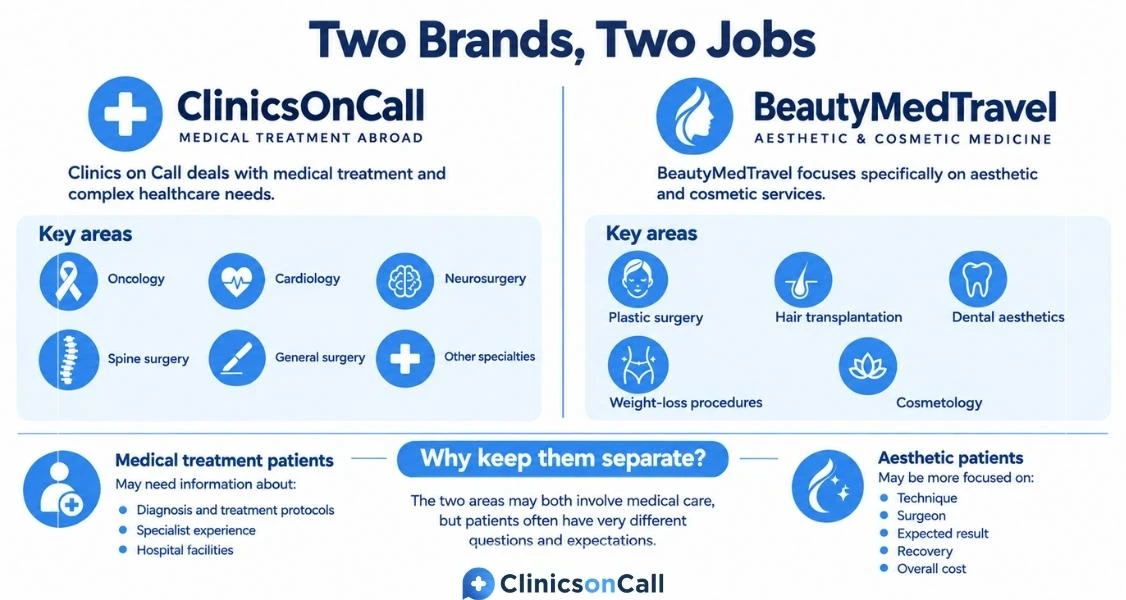
Two Brands, Two Jobs
Clinics on Call is not the only platform Dr. Zaman has developed. The company also operates BeautyMedTravel, which focuses specifically on aesthetic and cosmetic medicine.
Clinics on Call deals with medical treatment and complex healthcare needs. Its areas include oncology, cardiology, neurosurgery, spine surgery, general surgery and other medical specialties.
BeautyMedTravel focuses on aesthetic and cosmetic services such as plastic surgery, hair transplantation, dental aesthetics, weight-loss procedures and cosmetology.
The two areas may both involve medical care, but patients often have very different questions and expectations.
A person searching for cancer treatment may need information about diagnosis, treatment protocols, specialist experience and hospital facilities. Someone considering a hair transplant may focus more on the technique, surgeon, expected result, recovery, and overall cost.
Keeping the platforms separate allows each patient group to find information that is more relevant to its needs.
How Do You Vet a Hospital in a Country Your Patient has Never Visited?
This is perhaps the most important question for any medical travel company. A patient in the UK may be able to visit a local hospital before treatment. Someone travelling to Seoul, Istanbul or another international destination may have never even been to the country.
So how can they assess the hospital? Dr. Zaman says hospital selection cannot be based on a website, online advertisements or rankings alone.
Clinics on Call considers several factors. These include the hospital’s experience with a particular diagnosis or procedure, the specialist’s qualifications and experience, available facilities and technology, international patient services, communication, treatment information and cost transparency.
The company also maintains relationships with healthcare providers and communicates with hospital management and medical teams. Still, patients should understand an important limitation.
“No platform can guarantee a medical outcome,” he says. “Our responsibility is to help patients understand their options and connect them with suitable healthcare providers.”
That distinction matters. A medical travel coordinator can help with the process, but the treating doctor remains responsible for the medical assessment and treatment.
Korea, Turkey and the Gulf: Where the Demand is Coming from Now and Why
Medical travel is becoming more international. Patients are no longer looking only at a small group of traditional destinations.
South Korea has become an important destination for selected aesthetic procedures. Its medical institutions have built a strong international patient infrastructure and offer access to specialized services and modern medical technologies.
Turkey remains another major medical travel destination, with patients travelling there for areas ranging from surgery and oncology to transplantation, dentistry and aesthetic medicine. Its location also makes it relatively accessible to patients from Europe and the Gulf.
China is also developing as a healthcare and medical travel hub. Patients travel for different reasons. Some are looking for a particular specialist. Others are interested in treatments that may not be readily available to them locally. Waiting times, cost and the overall patient experience can also influence the decision.
The key, according to Dr. Zaman, is not to start with the destination. The starting point should be the patient’s medical needs.
What UK Patients Should Know Before Searching “Surgery Abroad”
Searching for surgery abroad can produce thousands of results. That does not necessarily make the decision easier.
- The first step is gathering your medical records, including scans, reports, previous treatment information, and relevant medical history.
- Patients should then seek a medical opinion rather than choosing a destination based on price alone. The doctor matters as much as the hospital.
- It is also important to ask exactly what a treatment quote includes. A headline price may not cover consultations, diagnostic tests, medicines, hospital stays, follow-up appointments or treatment for complications.
- Then there is the journey itself. Patients need to consider visas, flights, accommodation, airport transfers, language support and the length of their stay.
- Aftercare is particularly important. Before travelling, patients should understand how follow-up will be managed and who they can contact if a problem develops after they return home.
When the Patient Needs More than a Hospital Address
One anonymized case handled through Clinics on Call medical travel coordination involved a patient who was looking for treatment abroad but was unsure which hospital and specialist were appropriate.
The patient had already searched online and found several possible providers. However, the information did not answer the main questions: Which specialist was suitable for the case? What treatment was likely to be recommended? What would the complete journey involve?
The coordination process involved reviewing the patient’s medical information, identifying suitable providers and helping the patient communicate with the medical team. The patient could then decide with a clearer understanding of the available options.
That example reflects the gap Dr. Zaman says he noticed when he first entered medical travel. Patients do not simply need a list of hospitals. They need help making sense of their options.
Patient confidentiality remains central to this process, which is why individual patient details and identifying information are kept private.
From International Medical Travel to Seoul and Beyond
Clinics on Call‘s international outlook has also brought attention from major media. Zaman and the company were featured in a CNN Business article titled “How trips to Asia are making some Americans healthy again.”
The feature looked at the growing interest in medical travel to Asia and the reasons patients are considering international healthcare. For Zaman, the changing medical travel market points to a wider shift. Patients are becoming more willing to look beyond national borders, but they still need reliable information before making that move.
The future of medical travel, therefore, may not simply be about getting on a plane for treatment. It may be about making the entire process easier to understand.
For a patient considering Seoul, Istanbul, Dubai or another destination, the most important question is not simply, “How much does the surgery cost?” It is, “Is this the right treatment, with the right specialist, in the right setting for me?”
That is the gap Clinics on Call is trying to address: bringing together technology, medical knowledge and human coordination so patients can explore healthcare abroad with more information and a clearer understanding of their choices.