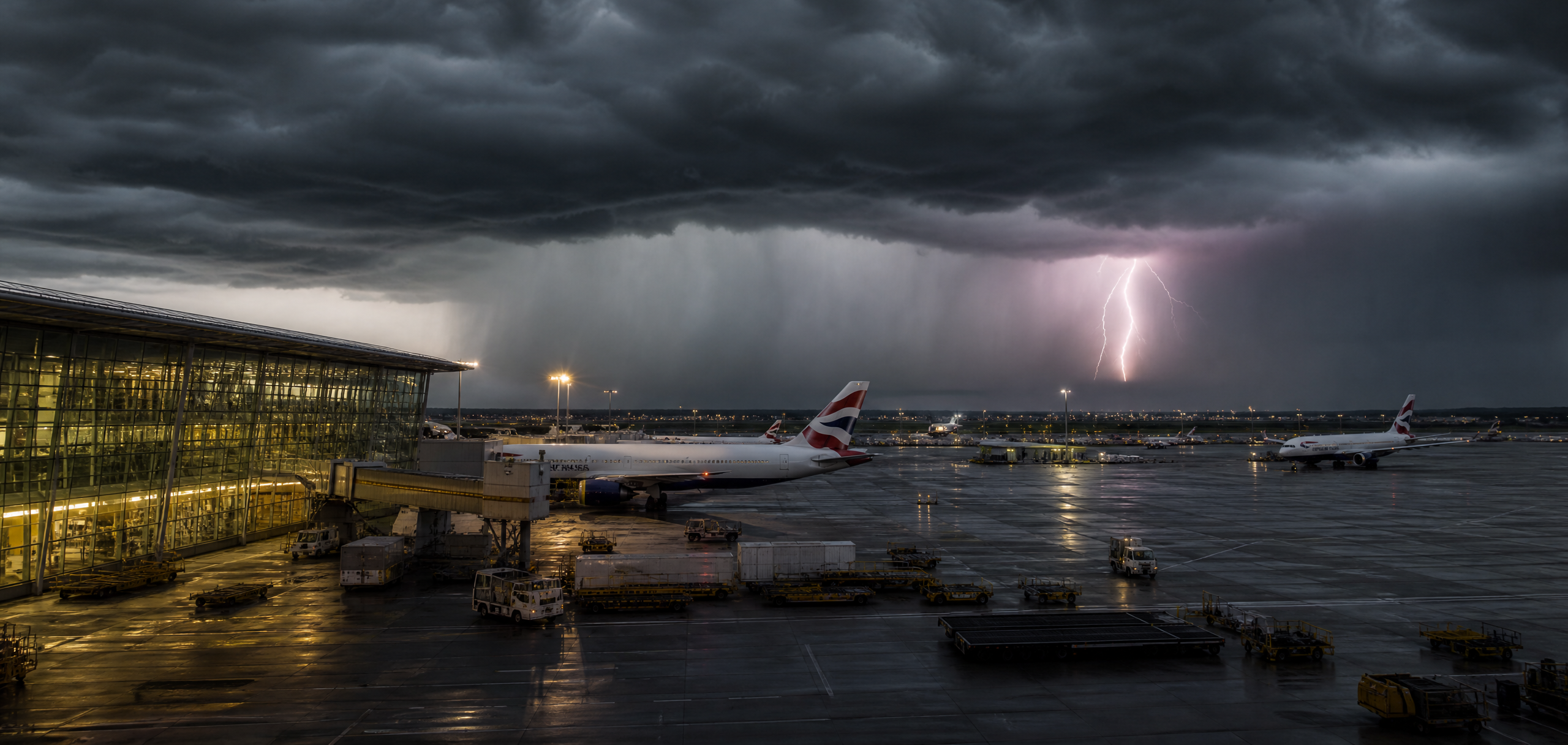

Severe thunderstorms sweeping across south‑east England and parts of north‑western Europe have caused substantial disruption at London’s two biggest airports, forcing hundreds of flights to be delayed or cancelled. Aviation tracker FlightAware recorded more than 900 affected services at Heathrow and Gatwick on Saturday, with knock‑on effects expected to continue overnight as air traffic control agencies reconfigure routes to keep aircraft clear of storm cells.
Scale of the disruption
FlightAware data showed 474 delayed flights at Heathrow and 439 delayed flights at Gatwick, a combined total of more than 900 delayed inbound and outbound services. Delays varied in length, with some passengers reporting waits of up to 11 hours and dozens of flights cancelled. Airlines adjusted schedules and advised travellers to check the status of their journeys before setting out for the airports.
Why flights are being held back
UK air traffic control provider NATS said the severe thunderstorms, which extended across south‑east England and into parts of Europe, were forcing aircraft to avoid affected areas and to be separated by greater distances than under normal conditions. The extra spacing reduces the number of planes that can safely transit controlled airspace, creating capacity constraints that ripple through airport schedules.
Europe’s air traffic coordination agency Eurocontrol produced mapping that showed the most intense air traffic control delays in the corridor between south‑east England and north‑western Europe, consistent with the location of the storm systems. NATS warned the disruption was likely to persist into the remainder of Saturday and overnight, as controllers and airlines sought to balance safety with the need to keep services moving.
Passengers caught up in long waits and cancellations
The human cost of the disruption was illustrated by several named passengers. Adam Joseph described being stranded at Venice airport after plans were upended, while Will Poole said an EasyJet flight he was due to take was cancelled, forcing him to subsequently call off an EasyJet Holidays package trip. Social media and airport queues showed numerous travellers seeking rebookings, refunds or accommodation.
Heathrow’s live arrival board highlighted the scale of individual delays, with a British Airways flight from Santiago, Chile, originally scheduled to touch down at 10:00 BST, not expected until around 21:00. Airlines and airport operators stressed they were working to assist affected customers, but acknowledged that weather‑related disruption can produce large and fast‑changing impacts that are difficult to resolve quickly.
Airlines and airports respond
British Airways and EasyJet issued statements confirming schedule adjustments and setting out passenger options, including rebookings and refunds where cancellations occurred. Airport operators at both Heathrow and Gatwick urged travellers to check with their airline for the latest information and to avoid travelling to the airport unless their flight was confirmed to be operating.
Airlines are required under passenger rights regulations to offer assistance where flights are significantly delayed or cancelled, but the scale and timing of the thunderstorms complicated efforts to provide immediate alternative flights. Where possible, carriers are rerouting aircraft around storm cells or holding departures until airspace capacity improves.
Weather context and outlook
The storms followed an intense heat spell in the UK, with Suffolk registering a record June high of 37.3°C on the Friday before the weather turned unstable. Such hot conditions can increase atmospheric instability, which in turn fuels thunderstorms. Forecasters warned that further unstable conditions were possible across parts of Europe, raising the prospect of additional disruption over the coming 24 to 48 hours.
Despite the widespread effect at the two London hubs, many other UK airports reported far fewer problems. The geographically focused nature of the storm cells, and the particular density of traffic in the south‑east England to north‑western Europe corridor, meant the busiest routes and airports bore the brunt of the impact.
What travellers should do
Passengers with imminent travel plans are advised to check their flight status directly with their airline before leaving for the airport, and to allow extra time if alternative arrangements are required. Where flights are cancelled or subject to long delays, airlines should offer rebooking or refunds and, where appropriate, assistance with meals and accommodation. Travellers should also register any complaints through the airline’s formal channels if they feel their rights have not been properly upheld.
Controllers and airlines emphasised that safety remains the overriding priority, and that temporary disruption is the unavoidable trade‑off of ensuring safe separation between aircraft in turbulent weather. Operational teams at airports, carriers and air traffic services continued to monitor conditions and work through the backlog of delayed services.
Concluding, the thunderstorms highlighted how quickly extreme weather can cascade through an already tightly scheduled aviation system, underscoring the importance of flexible planning by both operators and passengers in the face of increasingly volatile weather patterns.
FAQ
Q: Why are thunderstorms causing so many flight delays and cancellations?
A: Thunderstorms force aircraft to avoid hazardous weather cells and require increased separation between planes for safety, reducing airspace capacity. The south‑east England corridor is particularly busy, so constraints there have an outsized effect on schedules at major hubs.
Q: What can passengers do if their flight is delayed or cancelled?
A: First, check the airline’s official updates and contact them for rebooking, refund or assistance. For long delays or cancellations, airlines are generally obliged to offer alternatives and, in some cases, provide meals or accommodation. Keep receipts for any reasonable expenses incurred, and use the airline’s formal complaints process if required.
Q: Will the disruption continue into tomorrow?
A: Agencies handling air traffic have warned that disruption could continue overnight, and forecasts suggest further unstable conditions are possible across parts of Europe. Passengers should monitor official airline and airport information for updates on their specific flights.