
The United Kingdom and Taiwan have set a new framework for science and technology cooperation after their 28th annual trade talks in London. The Science, Innovation and Technology Arrangement was signed alongside the 2 October meeting, placing research and innovation collaboration within a defined bilateral structure.
A framework rather than a trade treaty
The arrangement links the Department for Business, Innovation, Science and Trade with Taiwan’s National Science and Technology Council. It is described as non-legally binding, so it does not itself create market-access rights, impose trade rules or commit either side to a stated level of spending. Its purpose is to make it easier to organise joint work where both sides choose to proceed.
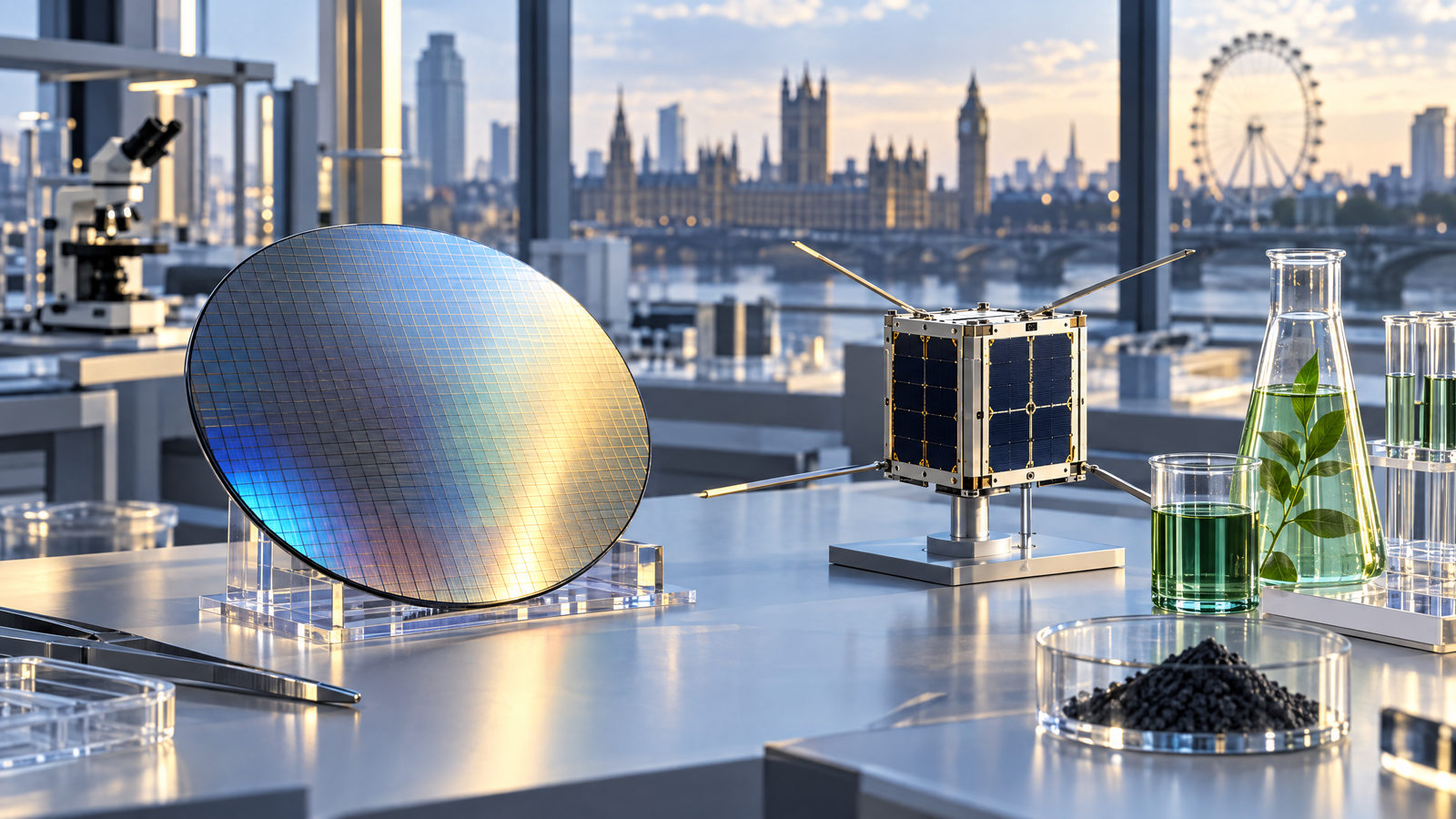
Semiconductors, space, telecommunications, net zero and artificial-intelligence standards are identified as initial areas of mutual interest. That combination reflects complementary roles: the UK is seeking to connect its research, design and innovation strengths with Taiwan’s advanced manufacturing and hardware capabilities. The framework is intended to provide continuity for researchers and businesses rather than to announce a single completed project.
Who signed in London
Ruth Bradley-Jones, the British Representative in Taipei, and Vincent Yao, the Taipei Representative in London, signed the arrangement. It was witnessed by the UK’s National Technology Adviser, Dr Dave Smith, and Bing-Yu Chen, Deputy Minister at Taiwan’s National Science and Technology Council.
The technology signing sat beside the annual trade talks, co-chaired by Minister for Trade Lord Sarwar and Deputy Minister of Economic Affairs Cynthia Kiang. Their agenda included trade and investment, digital trade, clean energy, advanced manufacturing and more resilient supply chains. The meeting was the 28th in a series that has been held annually since 1991.
Early areas for practical work
A subsequent roundtable considered the first wave of possible activity under the new framework. Participants agreed to pursue joint research and development in advanced satellite communications involving the UK Space Agency and the Taiwan Space Agency. They also discussed a Taiwan-UK silicon-photonics academic alliance, designed to connect research clusters, support talent exchanges and encourage industry-academic cooperation.
Semiconductor skills are another continuing strand. The discussion noted a previous cohort of UK master’s students undertaking internships in Taiwan and envisaged further visits for senior research talent. These are prospective collaborative activities, not evidence that every project has begun or that a funding award has been made.
Trade and business links alongside the talks
The two sides put total bilateral trade at £8.9 billion in 2025, making Taiwan the UK’s sixth-largest trading partner in the Asia-Pacific region. Ministers also met UK and Taiwanese businesses as part of a wider visiting-delegation programme focused on commercial partnerships and potential investment.
Separate from the science arrangement, UK Export Finance and Taiwan EximBank signed a memorandum intended to strengthen cooperation on export-credit opportunities. A technology-sector agreement involving business organisations was also scheduled during the visit. Those measures are distinct from the new science framework, but show how the London programme combined policy discussion, research cooperation and company-to-company engagement.
What happens next
The significance of the arrangement will depend on whether the identified projects move from discussion to jointly supported work. For now, it supplies a standing channel for the two sides to develop research links in strategically important fields while the established trade-talk process continues to address economic and regulatory issues.
The announcement does not set a public timetable for individual projects or state budgets for them. Progress will therefore be measured by later decisions on participants, funding and delivery, rather than by the signing alone.