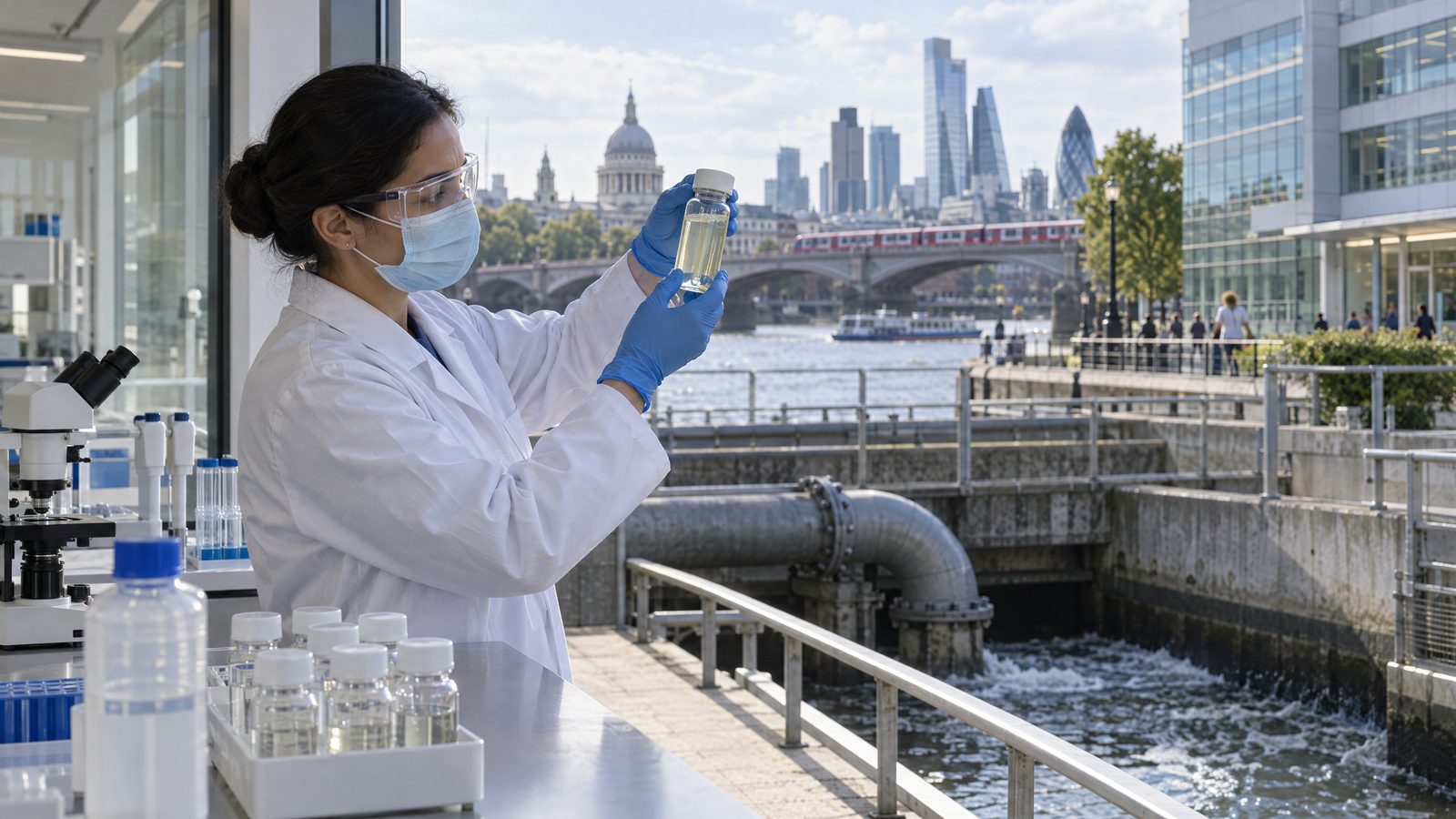

The UK Health Security Agency has announced a £3 million expansion of wastewater and environmental surveillance in England, with the programme due to include selected hospital wastewater sites and high-footfall locations such as transport hubs. The programme, known as PRISM, is intended to strengthen early detection of infectious threats and antimicrobial resistance over the next two years.
The announcement is nationally focused rather than a London site-by-site plan. No individual hospital, station or other capital location has been named, and no timetable for any London installation has been published. Even so, the inclusion of hospitals and transport hubs gives the scheme clear relevance for London, where large numbers of people move through major transport interchanges and use hospital services every day.
Moving beyond one-pathogen testing
PRISM stands for Pathogen Risk Intelligence through Surveillance and Modelling. It follows a wastewater-monitoring development programme launched in April 2025, which tested technologies capable of identifying viruses in wastewater. The new phase is described as an England-wide system that will add to existing surveillance and help public-health teams identify outbreaks.
The central change is a broader approach to testing. Instead of examining a sample only for one pre-selected infection, the system is designed to use one environmental sample for multiple forms of analysis. That differs from targeted wastewater schemes, including the long-established monitoring used for polio. The agency says the method could look for known threats, changes in known threats and pathogens not previously detected by the system.
Environmental surveillance is an early-warning tool, rather than a confirmation that people at a particular site are ill. The 23 September announcement did not report an outbreak in London or elsewhere in England. Its significance is the planned expansion of detection capacity and the range of settings where samples may be taken.
What the programme may track
During its development phase, PRISM tracked norovirus in wastewater and was able to distinguish between strains circulating in different places, with the support of artificial-intelligence tools. Norovirus is among the seasonal illnesses that can add pressure to health services during winter, so a broader picture of circulation could help inform preparedness.
The technology is also being developed to improve the national picture of antimicrobial resistance. The agency says scientists will be able to run different tests on the same samples to monitor drug-resistant bacteria and fungi. It specifically identified hypervirulent Klebsiella pneumoniae and Candidozyma auris as organisms that could be included in this work.
The programme’s pathogen-agnostic design means it has the potential to support preparedness for a wide range of hazards. The agency cited Crimean-Congo haemorrhagic fever, Ebola, Marburg and Lassa fever as examples of viruses that the technology might help detect early should they arrive. It also made clear that those viruses have not emerged in the UK. Their mention is about contingency planning, not a report of their presence.
Why the expansion matters to London
For London, the planned focus on hospital wastewater and high-footfall sites is the most immediate local connection. Transport hubs are specifically within the announced scope, but the authority has not said which hubs may be sampled or how results would be reported for individual places. It would therefore be premature to infer that any particular station, hospital or borough will be part of the programme.
Broad environmental surveillance can complement other ways in which health authorities follow disease patterns, including laboratory reporting and clinical surveillance. Its value lies in observing trends across a population or setting, potentially before pressure is apparent in routine services. The programme is presented as a way to give public-health teams more information for prevention and response, not as a replacement for medical testing or care.
Funding and next steps
The £3 million investment is being provided through the UK Integrated Security Fund over two years. The wastewater project forms part of that fund’s biosecurity portfolio, launched by the Cabinet Office earlier in 2026. UKHSA chief scientific officer Professor Robin May said the expansion was intended to build a stronger early-warning capability for biological threats while also providing information about common pathogens that affect winter service pressures.
The practical details will determine how visible the expansion becomes in the capital. The public announcement sets out the programme’s direction and funding, but does not provide a list of London sites, a start date for local sampling, or a public dashboard for location-specific findings. Those gaps mean the announcement should be understood as a surveillance investment and preparedness measure, rather than a health alert for a particular London community.
For now, the most concrete development is the move from a technology development project to a larger England-wide programme. If PRISM delivers the capability described, it could give health-security teams an additional way to identify changes in pathogens and resistance patterns across busy settings before they become wider pressures on hospitals and communities.