Long accepted in the fashion industry, the up cycling trend is now increasingly making its presence felt in the skincare industry in the sense of sustainability and recycling, and it relates to the use of foodstuffs and avoiding microplastic in products. As an innovative company that has always been committed to eco-awareness and freshness, RINGANA has already been engaging with this subject for many years.
“The idea behind any upcycling process is to transform waste products into other, new products. This means that less waste is created and less CO2 is produced, so we can be kinder to the planet. For the skincare industry, upcycled functional raw materials can be produced that generate added value for both skin and the environment,” says [RP1] Sabine Kitting-Muhr, an engineer from the RINGANA Development Team.
In addition, by dispensing with microplastic in skincare products – sadly still not a matter of course as we see from conventional exfoliants – pressure on the environment is reduced. Because, as we know, these particles can make their way into the environment through the sewage system, where they cause significant harm. RINGANA sustainability expert Patrick Sonnleitner has this to say on the subject:
“Plastic compounds remain standard in the skincare industry and are usually hidden in the full declaration of ingredients. It is incomprehensible that these ingredients still find their way into skincare products because they can be easily replaced by plant-derived alternatives with no loss of quality. We would welcome legislation in the near future that would regulate what has been obvious to us from the outset.”
Upcycling star in many different ways: RINGANA FRESH scrub face & body
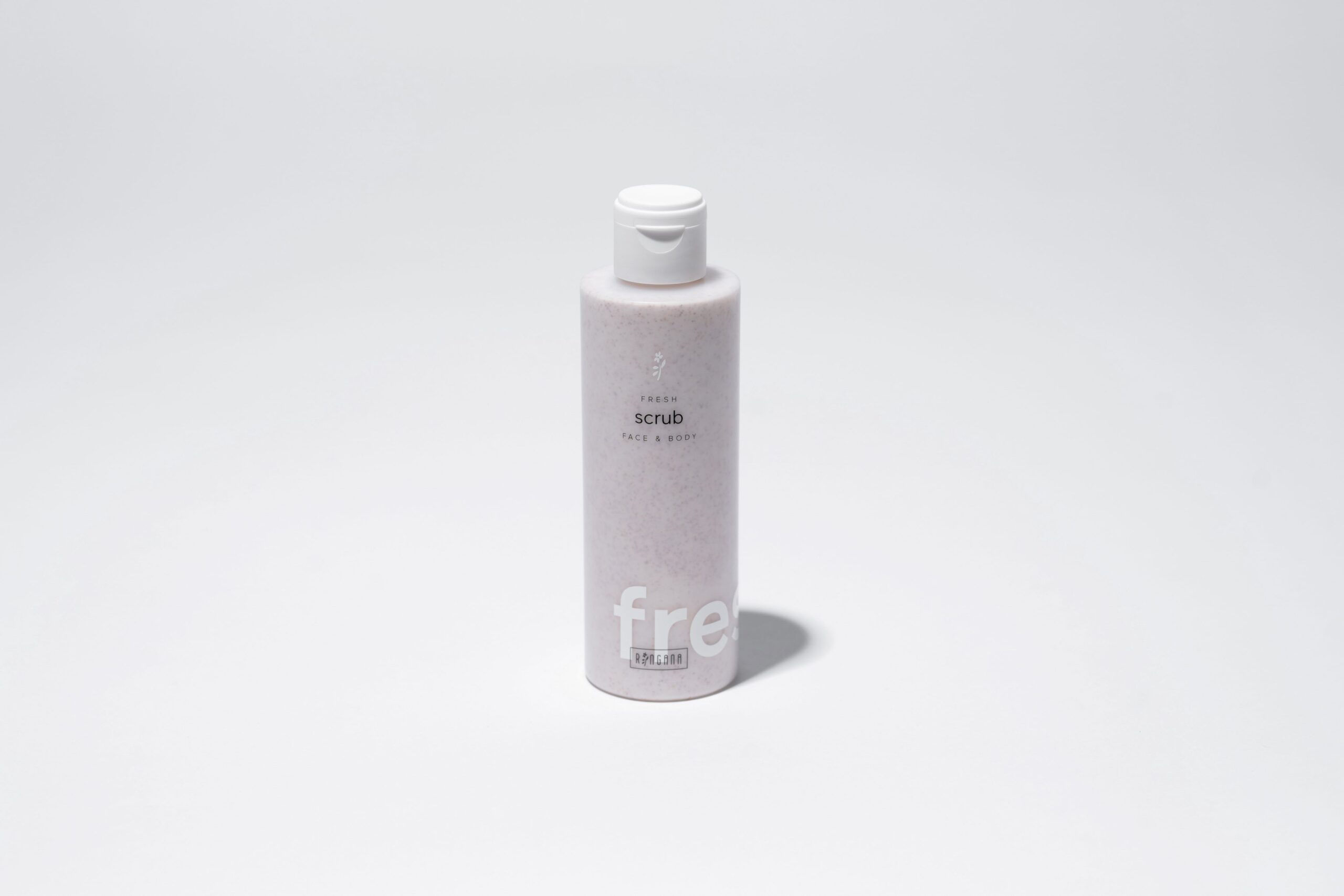
The exfoliating grains themselves are obtained from the leftovers of fruit such as raspberries and blueberries. The first “waste” is produced when the whole fruit is crushed into juice. What remains is seeds and kernels, which can then be processed into further products. The oil can be extracted from the seeds which in turn creates fresh “waste” – known as oil cake. This is then dried and ground, producing the natural exfoliant grains whose firmness enables them to be used for physical cleansing – and entirely without microplastic, as has always been the case at RINGANA.
“To give some examples, about 5 kg of exfoliating grains can be obtained from 100,000 raspberries, and around 14 kg from 800,000 blueberries”, the RINGANA Development Team explains.
The biggest environmental benefits of upcycling in the skincare industry are therefore that foodstuff waste is given a second or even a third life, and the use of microplastic is rendered completely redundant.
Further upcycling trends in the skincare industry
There are many different ways of using upcycled raw materials in the skincare industry:
Apart from valuable oils extracted from left-over seeds and the use of the resulting oil cake, coffee – or rather coffee grounds – can also have a powerful exfoliating effect.
“Furthermore, fruit juice or oil production can also give rise to fruit-infused water that shouldn’t end up in the bin, but can be used in the skincare industry. Extracts from grape skin, for instance, can even be used to colour hair,” Sabine Kitting-Muhr adds.
So there are a great many hidden talents in supposed raw material leftovers that are far too good to waste.
Stimulating FRESH scrub face & body from RINGANA with upcycled exfoliating grains from raspberry, blueberry, apricot and pomegranate removes dead skin cells and stimulates skin renewal. That allows grooming products to be absorbed particularly well by your skin, making it radiantly beautiful. Combined with orange fruit water and almond kernel oil, along with many other effective ingredients, FRESH scrub face & body supplies the skin with plenty of moisture, leaving it feeling soft and supple. Its accolades include COSMOS-organic certification, as well as a Beat the Microbead, and the EU-Ecolabel. 200 ml for £41.41.
[RP1]“DI” steht hier für Diplom-Ingenieurin, ist aber etwas verwirrend für Leser im englischsprachigen Raum wo die Abkürzung “Detective Inspector” bedeutet). Ich habe daher lieber umformuliert.