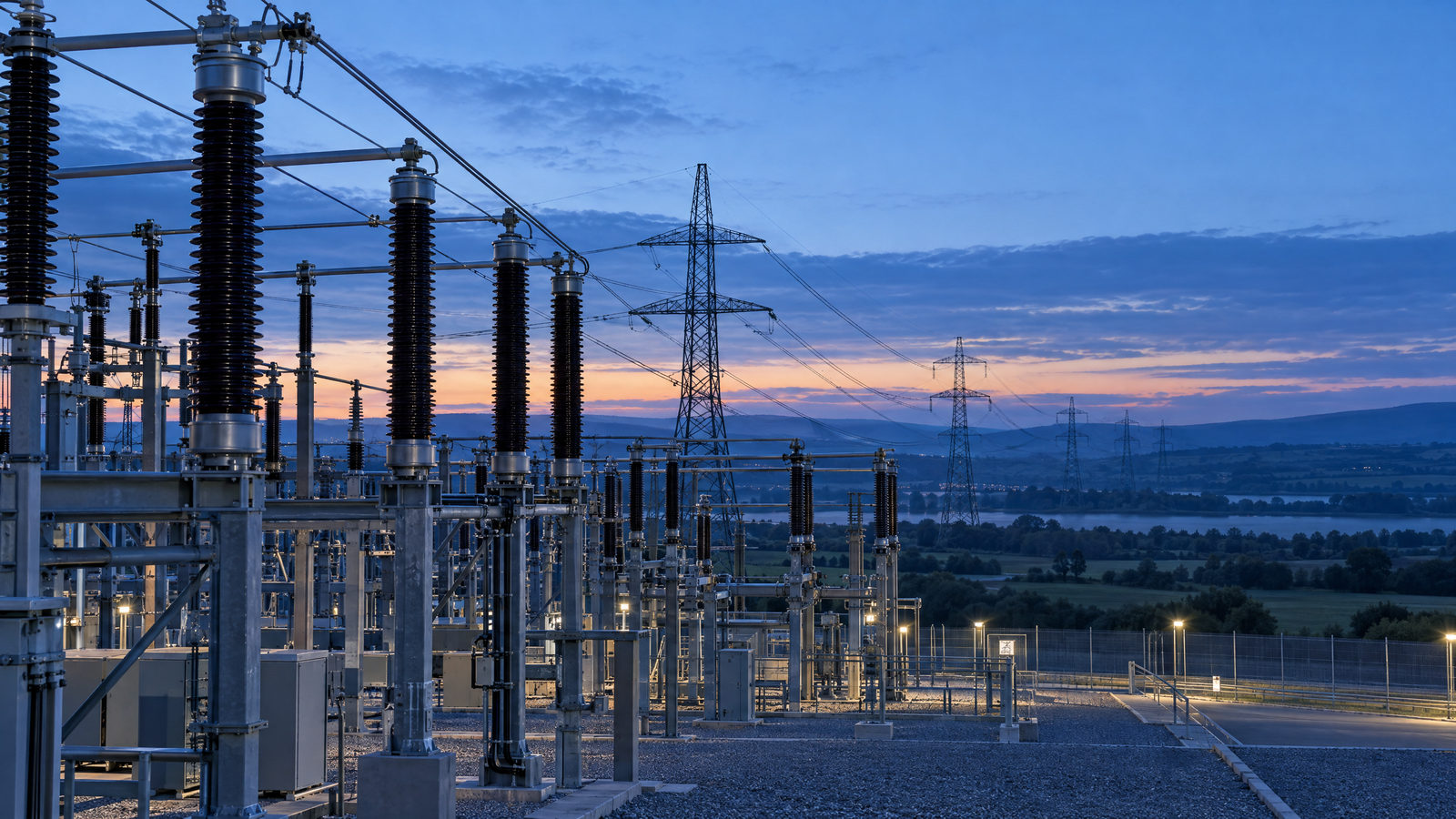

Ofgem has approved a technical change to the rules governing parts of Great Britain’s high-voltage electricity network, lifting the standard upper operating limit from 9% above nominal voltage to 10% for lines and equipment in the 200 kV to 300 kV range.
The decision, published on 2 October, covers both normal pre-fault operation and the period after a fault. It is intended to give system planners more room to schedule work without automatically falling outside the Security and Quality of Supply Standard, the framework used to safeguard the national transmission system.
What changes on the network
The change is narrowly drawn. The revised ceiling applies to the operational voltage limits for the 200–300 kV network, including the 275 kV system. A 275 kV circuit may therefore operate up to 302.5 kV within the standard. The previous 9% ceiling was introduced for the 275 kV network in 2017 and subsequently applied across the broader voltage range.
The measure is the first alteration to this standard emerging from the System Access Reform programme. System access is the coordinated process of taking sections of the transmission network out of service for maintenance, new connections or reinforcement work. It is a planning issue rather than a change to the electricity supplied to homes.
Why the old rule caused obstacles
Under the earlier threshold, planned outages could be rejected where the resulting voltage forecast exceeded 9%, even when it remained close to 10%. The constraint was particularly significant when large power stations or voltage-control equipment were unavailable at the same time as major reinforcement work.
Network studies identified several outage combinations that would have failed the former test, with simulated voltages approaching 302.5 kV. The regulator concluded that the tighter threshold could delay critical projects, trigger voltage-event reports and sometimes require synchronous generators to run solely to provide reactive-power support. The new envelope is designed to reduce reliance on those exceptional arrangements for routine circumstances.
A wider window, not a blank cheque
The approval does not permit unlimited voltage increases. Operation above 10% remains outside the standard and must continue to be handled through existing security and Grid Code processes, including agreement from every affected party. The decision also does not change the Grid Code itself or introduce a new system-risk assessment process.
The safety case rests on existing design tolerances. Transmission owners confirmed that their 275 kV networks are designed for operation up to 10%. Directly connected generators and demand customers are already required to withstand voltage up to that level. The regulator therefore judged the revised limit to use equipment capability already envisaged by the framework, while retaining safeguards beyond it.
What the evidence does — and does not — show
The change was assessed as having a medium impact on transmission operators, the system operator, distribution network operators, generators, interconnector operators, offshore transmission owners and directly connected customers. Effects on non-embedded customers are expected to be minimal because the limit remains within existing equipment margins.
There is no published figure for savings, and the decision does not promise lower bills or that every outage will benefit. It says directly observable financial effects are expected to be modest, although case studies suggest potential efficiencies where generators no longer need to run only for voltage support. The regulator also treated the effect on competition as neutral, saying the available evidence was not sufficient to call it positive.
Consultation and timing
Three non-confidential responses were received during the consultation, all backing the original proposal. One supporter sought more detail on implementation. The seven-member technical panel later voted unanimously for it, with no member identifying a detrimental effect against the applicable objectives.
The new limit takes effect ten business days after the authority decision. Implementation is expected to be limited, but relevant parties are to be notified of the revised limits and may need to review documentation, alarm settings or protection settings. For planners, the immediate significance is a clearer compliant operating range when arranging the maintenance and upgrade outages needed across the transmission network.