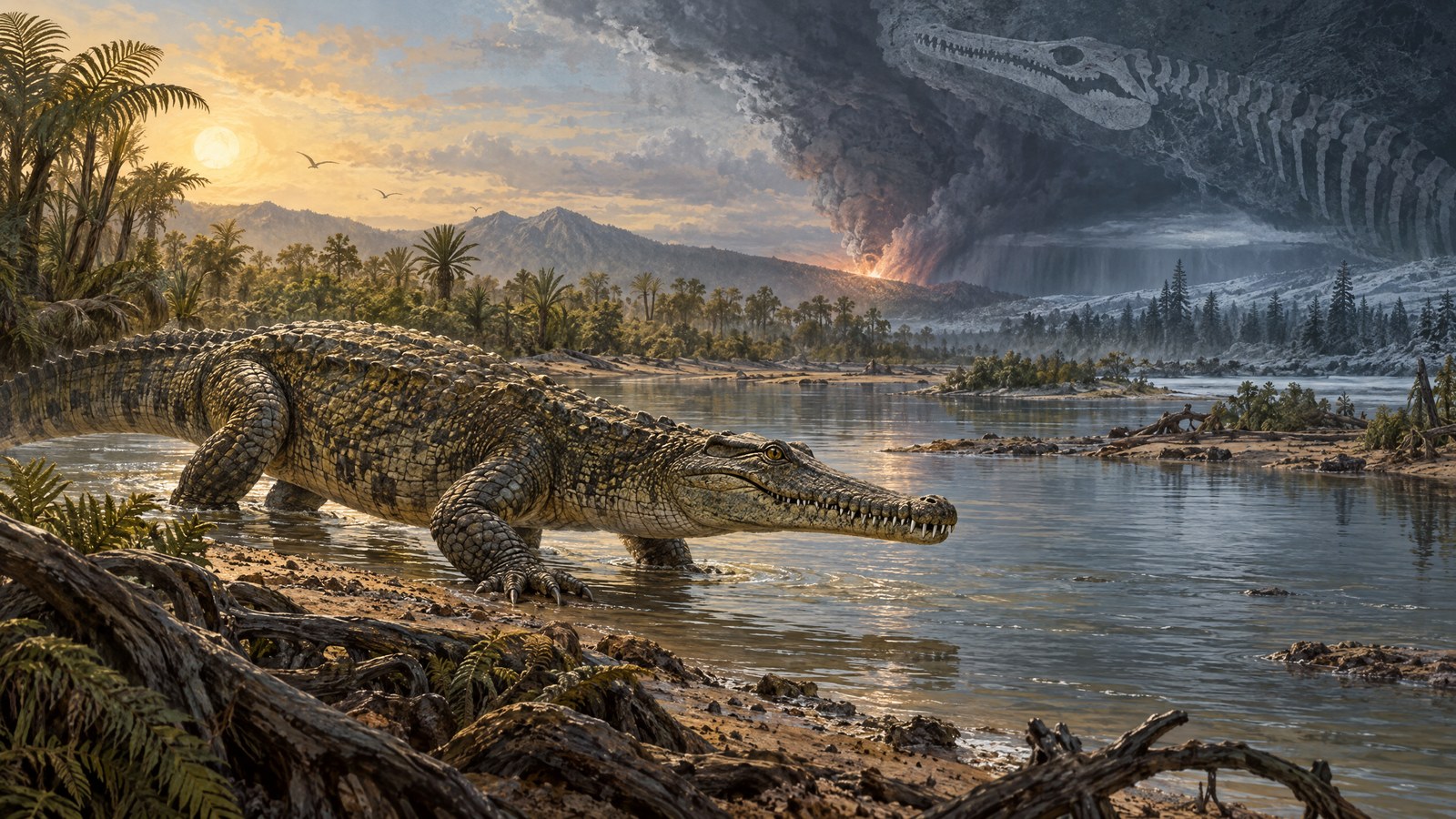

A new study suggests that crocodile relatives largely followed warm climates as they shifted across the world over the past 245 million years, and that this long-standing pattern may have helped some survive the asteroid impact that ended the age of non-avian dinosaurs.
The research reconstructs the climatic preferences and potential ranges of more than 400 living and extinct species in the crocodile lineage, known as pseudosuchians. Its authors found that suitable habitat generally expanded towards the poles during warmer periods and contracted towards the tropics when the planet cooled. They argue that warm regions near the equator and in the subtropics remained possible refuges after the Chicxulub impact in most of the scenarios they tested.
Tracking suitable conditions
The team combined fossil records and an evolutionary tree with information about where crocodilians live today. It used these records to estimate temperature and rainfall conditions associated with the group, then projected habitat suitability across reconstructions of climate and geography through deep time.
The resulting pattern was not one of a lineage repeatedly adapting to every new climate. Instead, crocodile relatives mostly tracked conditions that remained within their climatic tolerances. During the early Eocene, about 50 million years ago, global temperatures were roughly 10 degrees Celsius higher than today and polar regions were ice-free. The study indicates that crocodile relatives then lived at high latitudes in what are now North America, Europe and Antarctica. As the world cooled, their distribution moved back towards the tropics.
The group was far more varied in the past than living crocodiles might suggest. Its extinct members included land-dwelling predators, plant-eaters and animals with very different body forms. Despite this diversity, the researchers found a persistent association with warm conditions across much of the lineage’s history.
What the impact scenarios show
The researchers modelled possible climate conditions in the decades or centuries after the asteroid struck 66 million years ago. They tested scenarios including reduced sunlight from dust and ash, as well as increased carbon dioxide associated with volcanic activity. In scenarios with sunlight reduced by five or 10 per cent, equatorial warm regions remained suitable for crocodile relatives. That was not the case in the scenario with a 15 per cent reduction, which the researchers describe as an extreme possibility now considered unlikely. The carbon-dioxide scenarios did not remove climatic suitability for the group.
These results suggest that some crocodilian populations may have been located in areas where temperatures remained within their tolerances during the aftermath. The study compares this pattern with earlier modelling indicating that suitable climates for non-avian dinosaurs contracted more sharply. It does not demonstrate exactly where individual survivors lived, nor does it establish climate as the sole reason crocodilians endured the extinction event.
One part of a broader survival picture
The authors say other characteristics probably contributed. These include relatively small body size among some survivors, semi-aquatic ways of life, flexible diets and the comparatively low energy requirements of ectothermic animals. Together, such traits may have helped crocodile relatives cope with disrupted ecosystems and food scarcity. The study treats warm-habitat tracking as a plausible contributor, rather than a complete explanation of survival.
The reconstruction also has limits: it estimates suitable climatic conditions from fossil and modern distribution data and climate models, rather than providing a direct record of every population’s movements. Its broad time span offers a view of repeated range shifts, but the post-impact conclusions depend on which climate scenario is considered.
The findings may also inform thinking about living crocodilians as the climate changes. If movement towards suitable conditions has helped the group respond to past shifts, the ability to move could matter again. The researchers note that roads, farms and cities can make such movement harder. That implication is about habitat access and potential pressures; the study does not test the future outcome for any particular species.
Overall, the research describes a deep-time pattern in which crocodile relatives largely stayed associated with warmth while their suitable habitats moved. Equatorial and subtropical refuges persisted in most of the tested Chicxulub scenarios, offering one possible element in the explanation for their survival alongside biological and ecological advantages.