
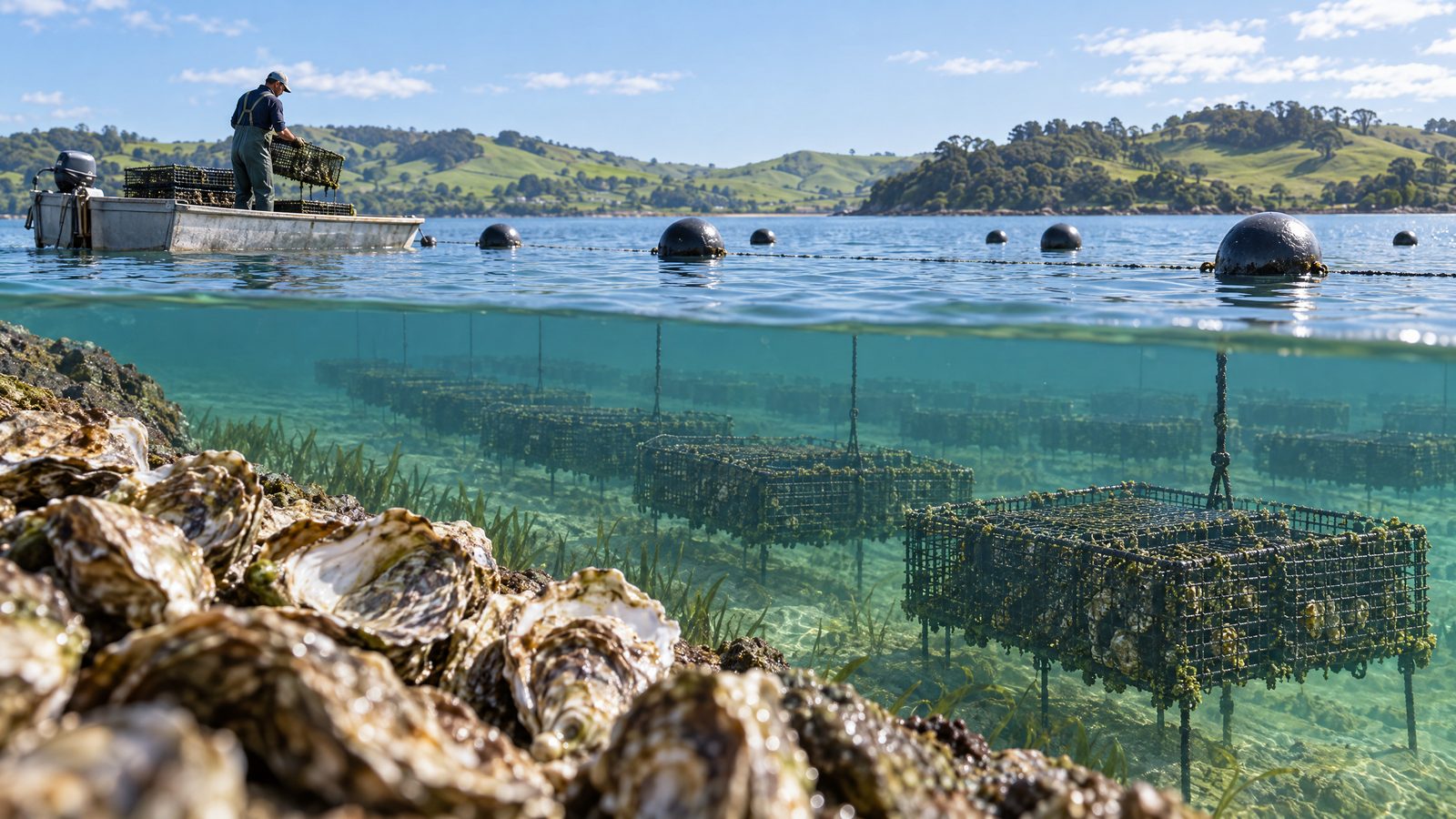

New Zealand’s Government has announced a NZ$2.8 million Regional Infrastructure Fund grant for a Kaipara project intended to keep Mahurangi oysters moving towards market during water-quality closures. The plan combines a six-hectare oyster relay site with a three-hectare commercial pilot farm and the vessels, moorings and marine equipment needed to operate them.
Regional Development Minister Shane Jones announced the funding at Pahi in Kaipara on 22 October. The project is being delivered by Te Uri o Hau Settlement Trust and the Mahurangi Oyster Farmers Collective, whose members farm in Mahurangi Harbour near Warkworth. The grant is repayable if the project generates sufficient revenue; the announcement did not specify a threshold or timetable for repayment.
How the relay is intended to work
When water-quality conditions prevent harvesting in Mahurangi, oysters could be transferred to the proposed relay site in Kaipara Harbour. There they would be allowed to purge naturally before being harvested, subject to the relevant water-quality requirements. The approach is designed to provide an alternative location during closures, rather than to prevent the conditions that trigger them.
The pilot farm is a separate but linked part of the proposal. The government says it is intended to build aquaculture skills and capability within local hapū Te Uri o Hau, with experienced Mahurangi growers mentoring the next generation of Kaipara oyster farmers. That makes the scheme both a continuity measure for existing growers and a proposed entry point for local participation in aquaculture.
The announcement describes planned infrastructure and intended benefits, not an operating facility. It gives no construction timetable, opening date, production target or estimate of how many harvest days might ultimately be recovered. Those details will matter in judging how much protection the relay can offer, and how quickly growers and the local community could see a return.
Closures have carried costs beyond a missed harvest
The proposed relay does not resolve the underlying water-quality risks in Mahurangi, nor does the announcement say that oysters can be moved automatically whenever a closure occurs. Its value will depend on the site becoming operational, the safe handling and transfer of stock, and the applicable testing and clearance rules. The proposal instead aims to give growers another place to hold and naturally purify oysters while restrictions remain in force.
The government says Mahurangi farms produce around a quarter of New Zealand’s oysters. That scale helps explain why disruption in one harbour can affect an industry beyond individual farms. The Kaipara site would add infrastructure in a different harbour, while the pilot farm is intended to develop local capability alongside the relay function.
The funding is also structured with a possible public return: it is a grant, but becomes repayable if project revenue is sufficient. The announcement leaves open how sufficiency will be assessed and what financial performance would trigger repayment. No project cost breakdown or revenue forecast was provided, so the grant’s final public cost cannot yet be calculated.
The announcement links the initiative to the Government’s goal of growing aquaculture revenue to NZ$3 billion by 2035. That is a national target, not a forecast for this project. For the growers and communities involved, the more immediate test will be whether the proposed facilities can be built, meet operational and food-safety requirements, and provide a dependable alternative during future closures.







