
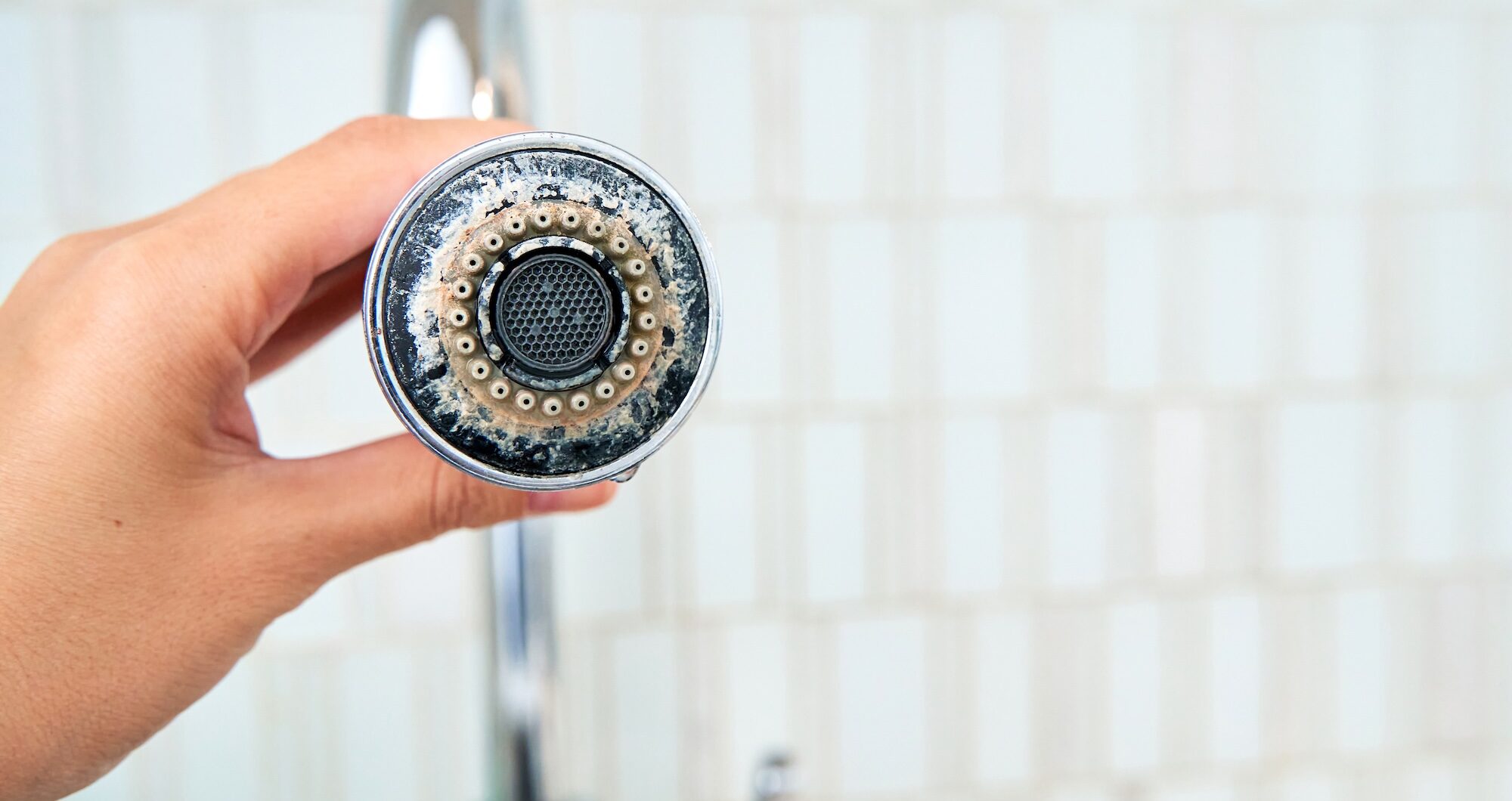

If your kettle furs up within weeks and the shower screen never quite looks clean, you are almost certainly dealing with hard water. Most London homes are.
The remedies run from cleaning habits to a plumbed-in appliance. Before buying anything, find out how hard your water actually is and decide whether you want to reduce limescale throughout the house or treat water at a single tap.
How hard is London’s water?
Thames Water says most of South East England has naturally hard water. It draws roughly 65% of its supply from rivers and 35% from underground sources, and water passing through chalk and limestone picks up the dissolved calcium and magnesium responsible for hardness.
Hardness is normally stated in milligrams per litre as calcium carbonate. Water between 200 and 300 mg/L is commonly described as hard, and above 300 mg/L as very hard.
Check your postcode rather than trusting a city-wide figure. Thames Water publishes an online hardness checker, and parts of North and West London are supplied by Affinity Water, which indicates a general range of 300 to 350 mg/L across much of its area.
That number matters practically. It determines how often a softener regenerates, how much salt you get through and which capacity you need, so it is the first thing any competent installer will ask for.
What hard water actually does at home
Hard water is not a health risk. The Drinking Water Inspectorate states that mains tap water in England and Wales is safe and that extra home treatment is not required for health protection.
The nuisance is limescale. Heating hard water leaves deposits on kettle elements, shower heads, taps and the components inside hot-water systems. Soap also lathers less readily, so cleaning takes more product.
Your options, from light touch to whole home
Ion exchange softeners
An ion exchange softener passes water through resin that swaps calcium and magnesium ions for sodium ions, then flushes the resin with brine to regenerate it. This is the standard domestic method for removing hardness minerals from a whole-home supply.
The design differences matter more than the marketing does.
Single-cylinder units pause the softened supply while regenerating, so timing matters.
Alternating twin-cylinder units switch between cylinders, so one works while the other regenerates.
Parallel twin-cylinder units run both cylinders continuously, which means no water sits stationary inside a cylinder between uses. Harvey builds its water softeners this way.
Some models operate on water pressure alone and need no electrical connection, which removes a failure point and a socket from the cupboard.
Conditioners and inhibitors
Scale inhibitors and conditioners aim to change how scale forms or how firmly it sticks. They do not remove hardness minerals.
The ASA and CAP state that magnetic and electromagnetic conditioners are not capable of softening water and should not be presented as equivalent to water softeners. If a product is sold as a softener at a fraction of softener prices, that is usually why.
Safety and the UK rules in plain English
A home with an ion exchange softener should keep an unsoftened cold-water tap. Thames Water advises against using softened water for drinking or cooking and recommends a separate unsoftened outlet, and Drinking Water Inspectorate guidance says the same where base exchange softening is used. Water for preparing baby formula should come from the unsoftened supply.
The UK parametric value for sodium in drinking water is 200 mg/L at the consumer’s tap.
Installation must also comply with the Water Supply (Water Fittings) Regulations, including safeguards against contamination and backflow. This is not optional and it is not a formality.
Choosing a system that fits a London home
Space usually decides this before anything else does. In a flat, installation near the kitchen cold-water main is the norm, so measure the cabinet properly and check what the unit needs for drainage, overflow protection and salt access.
Compact matters more here than anywhere else in the country. Some units are built specifically to fit under a standard kitchen sink, which is often the difference between a straightforward install and losing a cupboard entirely.
Sizing follows household use, bathroom count and local hardness. Harvey, for example, sizes its compact twin-cylinder units for homes with one to three bathrooms and offers a larger model above that. Demand-initiated regeneration, where the unit responds to actual water use rather than a timer, cuts unnecessary salt and water.
The efficiency figures are worth asking for rather than accepting in general terms. Harvey publishes a regeneration cycle of around 11 minutes using 300g of salt and 17 litres of water, which gives you something concrete to compare against other quotes.
Leasehold and the neighbour problem
Many London leases require freeholder or managing agent consent before plumbing is altered. Check yours before booking an installer, not after.
The reason is structural rather than bureaucratic. London housing stacks flats above flats, so a plumbing fault becomes a neighbour dispute, a leasehold matter and an insurance claim at once. That risk of water damage travelling downward is exactly why freeholders take an interest in drainage and overflow arrangements, and why the overflow detail on a softener quote deserves a proper look.
What an installation involves
A plumber normally fits the unit to the incoming cold main just after the internal stop tap. The work includes a bypass valve, a drain connection and an overflow arrangement.
The softener then feeds the hot-water system and selected appliances, while the kitchen drinking tap and usually the outdoor tap stay on unsoftened water.
Use a qualified installer who understands the Water Fittings Regulations. Before work starts, confirm what the quote includes, where the unit drains and how easily you will be able to add salt once the cupboard door is shut.
The running cost nobody quotes for
Ongoing care means salt, and the type is not always your choice.
Harvey specifies Grade A salt meeting the BS EN 973 standard at 99% purity or better, and states that using anything else voids the warranty. Block salt systems and granular salt systems are not interchangeable, so establish which the unit takes and what that salt costs locally before you sign.
Some units now monitor salt levels themselves. Harvey’s newer models use a WiFi-enabled lid linked to an app, which removes the recurring job of opening the cupboard to check.
The wider market
Harvey is one of several UK suppliers. Kinetico also offers dual-tank non-electric systems, while BWT, Monarch and EcoWater have their own domestic ranges.
Compare capacity, regeneration method, salt type and consumption, warranty terms and local servicing rather than broad marketing claims. Ask specifically whether servicing is required at intervals or whether the unit is designed to run without scheduled appointments, since that changes the ten-year cost considerably.
Warranty structures vary more than headline numbers suggest. Check what is covered for parts, what is covered for labour, how long each runs and whether cover depends on using the manufacturer’s own consumables.
A short checklist
- Confirm the hardness figure for your postcode with your water company
- Decide between whole-home softening and point-of-use filtering
- Plan where the unsoftened drinking-water outlet will be
- Check cabinet space, drainage, overflow protection and maintenance access
- Confirm leasehold or freeholder consent if required
- Ask more than one qualified installer for an itemised quote
- Allow for ongoing salt, water use and any servicing
FAQ
Can I drink softened water?
Thames Water advises against using softened water for drinking or cooking and recommends keeping a separate unsoftened tap. Ion exchange softening increases sodium content, and the UK parametric value for sodium is 200 mg/L at the tap.
Do water softeners need electricity?
Not all of them. Some designs run on water pressure alone with no electrical connection, which removes a failure point and frees a socket. Harvey’s twin-cylinder units work this way.
What is the difference between a softener and a conditioner?
A softener removes hardness minerals through ion exchange. A conditioner attempts to change how scale forms without removing anything. The ASA and CAP have been explicit that magnetic and electromagnetic conditioners cannot soften water and should not be advertised as though they can.
Will a softener fit in a flat?
Often, yes. Compact twin-cylinder units are designed to fit under a standard kitchen sink. Measure the cabinet, confirm drainage and overflow requirements, and check whether your lease requires consent first.
How much salt does a softener use?
It depends on hardness, household size and whether the unit regenerates on demand or on a timer. As a reference point, Harvey publishes 300g of salt and 17 litres of water per regeneration cycle.
Does using cheaper salt matter?
It can void your warranty. Harvey requires Grade A salt to BS EN 973 at 99% purity or better, and other manufacturers set their own conditions. Check before buying salt in bulk from a third party.
Do I need freeholder permission?
Frequently in London. Many leases require freeholder or managing agent consent for plumbing alterations, particularly where drainage or building insurance is affected. Ask before you book the work.
Getting it right first time
Start with the hardness figure for your postcode, then the space you actually have, then the lease if you have one. Those three narrow the field before any salesperson gets involved.
After that, compare like with like on regeneration efficiency, salt type, warranty terms and whether the unit needs servicing. The headline price is the smallest part of what a softener costs over ten years.
Feature image by Kate from Adobe Stock







