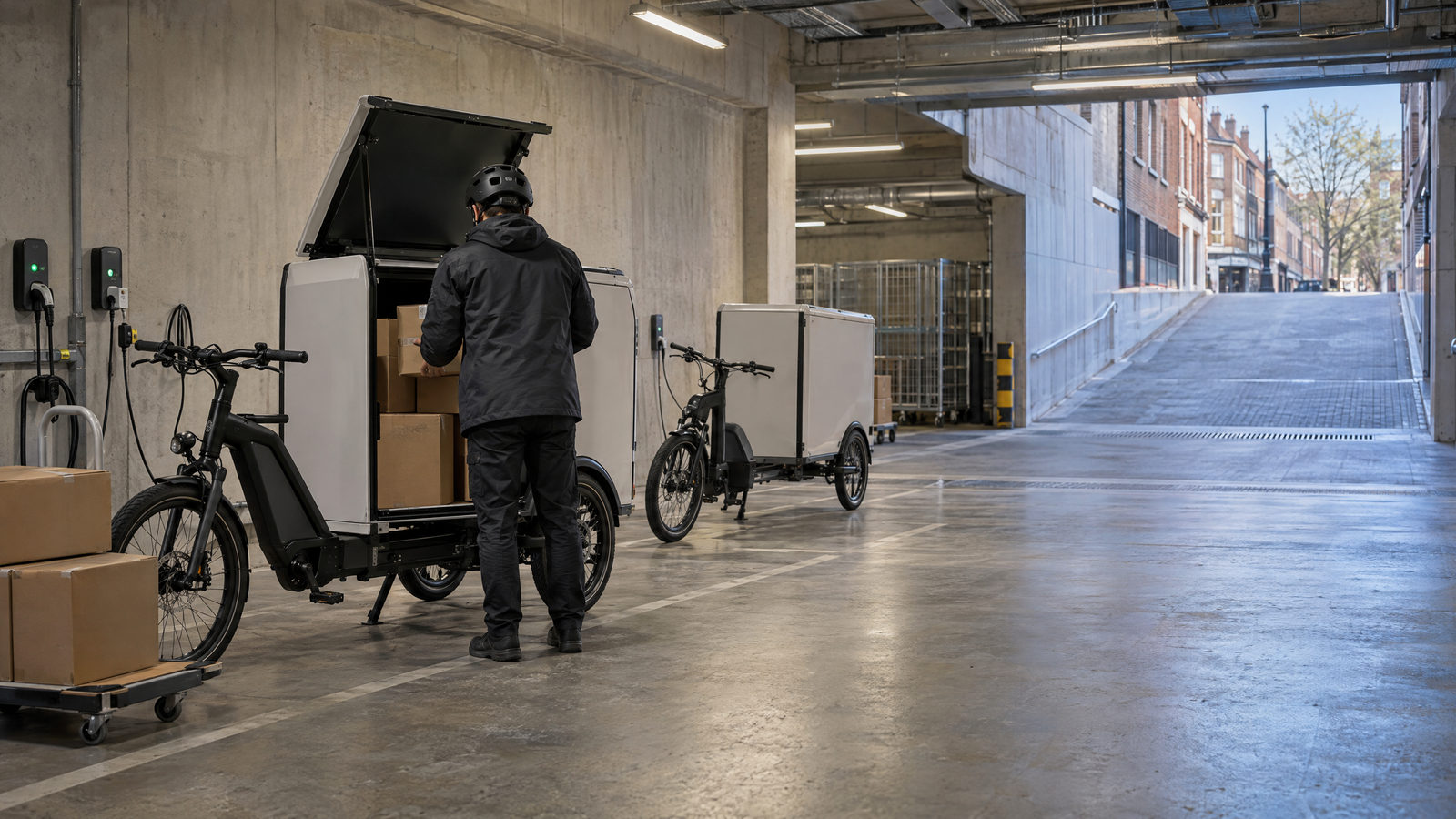

A new base for low-emission deliveries has opened inside Q-Park Leicester Square, giving e-cargo-bike courier Closer2 space to collect, charge and dispatch vehicles for deliveries across the West End, central London and other boroughs.
The approximately 598 sq ft facility occupies an area equivalent to six car parking spaces. Westminster City Council’s Transport and Connectivity team delivered the project with co-funding from the Zero Emissions Network and Westminster Climate Fund, with support from Cross River Partnership. Closer2 has been appointed to operate deliveries from the site.
A last-mile base in a busy district
The hub is designed to move the final part of a delivery journey away from larger, higher-emitting vehicles and towards e-cargo bikes. Its parking and charging infrastructure gives the operator a central place to organise collections and drop-offs for businesses in the surrounding area. The service is intended to cover destinations beyond Westminster as well as those within the borough.
That geography matters in the West End, where retail, hospitality, offices and cultural venues generate frequent goods movements amid crowded streets and limited kerb space. A smaller delivery vehicle can reach local destinations without requiring a van for every final leg. Consolidating work at a central base can also reduce pressure from vehicle trips and kerbside activity. No forecast has been set out for delivery numbers, van journeys avoided or emissions saved by this new site.
The project sits alongside Westminster’s air-quality, freight and climate policies, including its ambition to reach net zero by 2040. Its practical test will be whether a compact space in a high-demand location can support reliable business deliveries while reducing the need for conventional van movements, rather than simply relocating loading activity.
Building on a Westminster trial
The Leicester Square project follows a micro-logistics trial in Pimlico, which began in 2023. That earlier operation received parcels by electric van and redistributed them by electric cargo bike. During its nine-month trial, the bikes travelled 14,029 miles. The comparison with conventional diesel-van deliveries produced estimated savings of 4,186kg of carbon dioxide, 15,141g of nitrogen oxides and 303g of fine particulate matter.
Those figures belong to the Pimlico trial, not the new West End hub. They offer a local precedent for the delivery model, but they are not a performance guarantee for a different operator, site or set of routes. The Leicester Square project does not yet have a published measurement period or equivalent target against which its results can be judged.
The location has also hosted other last-mile mobility activity. Q-Park Leicester Square was used for a separate electric-vehicle “dark hub” launched in 2022, where delivery firms could access and charge small electric vehicles. The newly opened council-backed micro-logistics space is a distinct project, with Closer2 named as its delivery operator; the available launch details do not describe how its day-to-day activity will interact with that earlier operation.
What comes next
Closer2 is now to run deliveries from the West End base, serving businesses locally and routes beyond the borough. The facility has space and charging provision for e-cargo bikes, but no public schedule, delivery-volume target or operating-hours information has been announced. Nor has a monitoring plan for mileage, air pollutants or avoided van journeys been set out in the launch details.
That leaves the next stage focused on implementation and evidence: how often the hub is used, which business areas it serves, and whether bike-based final legs displace van trips. The new site extends Westminster’s experiment with micro-logistics into a major commercial district. Its value will ultimately depend not only on opening a low-emission base, but on showing that the delivery pattern it enables brings measurable benefits to streets and businesses.