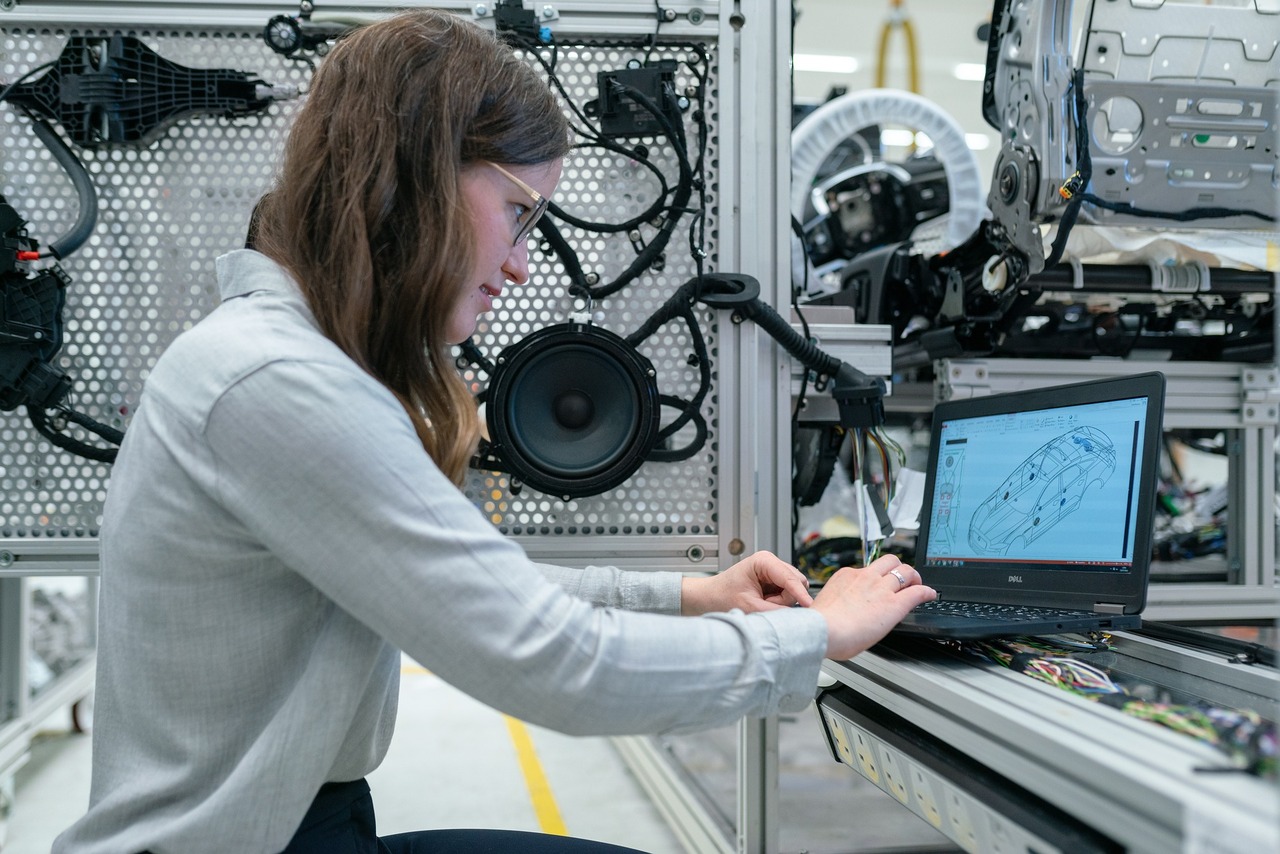

Because of its size, volume, and precision, the automotive industry is usually at the centre of innovation in robotics and manufacturing. Electric vehicles have turned a lot of progress on its head, making many components entirely redundant – and threatening entire European industries. But, it’s also paved the way for a more interconnected and data-driven process, something that Europe must lean into.
Intelligent robotics
Automation is everything to bringing down variable costs in manufacturing, but it’s a difficult thing to achieve when manufacturing a car. Rigid machines struggle to assemble many different parts, and some technical components that require precision are difficult to access. This is where cobots, which are collaborative robots, are helping technicians.
Because the robots have better sensors than before, they understand their environment. For less rigid tasks which require more complex decision-making, this is necessary. And with more data in, over time, feedback and reinforcement learning means that the robots get more intelligent over time unlike rigid automation of the past. 2025 saw a record year for robot installations more broadly, and it’s mostly coming from better dexterity, while the workforce is transitioning to a more digital role.
Improving finish quality with advanced vision technology
The structural integrity of a vehicle is needed for the constantly tightening safety compliance, but aesthetics remains the primary differentiator. A flawless finish is absolutely necessary, and it’s something that the Tesla Cybertruck received bad PR over (e.g. panels not being perfectly flush).
This is where high-tech inspection devices are now seen as a positive ROI to lean into. Leading innovators in this space, like Eines, use specialized vision systems that automate the detection of surface imperfections and assembly errors. So, it’s not about having the perfect robot for the perfect production – that’s impossible. Instead, it’s about integrating these same processes into quality assurance to automate the reduction of errors.
Eines’ devices like the All-in-One tunnel is a great example of a final assembly inspect. It uses the vision systems to detect surface damages like scratches that may have otherwise been missed by the naked eye. Automated Gap & Flush systems are also used to measure the alignment between body panels with sub-millimeter accuracy. Because all the data is synthesized into a real-time system, the feedback loop is immediate for upstream adjustment.
With China capturing more of the low-cost market, Europe in particular will need to lean into luxury brands and aesthetic differentiation. Here, automating quality assurance will help them succeed while remaining somewhat price-competitive.
The power of real-time data
The spiderweb of Internet of Things (IoT) cannot go understated. It’s turned the entire factory into a smart environment. Each and every machine on the floor generates vast amounts of data. It’s primarily analysed to then optimize workflows, but it could be data that spawns other revenue-generating activity, like consulting or even selling workflows. Predictive maintenance is a huge change coming from this digitalization – by monitoring even just the vibration and temperature of equipment, AI algorithms will predict when a part will fail before it actually does. Downtime is reduced, as are maintenance costs.
Moving to sustainable and zero-defect manufacturing
Much of Industry 4.0 has gotten on its way. The impact on culture and workflows has already landed, what we expect next is the iteration of the robots themselves to be more optimized, as many are still in their early versions, as well as the implementation of this data-rich production to help achieve less waste. By cutting down on errors and product recalls, this happens naturally, but it can also be more intentional than it is today. It may also become a European tool by proxy – to raise standards to make it harder for low-priced imports to compete and comply. As ESG targets become more important, we expect to see robotics solutions focusing more on sustainability.