
The Trust Certificate That Can Help You Win Bigger Clients, Protect Data and Scale Faster
In today’s business world, trust is no longer built only through good branding, strong sales calls or an impressive website. Trust is built through proof.
For startups, SMEs, SaaS companies, IT service providers, fintech firms, healthcare platforms, e-commerce brands, agencies and B2B service companies, one question is becoming more common during sales conversations:
“Are you ISO 27001 certified?”
If your answer is no, you may still win small clients. But when you start targeting enterprise customers, government contracts, regulated industries, international clients or serious investors, the absence of ISO 27001 can quickly become a barrier.
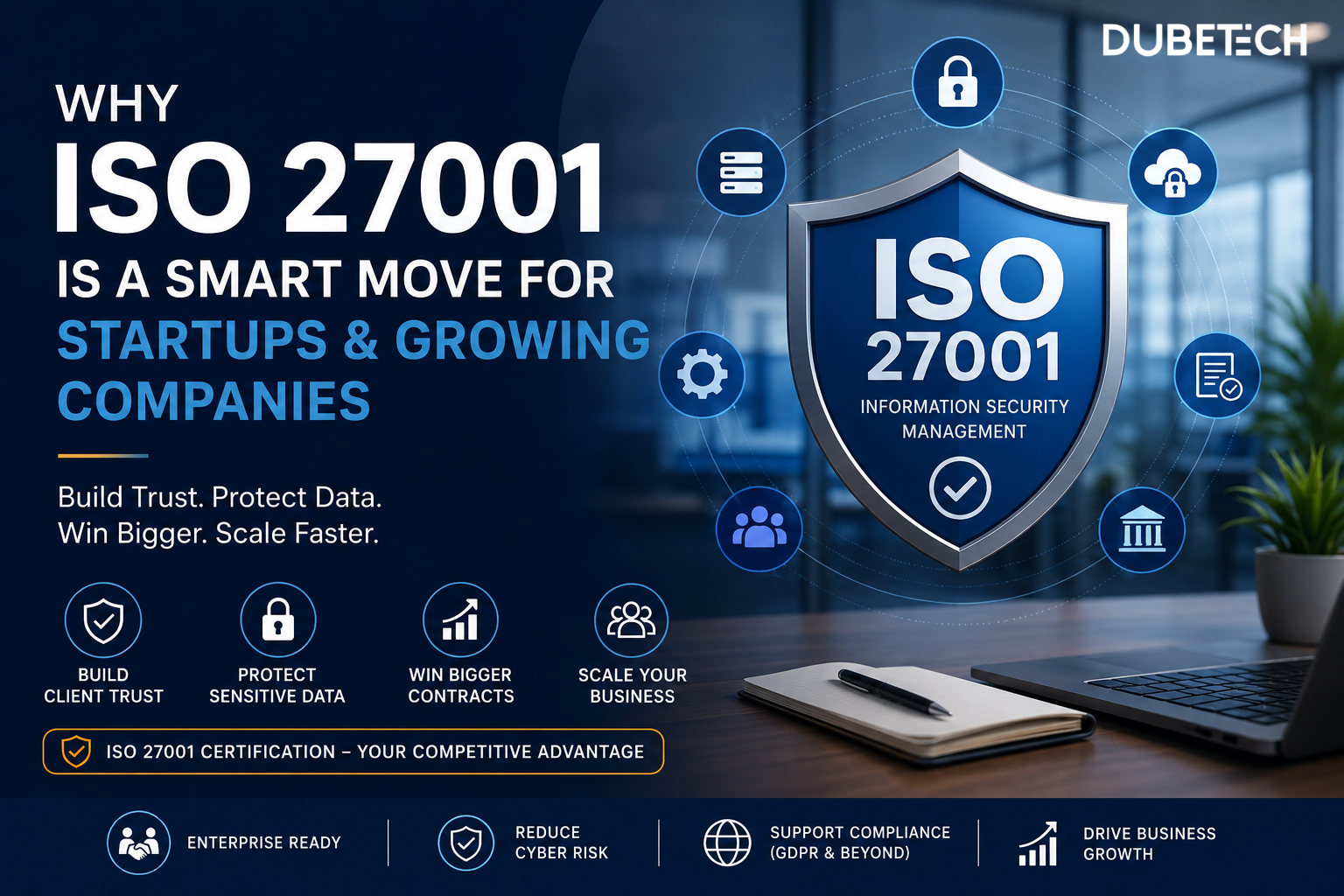
ISO/IEC 27001 is the international standard for an Information Security Management System, commonly known as an ISMS. It helps organisations manage risks around the confidentiality, integrity and availability of information. The 2022 version of ISO 27001 is widely recognised as a foundation for information security risk management.
For a startup or growing company, ISO 27001 is not just a compliance badge. It is a business growth asset.
What Is ISO 27001 in Simple Terms?
ISO 27001 is a globally recognised information security standard that helps businesses protect sensitive data, manage cyber risks and prove that they follow structured security practices.
It is not only about installing antivirus software or using strong passwords. ISO 27001 looks at the full business system, including:
- People
- Processes
- Technology
- Policies
- Risk management
- Supplier security
- Access control
- Incident response
- Business continuity
- Data protection
- Leadership accountability
In simple words, ISO 27001 helps a company answer three critical questions:
- What information do we need to protect?
- What risks could damage that information?
- What controls do we need to reduce those risks?
This makes it especially powerful for startups and SMEs because it turns cybersecurity from a random technical activity into a structured business system.
Why ISO 27001 Matters More Than Ever
Cybersecurity is no longer only an IT department issue. It is now a boardroom issue, a sales issue, a legal issue and a reputation issue.
Customers are sharing more data than ever. Businesses are using more cloud platforms, CRM systems, ERP systems, AI tools, payment gateways, third-party apps and remote teams. Every new tool creates a new risk.
A single data breach can damage:
- Customer trust
- Investor confidence
- Brand reputation
- Sales pipeline
- Legal compliance
- Operational continuity
- Future partnerships
For startups, the impact can be even more serious. A large company may survive a major security incident. A startup may not.
That is why ISO 27001 is becoming a smart move for companies that want to scale responsibly.
The Big Reason Startups Should Care: Enterprise Clients Ask for It
Many startups focus on product development, marketing and fundraising. But when they finally get the chance to work with a large enterprise, they face a difficult surprise.
The enterprise procurement team asks for:
- ISO 27001 certification
- Information security policy
- Risk assessment records
- Data protection procedures
- Incident response process
- Access control policy
- Supplier security process
- Business continuity plan
If the startup does not have these documents and systems in place, the deal can slow down or collapse.
This is where ISO 27001 becomes a sales accelerator.
It gives your business a structured way to prove that you take security seriously. Instead of answering every client security questionnaire from scratch, you can show that your organisation follows an internationally recognised framework.
For B2B startups, IT companies, SaaS platforms, CRM providers, ERP consultants and digital agencies, this can be the difference between being seen as a small vendor and being trusted as a serious business partner.
ISO 27001 Helps You Win Trust Before the Sales Call Starts
Trust is one of the biggest conversion factors in B2B sales.
A prospect may like your service, your pricing and your team. But if they are unsure about how you handle data, they may hesitate.
ISO 27001 helps remove that hesitation.
It sends a clear message:
“We do not just talk about security. We have a certified system to manage it.”
This matters especially if your business handles:
- Customer data
- Employee data
- Financial information
- Healthcare data
- Login credentials
- Business documents
- CRM data
- ERP data
- Marketing databases
- Cloud infrastructure
- AI-generated business intelligence
For companies offering digital transformation, CRM implementation, ERP support, cybersecurity, automation or IT staff augmentation, ISO 27001 can become a strong credibility signal.
ISO 27001 Is Not Only for Big Companies
One common myth is that ISO 27001 is only for large corporations.
That is no longer true.
Startups and SMEs are now expected to demonstrate security maturity much earlier, especially if they want to work with enterprise clients or regulated sectors. BSI also highlights ISO/IEC 27001 as an important information security management standard for SMEs and startups working with sensitive data and emerging technologies.
The advantage for startups is that they can build security properly from the beginning.
Large companies often struggle because they already have complex legacy systems, scattered data, old processes and multiple departments. Startups can implement ISO 27001 in a cleaner, leaner and more practical way.
For a startup, ISO 27001 can become part of the company’s operating system.
10 Reasons Your Startup or Company Should Get ISO 27001
1. It Builds Instant Credibility
ISO 27001 gives your company external validation. It shows clients, investors and partners that your security practices are not random or informal.
This is powerful because trust is easier to win when it is backed by a recognised standard.
2. It Helps You Win Bigger Contracts
Many enterprise clients, government buyers and regulated industries prefer or require suppliers to demonstrate strong information security controls.
If two vendors offer similar services, the ISO 27001-certified company may look safer, more mature and easier to approve.
For startups trying to move from small clients to larger accounts, this can be a major competitive advantage.
3. It Reduces Cybersecurity Risk
ISO 27001 helps businesses identify risks before they become expensive problems.
This includes risks such as:
- Weak passwords
- Uncontrolled access
- Poor employee training
- Insecure cloud storage
- Lack of backup planning
- Unclear incident response
- Supplier security gaps
- Poor device management
- Unprotected customer data
The goal is not to eliminate every risk. That is impossible. The goal is to understand risks clearly and reduce them systematically.
4. It Improves Internal Discipline
Many startups grow quickly, but their internal processes do not grow at the same speed.
At the beginning, everyone knows everything. Access is informal. Files are shared casually. Passwords are stored in unsafe places. Policies are not documented.
This may work with five people. It becomes dangerous with 20, 50 or 100 people.
ISO 27001 helps create structure around:
- Who can access what
- How data is stored
- How systems are monitored
- How employees are trained
- How suppliers are reviewed
- How incidents are reported
- How risks are reviewed
This makes the business more scalable.
5. It Supports GDPR and Data Protection Readiness
ISO 27001 is not the same as GDPR compliance, but it can strongly support a company’s data protection posture.
If your business handles personal data, especially in the UK or EU, clients want to know that you have proper security controls in place.
ISO 27001 helps demonstrate that your organisation has a structured approach to protecting information. ISO also positions ISO 27001 as a foundation for information security management, while related standards such as ISO 27701 and ISO 27018 address privacy and cloud data protection.
For companies working with CRM, ERP, HRMS, marketing automation or customer databases, this is especially relevant.
6. It Makes Investor Due Diligence Easier
Investors do not only look at revenue, growth and product-market fit. They also look at risk.
If a startup has poor security practices, it can become a red flag during due diligence.
Investors may ask:
- Is customer data protected?
- Are there documented security policies?
- Is there a risk management process?
- Are cloud systems secure?
- Is there a business continuity plan?
- Could a breach damage valuation?
ISO 27001 helps answer these questions with confidence.
For startups preparing for funding, acquisition or enterprise partnerships, certification can improve investor confidence.
7. It Protects Your Reputation
Reputation is one of the most valuable assets of a young company.
A startup may spend years building trust and lose it in one security incident.
ISO 27001 helps reduce the likelihood and impact of incidents by creating a proactive security culture. It also helps your team respond more effectively if something does go wrong.
In the digital economy, reputation is not only built by what you promise. It is protected by how well you manage risk.
8. It Improves Team Awareness
Many cyber incidents happen because of human error.
Employees may click phishing emails, use weak passwords, share files incorrectly or ignore security procedures.
ISO 27001 requires businesses to think about people, training and awareness. This helps create a security-conscious culture where everyone understands their role.
Security becomes everyone’s responsibility, not just the IT team’s responsibility.
9. It Strengthens Supplier and Vendor Management
Startups often depend on many third-party tools:
- Cloud hosting
- CRM platforms
- ERP systems
- Email marketing tools
- Payment processors
- Analytics tools
- HR software
- Development tools
- AI platforms
- Outsourced teams
Every supplier can create risk.
ISO 27001 encourages companies to assess supplier risks and manage them properly. This is important because your security is only as strong as the ecosystem around you.
10. It Creates a Competitive Advantage
In crowded markets, every company claims to be reliable, secure and trustworthy.
ISO 27001 helps you prove it.
For startups and SMEs competing against bigger players, this can be a powerful differentiator. It shows that even if your company is smaller, your security mindset is mature.
That can help you stand out in industries such as:
- SaaS
- Fintech
- Healthtech
- Edtech
- Legaltech
- E-commerce
- IT services
- CRM consulting
- ERP implementation
- Digital marketing
- AI automation
- Cybersecurity services
- Business process outsourcing
ISO 27001 and the Rise of AI, CRM and ERP Security
Modern businesses are becoming more data-driven. They use CRM systems to manage customers, ERP systems to manage operations, AI tools to automate decisions and marketing platforms to personalise campaigns.
This creates a new challenge.
The more connected your business becomes, the more important information security becomes.
For example:
- A CRM system may contain leads, customers, contracts and communication history.
- An ERP system may contain financial, inventory and operational data.
- An HRMS may contain employee records and payroll information.
- An AI tool may process sensitive business data.
- A marketing automation platform may store customer behaviour and segmentation data.
If these systems are not managed securely, the business is exposed.
ISO 27001 helps companies create a governance framework around these systems. It ensures that digital transformation does not happen at the cost of security.
This is exactly where a technology partner like DubeTech can support startups and SMEs: by helping them align CRM, ERP, automation and cybersecurity practices with a stronger compliance mindset.
The Hidden Cost of Not Having ISO 27001
Many companies ask, “How much does ISO 27001 cost?”
A better question is:
“How much could it cost us not to have it?”
Not having ISO 27001 can lead to:
- Lost enterprise deals
- Failed supplier onboarding
- Longer procurement cycles
- Weak client confidence
- Higher cyber risk
- Poor internal processes
- Investor concerns
- Regulatory pressure
- Reputational damage
- Emergency compliance work under pressure
When security is ignored, it usually becomes more expensive later.
ISO 27001 helps companies move from reactive security to proactive security.
When Should a Startup Start Thinking About ISO 27001?
A startup should start thinking about ISO 27001 earlier than most founders expect.
You may not need certification on day one, but you should start building ISO 27001-aligned practices as soon as you:
- Handle customer data
- Sell to B2B clients
- Use cloud infrastructure
- Hire remote employees
- Work with third-party vendors
- Build SaaS products
- Target enterprise clients
- Process financial or personal data
- Prepare for investment
- Enter regulated markets
- Offer IT, CRM, ERP or cybersecurity services
The earlier you start, the easier it becomes.
Trying to implement ISO 27001 after a large client demands it can create stress, delays and rushed documentation. Building it gradually gives your company a stronger foundation.
Is ISO 27001 a Legal Requirement?
In most cases, ISO 27001 is not legally mandatory. Standards are generally voluntary unless they are referenced in regulations or contracts. BSI explains that standards provide best-practice frameworks, while regulations are legally binding when enforced by law.
However, ISO 27001 can become practically necessary when:
- A client requires it
- A tender requires it
- A regulated industry expects it
- An investor asks for it
- A partner includes it in due diligence
- A cyber insurance provider asks for stronger controls
So while ISO 27001 may not always be legally required, it can become commercially essential.
What Does ISO 27001 Certification Involve?
The ISO 27001 journey usually includes the following steps:
1. Define the Scope
Decide what part of the business the ISMS will cover. For example, it may cover your full company, your SaaS platform, your IT services department or your customer data operations.
2. Conduct a Gap Analysis
Review your current security practices against ISO 27001 requirements.
3. Identify Information Assets
List the information, systems, tools and data your business needs to protect.
4. Assess Risks
Identify threats, vulnerabilities and possible impacts.
5. Select Security Controls
Choose appropriate controls to reduce risks.
6. Create Policies and Procedures
Document how your company manages security.
7. Train Employees
Make sure your team understands their security responsibilities.
8. Monitor and Improve
Review risks, incidents, audits and performance regularly.
9. Internal Audit
Check whether your ISMS is working properly before certification.
10. Certification Audit
An accredited certification body audits your ISMS and decides whether you meet the requirements.
Common Mistakes Companies Make With ISO 27001
Mistake 1: Treating It as a Documentation Exercise
ISO 27001 is not just about creating policies. It is about building a working security management system.
Documents are important, but implementation matters more.
Mistake 2: Leaving It Only to IT
Information security is not only an IT responsibility.
Leadership, HR, operations, finance, sales, marketing and suppliers all play a role.
Mistake 3: Starting Too Late
Many companies wait until a client demands ISO 27001. By then, the timeline becomes stressful.
It is better to prepare early.
Mistake 4: Copying Generic Templates
Templates can help, but copying policies without adapting them to your business creates weak compliance.
Your ISMS should reflect your actual risks, systems and operations.
Mistake 5: Ignoring Continuous Improvement
ISO 27001 is not a one-time project. It requires ongoing monitoring, review and improvement.
Security risks change. Your ISMS must evolve with them.
Why ISO 27001 Is a Growth Strategy, Not Just a Security Strategy
The biggest misunderstanding about ISO 27001 is that it is only about cybersecurity.
In reality, ISO 27001 can support growth in five major ways:
- Sales growth — helps win bigger clients.
- Operational growth — creates scalable processes.
- Investor confidence — reduces risk concerns.
- Brand trust — improves market credibility.
- Risk reduction — protects the business from disruption.
For startups and SMEs, this makes ISO 27001 a strategic investment.
It helps your company move from “promising startup” to “trusted business partner.”
How DubeTech Can Help Startups and SMEs Prepare for ISO 27001
At DubeTech, we understand that modern businesses need more than websites and software. They need secure, scalable and compliant digital systems.
Our work across CRM, ERP, automation, cybersecurity, IT staff augmentation and SME digital transformation gives us a practical understanding of how information flows through a business.
We can help companies prepare for ISO 27001 by supporting areas such as:
- Digital process mapping
- CRM and ERP security review
- Access control improvement
- Data flow documentation
- Cybersecurity readiness
- Vendor and supplier risk review
- Policy and process structuring
- Staff awareness planning
- Cloud system security alignment
- Automation governance
- Compliance-focused digital transformation
Whether you are a startup preparing for enterprise clients or an SME looking to strengthen trust, ISO 27001 can help you build a more secure and credible business.
Final Thought: The Companies That Win Trust Will Win the Market
The next wave of business growth will not belong only to companies with the best product or the lowest price.
It will belong to companies that can prove they are trustworthy.
Customers want secure partners. Enterprises want reliable suppliers. Investors want risk-aware founders. Regulators want responsible data handling. Employees want safe systems.
ISO 27001 helps bring all of this together.
For startups and growing companies, it is more than a certificate.
It is a signal that your business is ready for serious growth.
If your company wants to win bigger clients, protect sensitive data and build a stronger digital foundation, now is the right time to start your ISO 27001 journey.
Feature Image by freepik