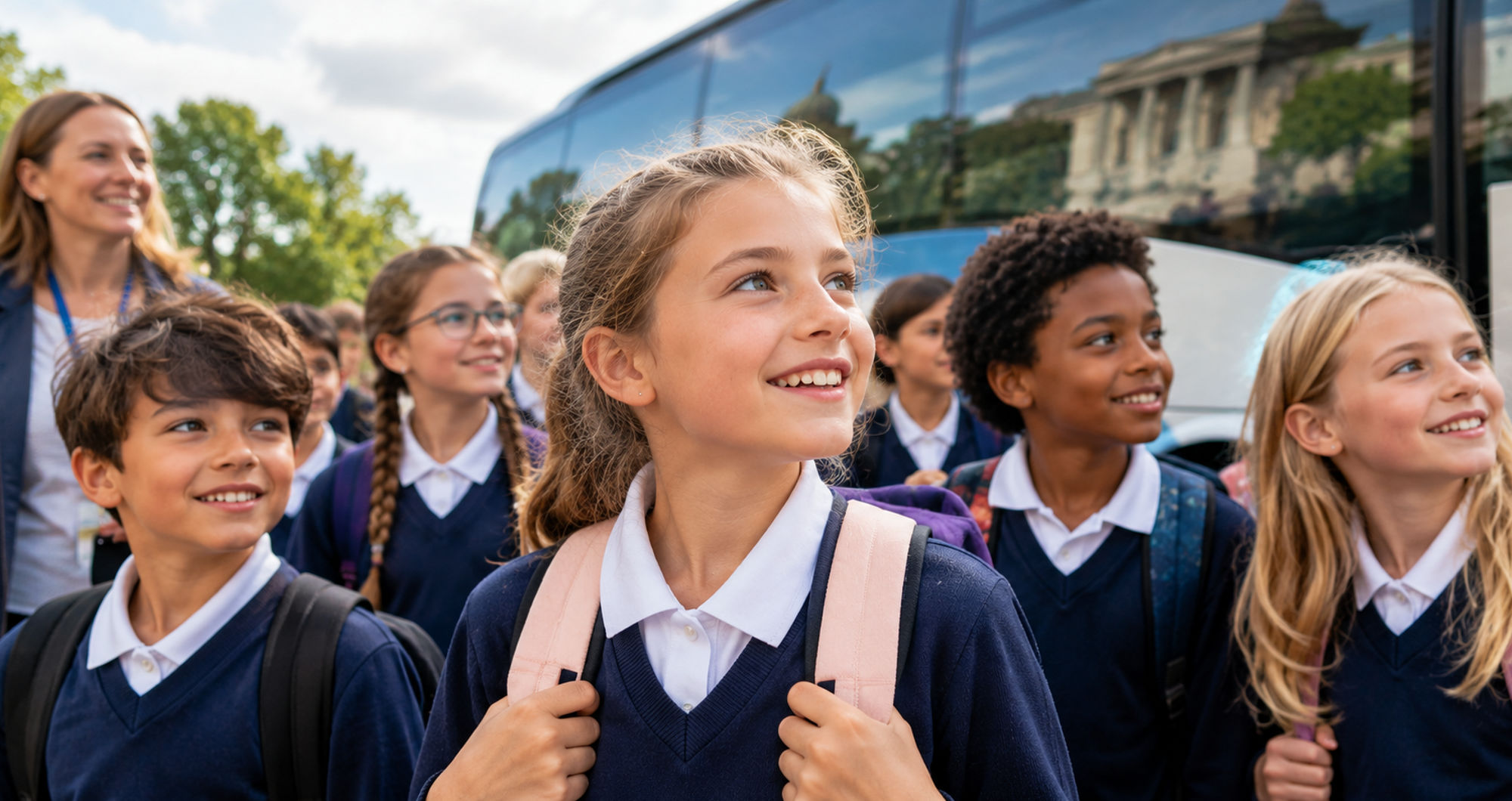

A generation ago, the school trip was practically a rite of passage. The coach pulling up outside the school gates, the packed lunches, the head count in the car park. For most children it was one of the best days of the year. But for a growing number of pupils across Britain, that experience is disappearing.
The numbers tell a bleak story. The Sutton Trust’s 2026 survey, conducted by the NFER, found that 47% of school leaders cut spending on trips and outings this year. That figure has been at or above 50% for three consecutive years before dropping slightly, and it stood at just 21% back in 2022.
Meanwhile, a University of Greenwich study published in April 2026 found that school trips boost children’s wellbeing and engagement by 60% and deliver an 80% uplift in attention compared to a normal classroom day. The children who’d benefit most are the ones least likely to go, and that’s a problem that goes well beyond missing a day out.
The Budget Squeeze That Won’t Go Away
School funding in England is allocated per pupil, which means falling rolls hit budgets directly. In London alone, approximately 90 school closures or mergers in five years have already shrunk the pot, and London Councils estimates a further £45m in funding cuts between 2025/26 and 2029/30 as pupil numbers continue to fall. When budgets tighten, trips are among the first things to go because they’re classified as enrichment rather than core delivery.
The Sutton Trust’s polling over recent years paints a clear picture of where the pressure falls hardest. In their 2023 survey, 68% of leaders in the most deprived schools reported cuts to trips, compared to 44% in the least deprived. That gap hasn’t closed. Primary schools are consistently worse affected than secondaries, and the pattern repeats across every measure of disadvantage.
A North-South Divide in Who Gets to Go
Money is only part of the picture. Geography plays a role too. The Council for Learning Outside the Classroom published a report in December 2025 analysing data from over 25,000 education settings across England. They found that non-adventurous residential visits, the subject-based trips most closely tied to the curriculum, have fallen sharply since before the pandemic. Duration has dropped, participation has dropped, and the recovery since Covid hasn’t reached pre-2019 levels.
The regional picture is stark. Children attending schools in the South of England are significantly more likely to take part in adventurous residential visits than those in the North, a pattern that closely mirrors free school meal eligibility. As the CLOtC report put it, the similarity between the gradients for residential provision and deprivation as you move from North to South is striking.
Two-fifths of UK children have either missed a school trip entirely or nearly missed one because of cost, according to the Hyundai-commissioned study that accompanied the University of Greenwich research. Teachers surveyed as part of that work identified cost as the biggest barrier, both for schools (82%) and for parents (77%).
The School Trip Is Still a Fight That’s Winnable
None of this means the school trip should be written off. In fact, the case for protecting it has never been stronger.
That same University of Greenwich study found 77% of children described a school trip as their best school day ever. Attention, curiosity, self-esteem and social connection all measured significantly higher on trip days than in the classroom. These aren’t soft outcomes. They’re the building blocks of engagement, and for children from disadvantaged backgrounds, they’re often the experiences that spark a genuine interest in learning.
The evidence also shows that the benefits compound. Residential visits in particular build confidence, resilience and the kind of independence that doesn’t come from sitting behind a desk. Every trip that gets cancelled is one less chance for a child to discover something about themselves.
What Schools, PTAs and Trip Organisers Can Do
The good news is that cost doesn’t have to be the end of the conversation. There are concrete steps schools can take to bring trip budgets under control without cancelling the trips altogether.
Book Transport Early and Compare Rates
Transport is the single largest variable cost for most school trips. Coach hire rates fluctuate by season, day of the week and how far in advance you book. Autumn-term bookings for spring and summer trips tend to get better rates because fleet availability is at its widest and demand hasn’t yet peaked.
Schools that stay on top of coach hire prices in the UK well in advance of locking in dates and destinations give themselves far more control over the final per-pupil figure. Think of it as a planning discipline, not a shopping exercise.
When you know what transport will cost before you commit to a venue, you can design a trip that fits the budget instead of discovering the budget can’t fit the trip. Midweek departures, off-peak dates and flexible pick-up points can all bring the price down further.
Pick Destinations With Free Entry
London’s Natural History Museum, Science Museum and British Museum all charge nothing for school groups. Across the country, dozens of galleries, heritage sites and nature reserves offer free or heavily subsidised access for educational visits. The destination itself doesn’t need to cost anything. The learning value comes from the experience of being somewhere new, not from the ticket price.
Combine Year Groups and Share Coaches
A single coach for one class of 30 rarely makes financial sense. Combining year groups or coordinating transport with other schools within the same Multi-Academy Trust (MAT) can help fill a 49- or 53-seat vehicle and spread transport costs across more pupils.
Where schools within a Trust are travelling to the same destination, coordinating departure times and sharing transport can significantly reduce the cost per pupil while making better use of available coach capacity.
The Trips That Don’t Happen Leave a Mark
School trips have always been more than a break from the classroom. They’re where children build memories, develop social skills and see the world beyond their postcode. The data is clear that they work, and equally clear that the children who’d gain the most are the ones being priced out.
Funding pressures won’t disappear overnight. But schools, PTAs and trip organisers who plan smartly, share resources and treat transport as a cost to manage rather than a cost to absorb can keep these experiences alive. The alternative, a generation of children who never get on the coach at all, is one that nobody should be comfortable with.