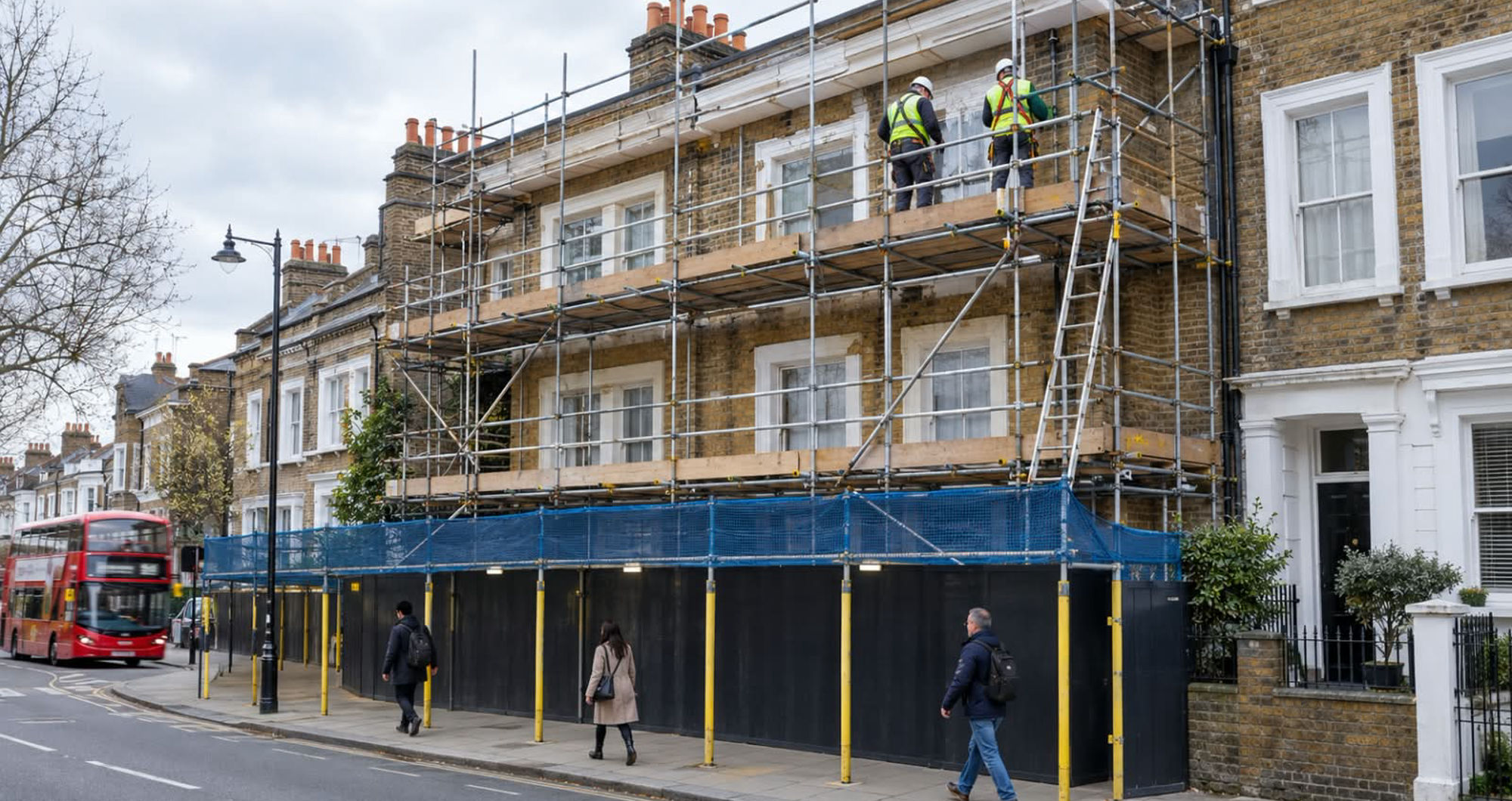

London is constantly being rebuilt, repaired and adapted. From the restoration of period homes in established neighbourhoods to commercial refurbishments and new developments, construction work is part of everyday life across the capital.
Yet while attention often focuses on the finished building, one of the most important parts of a project happens before much of the visible work begins: creating safe and reliable access to the areas where people need to work.
For many construction and renovation projects, that means carefully planned scaffolding.
Access is more than simply getting to a building
Working at height introduces a different set of challenges to an ordinary construction site. Workers may need to reach roofs, upper floors, external walls, windows or other difficult areas while carrying tools and materials.
In London, those challenges can be made more complicated by the built environment itself.
Properties can sit close to pavements, neighbouring buildings and busy roads. Access may be restricted, while residents, pedestrians and businesses may need to continue using the surrounding area throughout the work.
A suitable access system therefore needs to be considered as part of the wider project, rather than as something added at the last minute.
Good scaffolding provides a stable working platform and can help contractors carry out their work more efficiently. It can also help separate construction activity from people using the building or passing nearby.
Why professional scaffolding matters
No two construction projects are exactly alike, and the access required for a small roof repair can be very different from what is needed for a major commercial refurbishment. Older properties, restricted sites and buildings close to busy roads can also present their own challenges.
This is particularly important when arranging scaffolding in London, where space can be limited and construction work often takes place alongside occupied homes, businesses and busy public areas.
A professional approach starts with understanding the building and the work being carried out. The height and shape of the property, access points, ground conditions, pedestrian routes and expected duration of the project can all influence how the scaffold should be planned and erected.
More complex structures may also require specific scaffold design and calculations before work begins. Getting these details right at the outset can help avoid unnecessary disruption and provide tradespeople with safe, practical access throughout the project.
Ultimately, professional scaffolding is not simply about putting a temporary structure around a building. It is about creating a properly considered working environment that supports the people on site while taking account of the safety of everyone around it.
Training should not be an afterthought
The people erecting and dismantling scaffolding have an important role in maintaining safe access throughout a project.
The Construction Industry Scaffolders Record Scheme, commonly known as CISRS, provides recognised training and competency routes for scaffolders working in the UK. Using appropriately trained personnel gives contractors and project managers greater confidence that the work is being carried out by people with relevant skills and knowledge.
Construction training more broadly also matters. Many site workers are CITB-trained, having completed training through the Construction Industry Training Board framework, which supports safer working practices across construction sites.
These qualifications and training standards do not replace proper planning or site management, but they form an important part of a competent approach to construction work.
Standards help create consistency
Safety on a construction site depends on more than individual decisions. Established industry guidance and standards provide a framework for planning, erecting, using and maintaining temporary access structures.
Guidance from the National Access and Scaffolding Confederation (NASC), such as its SG4 guidance on preventing falls in scaffolding operations and its TG20 guidance for tube and fitting scaffolds, is widely recognised within the UK scaffolding sector.
The law sets clear expectations too. Under the Work at Height Regulations 2005, work at height must be properly planned, supervised and carried out by competent people. Scaffolds used as working platforms also need to be inspected by a competent person before first use, at regular intervals of no more than seven days, and after any event that could affect their safety, such as severe weather.
Following recognised standards helps contractors approach scaffolding systematically, particularly where projects involve unusual structures, difficult access or demanding working conditions.
For clients, developers and main contractors, this can also make it easier to ask the right questions before work begins: Who will design the scaffold where required? Who will erect it? How will it be inspected? What happens if site conditions change?
These questions are particularly relevant in a city where construction sites can sit immediately alongside occupied homes, offices, shops and public spaces.
Protecting more than the workforce
One of the biggest misconceptions about scaffolding is that its only purpose is to protect workers.
On a busy London site, the considerations can extend much further.
A well-planned scaffold can help control access around the building and provide protection where work is taking place above areas used by residents, employees, customers or pedestrians. Boarding, sheeting, netting and other measures may be appropriate depending on the project.
Where a scaffold stands on a pavement or road, a licence from the local council is usually needed before it goes up. This helps make sure that pedestrian routes, lighting and protection for passers-by are properly managed.
This becomes particularly important when renovation work is carried out on occupied buildings.
A roof repair, external refurbishment or façade project may continue for weeks while people still need to enter and leave the property every day. The access arrangement therefore needs to work for both the construction team and the people living or working around it.
London’s older buildings bring additional challenges
London’s architectural history creates another layer of complexity.
Period properties can have unusual façades, narrow access points, extensions added at different stages and structural features that differ considerably from modern buildings. Listed or sensitive properties may also require additional planning and care.
A scaffolding solution that works perfectly well on a modern development may not be appropriate for a Victorian townhouse or another older property.
This is why site assessment and communication between the scaffold contractor, builder, engineer and property owner are so important.
Understanding the building before erection begins can help identify potential problems early rather than discovering them once work is already underway.
Good planning can prevent delays
Construction delays are not always caused by major structural problems. Sometimes they come from relatively simple logistical issues.
If workers cannot safely reach an area, materials cannot be moved efficiently or access arrangements interfere with other trades, the programme can quickly become more complicated.
Professional scaffolding should therefore be considered alongside the wider construction schedule.
For example, roofing contractors, bricklayers, painters, renderers and other trades may all depend on the same access structure. If the scaffold is planned properly from the beginning, different stages of work can often be coordinated more efficiently.
This is particularly valuable on projects where several trades are working simultaneously.
Choosing the right scaffolding contractor
For property owners and construction professionals, price will naturally be a consideration. But it should not be the only one.
Before appointing a scaffolding contractor, it is worth considering their experience, training, insurance, approach to site assessment and understanding of the type of project involved.
Questions about CISRS-trained scaffolders, CITB training, NASC guidance, inspections and relevant experience can help establish whether a contractor has taken the necessary steps towards safe and professional delivery.
Experience with similar projects is also valuable. A contractor familiar with residential refurbishment may approach a large commercial development differently, while projects involving restricted access or unusual structures may require additional planning.
Companies such as RCA Scaffolding have experience providing access for domestic, commercial and renovation projects across London and surrounding areas. For clients, the important point is not simply the name of the contractor, but whether the team understands the practical demands of the particular building and project.
Safe access is part of good engineering
Scaffolding is temporary, but that does not make it a minor part of a construction project.
It supports people while they work, affects how materials and trades move around a building and can influence how safely a project operates from beginning to end.
In a city as densely developed as London, where construction often takes place alongside occupied properties and busy public spaces, careful access planning becomes even more important.
The best scaffolding solutions are rarely the ones that simply appear on site. They are the result of planning, competent installation, appropriate standards and an understanding of how the temporary structure fits into the wider project.
Ultimately, safe access is not just about reaching a higher floor. It is about creating the conditions in which construction and renovation work can be carried out safely, efficiently and with as little disruption as possible.
For London’s continually changing built environment, that is an important part of building work done properly.