
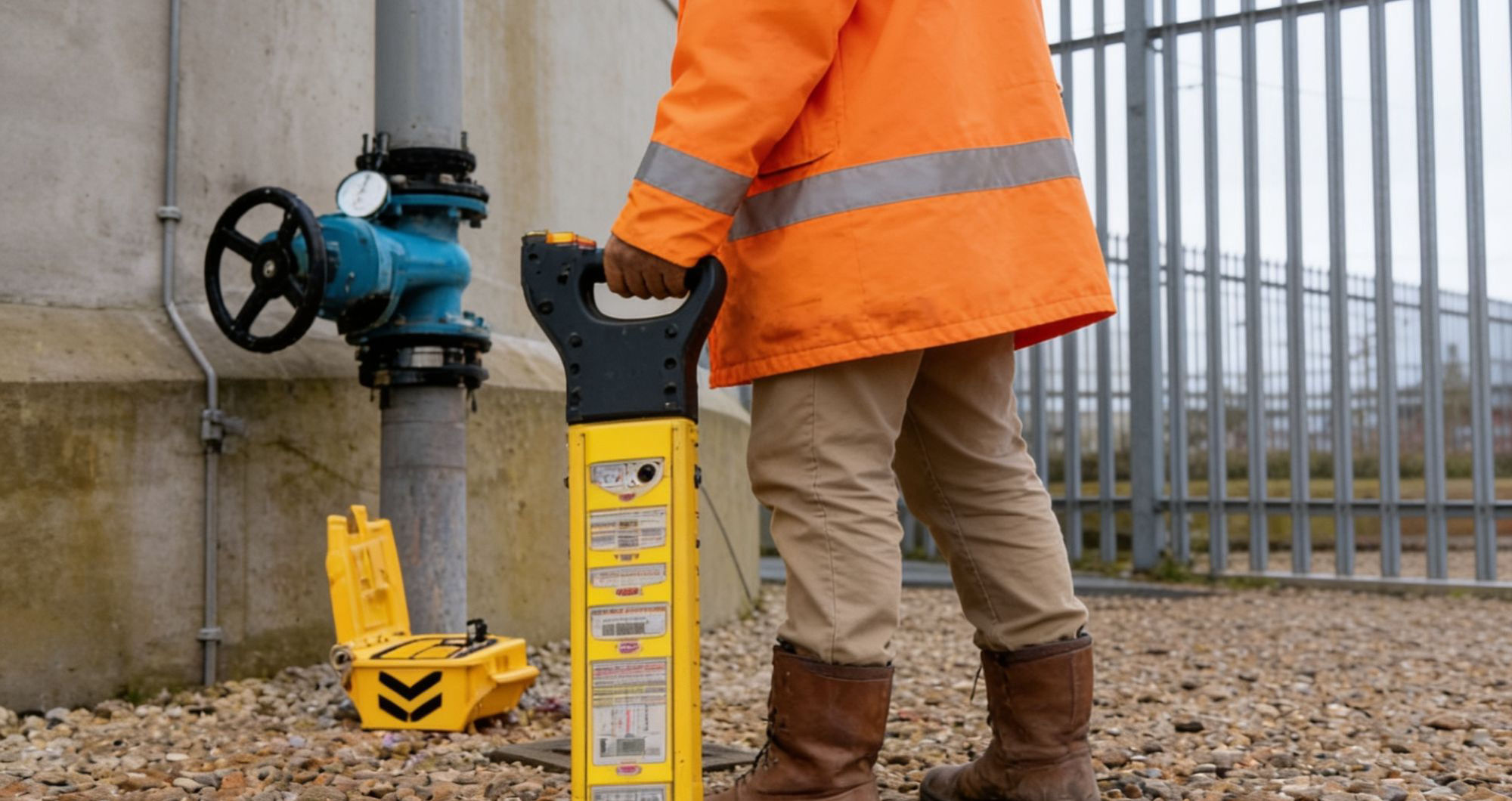

Thousands of times a year, someone digging into a British street strikes a buried cable or pipe that no one meant to hit. The surprising part is not that it happens. It is how avoidable almost all of it is.
Under the pavement outside almost any building in the country runs a tangle of cables, ducts and pipes, laid down over more than a century by water companies, power networks, telecoms firms and contractors who have long since moved on. Some of it is mapped accurately. A great deal of it is not, having been moved, added to or simply never recorded properly in the first place. Every time a crew breaks ground for a new connection, a repair or a development, they are digging into that uncertainty, and the Health and Safety Executive logs the results in the hundreds every year. The true figure, counting the near misses that never get reported, is higher.
When a cable is struck, the consequences run from the alarming to the merely expensive. At worst, an operative is injured by an arc flash from a live power cable. More often, the damage is to the programme and the budget: a single strike can cost five or six figures once the repair, the disruption to others and the insurance fall due. Either way, the work stops, and a problem that was invisible a moment earlier becomes everyone’s concern.
What makes this frustrating, rather than simply unfortunate, is that the tools to prevent it have been standard for years, and the gap is in how they get used. That gap is the whole focus of the Wigan firm, where Sygma Solutions trains crews to locate buried services, the UK’s only independent specialist in underground utility location and avoidance. Founder Peter Ashcroft has spent over twenty years watching the same mistake repeat. “The kit on site is good enough to find almost everything down there,” he says. “The problem is that it is routinely used in a way that finds far less. People trust a quick reading that was never going to tell them the full picture.”
The Tool People Skip
The standard equipment is a Cable Avoidance Tool, known on site as the CAT, paired with a signal generator called the Genny. Used in its passive settings, the CAT listens for signals that buried cables happen to give off on their own. The trouble is that plenty give off nothing useful: a cable carrying no current, a circuit switched off at the time, a balanced electrical load that effectively cancels itself out. The Genny solves this by sending a known signal along a pipe or cable so the CAT can trace it deliberately. Used properly, it turns guesswork into detection. The common habit, though, is to sweep with the CAT alone and leave the Genny unused, which is exactly where strikes come from.
A Problem That Can Be Measured
The encouraging part of the story is that the fix is measurable. Sygma reads how operatives actually use their equipment straight from the data the locators record, so it is working from evidence rather than impression. Before its training, Genny’s use on live sites typically sits below 30%. Afterwards, it rises to between 70% and 80%, with the firm setting crews a target of better than 60% on every job. Its client base includes Severn Trent Water and Wales & West Utilities, organisations that manage this buried-network risk across thousands of sites and treat it as a serious operational concern rather than an occasional hazard.
Built Into The Rules Already
This is not a matter of going beyond what is required. HSG47, the official guidance for working safely near buried services, already expects the network to be located before anyone digs. A survey that relies on a quick passive sweep and skips the step that would actually find the cable has not really met that standard, however careful it looked at the time.
The cables under our streets are not going to get simpler or better mapped any time soon. The realistic answer is not a perfect record of what lies beneath every road. It is making sure the person holding the detector knows how to find what was left out in the record. On that, the difference between a near miss and a clean job is mostly a matter of training.







