

When people choose software, they often focus on what the product does. Does it work quickly? Is the interface easy to use? Does it solve the immediate problem without too much friction?
Those questions still matter, but for privacy tools, they are no longer enough.
A growing number of users now care just as much about who runs the product as they do about the product itself. That shift is hardly surprising. Privacy tools sit unusually close to a person’s online activity, which means trust cannot be built through convenience alone. A polished app may look reassuring, but if users know very little about the company behind it, confidence tends to weaken.
Privacy Decisions Have Become More Mature
This is one reason privacy decisions have become more mature.
A few years ago, many users were willing to stop at broad claims such as “safe,” “private,” or “secure.” Today, they are more likely to ask harder questions. Where is the company based? Does it explain its privacy position clearly? Does it publish anything that helps people evaluate trust? Does it behave like a real operating company rather than just a marketing front?
Those questions reflect a broader change in digital life.
Internet use has become more distributed, more mobile, and more dependent on services that ask for trust without always showing how that trust is earned. People use privacy tools while travelling, working remotely, connecting on shared networks, and moving between devices throughout the day. In that setting, company identity becomes part of product evaluation.
Why Trust Signals Matter More in Privacy Software
This matters because privacy software is not judged in the same way as entertainment or utility apps.
If someone downloads a simple convenience tool, they may care mostly about whether it is smooth and functional. But when a product is positioned around privacy, protection, or browsing safety, users want more context. They want to know whether the company appears transparent, whether its public materials feel coherent, and whether its trust claims are visible enough to examine.
That does not mean every user performs deep corporate research before installing an app. Most do not. But many users now look for signals that help them decide whether a company feels credible. A visible company profile, a clear explanation of what the service is for, and public trust materials all reduce uncertainty.
This is why “who runs the tool” has become part of the product experience.
A company that explains itself clearly lowers the burden on the user. It helps readers move from vague reassurance to practical evaluation. Instead of asking only whether the app looks good, users can ask whether the company behaves in a way that deserves confidence.
Company Context Helps Anchor Trust
That broader framing appears on X-VPN’s company background. On its About page, X-VPN describes itself as a cybersecurity company, says it has been trusted since 2017, and states that it operates from Singapore while serving users worldwide. It also presents the product as part of a wider privacy and security mission, not only as a utility for one-off access.
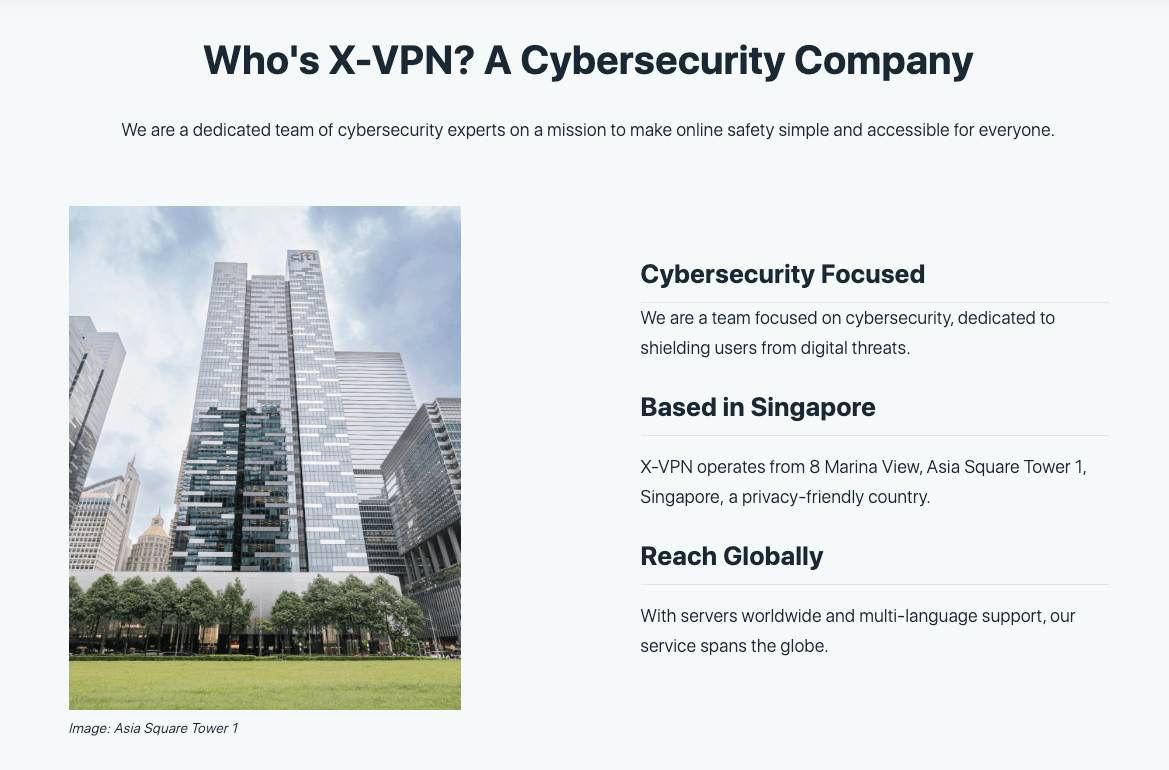
That kind of company context matters because it gives users something to anchor their trust to.
While company transparency is an important trust signal, users should still evaluate privacy tools carefully. Not all VPN providers offer the same level of clarity around data handling, logging policies, or security standards. Free VPN services in particular can vary widely in how they operate, so reviewing independent information and understanding the provider’s policies is essential before use.
Without it, privacy messaging often feels weightless. A service may promise online protection, but users are left guessing about what kind of company stands behind that promise. Is it focused on cybersecurity? Does it explain its history? Does it show how the product has evolved? Even basic questions like these can shape whether a privacy tool feels substantial or interchangeable.
Users Compare Ecosystems, Not Just Apps
Another reason company identity matters is that users are no longer choosing between products in a vacuum.
They are comparing ecosystems, not just apps. They want to know whether the company supports multiple platforms, whether it offers free or paid entry points, whether it publishes support materials, and whether its public-facing pages are consistent with one another. These factors do not replace technical evaluation, but they do make trust easier to form.
That is also why entry-level access matters. Its free VPN option is one example. X-VPN says the free plan does not require an email address, credit card, or account sign-up, and presents that as part of a lower-friction path into privacy protection for mainstream users.
That kind of offer does not answer every trust question, but it does reveal something about product strategy.
It suggests the company is thinking not only about premium buyers or technical users, but also about people who want a simpler first step. In a market where many privacy tools still feel abstract or intimidating, that matters. Users often trust a product more when they can understand both who runs it and how the company expects ordinary people to begin using it.
Brand Trust Is Now Practical, Not Symbolic
This is where brand trust becomes more practical than symbolic.
Users are not just rewarding polished storytelling. They are looking for signs of accountability, clarity, and coherence. They want to see that the company behind the app has a visible identity, a stated mission, and materials that help explain why the service exists and how it is meant to be used.
For privacy brands, that means product messaging can no longer stand on its own.
A fast app or a large feature list may still attract attention, but long-term confidence increasingly depends on whether the company behind the service looks real, understandable, and publicly legible. That is especially true in categories built on invisible promises. Privacy, by definition, is hard for most users to inspect directly, and company identity helps fill part of that gap.
Final Takeaway
For readers, the takeaway is simple.
When evaluating a privacy tool, do not stop at the interface or feature page. Look at who runs it. Look at how the company explains itself. Look at whether the public materials help you understand what kind of organisation you are being asked to trust.
Because in privacy software, the product is only part of the decision. The company behind it matters too.
A couple of light editorial notes: “rather than just a marketing front” reads a bit more natural than “only like a marketing front,” and I also tightened a few sentences to reduce repetition around “matters” and “trust.”