
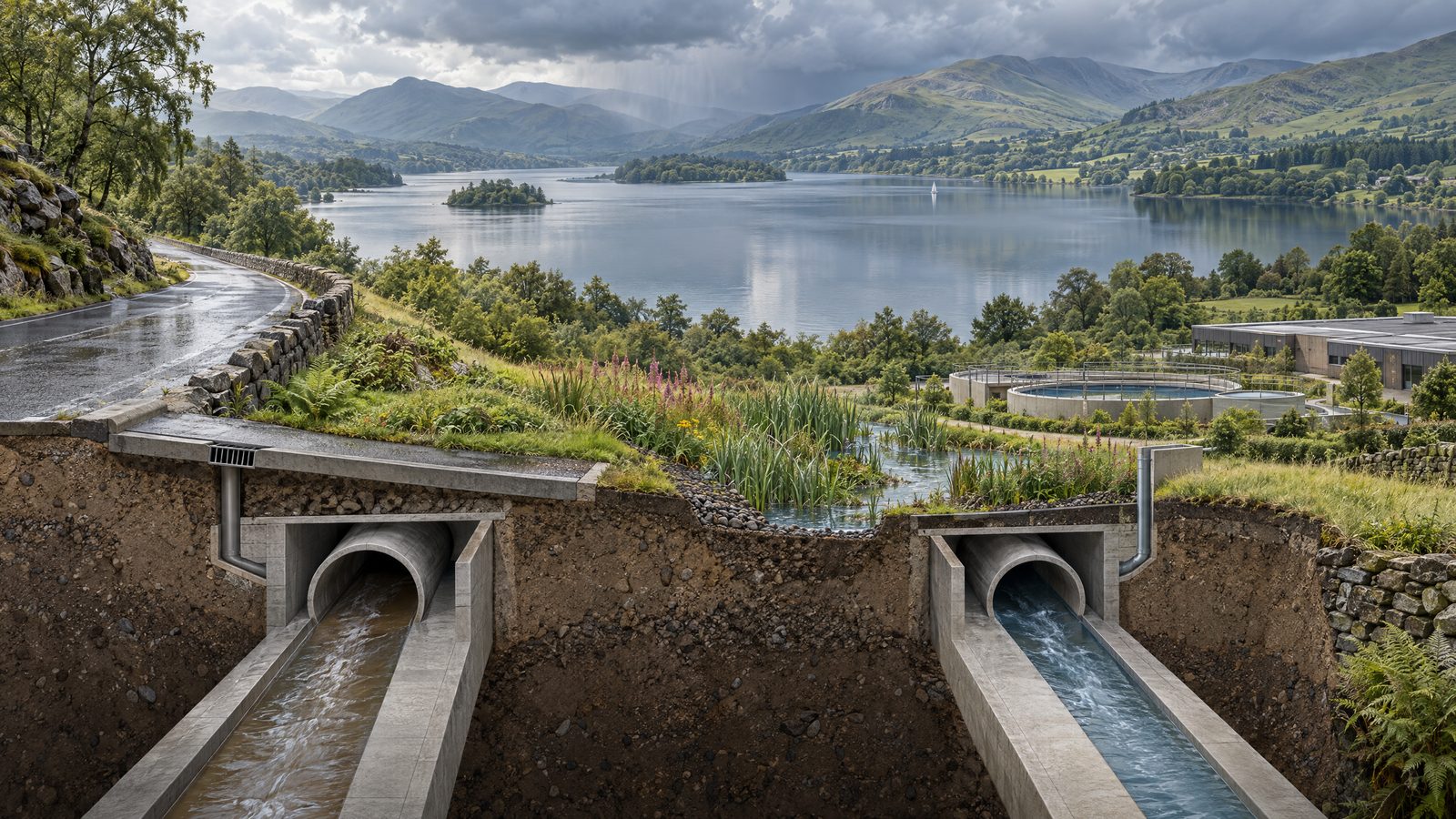

A £3.6bn to £3.7bn catchment-wide infrastructure proposal could keep wastewater and highway runoff out of Windermere, according to a feasibility study published on 21 October. The study says the approach is technically possible, but it remains a proposal: funding, detailed design and regulatory approvals are still outstanding, and regulators have yet to decide whether it should proceed.
The work was developed over 15 months by the Only Rainwater into Windermere coalition, which includes the Environment Agency, the Lake District National Park Authority, local community and environmental organisations, Westmorland and Furness Council and United Utilities. More than 70 possible approaches were considered before two preferred options were selected for further development.
Both options would collect wastewater and route it away from the lake for advanced treatment. The plans also include new infrastructure to capture road runoff and sustainable drainage intended to manage rainwater more effectively. The study outlines up to 138 kilometres of new sewer network, 35 kilometres of highway-runoff interception works and 37 hectares of sustainable drainage systems.
If developed, the network could grow by as much as 75 per cent across the catchment and connect about 12,800 people to public sewers for the first time. A tunnel is proposed to transfer wastewater to treatment facilities. The scale and route of that work, as well as the associated environmental and planning requirements, would be developed in later stages.
Estimates, not a construction commitment
The feasibility report puts the investment needed for its preferred approaches at £3.6bn to £3.7bn. It estimates that the options could generate about £7.5bn in economic, environmental and social benefits, or roughly £1.90 for each pound invested. Those figures are forecasts made by the study, not guaranteed returns or an approved spending package.
The report compares the proposal with an estimated £2.5bn of incremental investment in existing infrastructure over the next century if the catchment-wide scheme is not built. In that alternative, the study says treated wastewater would continue to be discharged into the lake. These figures describe scenarios assessed in the report; they do not establish what future investment will actually be made.
Windermere is already experiencing nutrient enrichment, increasing algal biomass and pressure on sensitive freshwater habitats and species, the study says. It also identifies warmer temperatures and more intense rainfall as risks that could add to environmental pressures and strain wastewater systems. The proposal is intended to address pollution pathways across the wider catchment rather than focus on a single discharge point.
The potential benefits identified extend to connected waters including Grasmere, Rydal Water, Elterwater, Esthwaite Water and Blelham Tarn. The study also points to possible employment and training opportunities during construction, including the idea of a local skills academy. These are anticipated benefits, dependent on the project advancing.
What happens next
The coalition has said the findings should inform the next phase, including detailed design, planning, environmental assessment and arrangements for funding. United Utilities has begun seeking a contractor for detailed design. The report envisages a seven-year construction programme after the required preparatory work and approvals, but that timetable is not a start date or a promise that construction will happen.
There is therefore a significant gap between the technical conclusion and delivery. The study establishes that the proposed engineering approach can be pursued; it does not mean the scheme has been authorised, financed or approved. Regulators will decide whether to proceed after detailed design work, while further decisions will be needed on planning and funding.
The findings set out a long-term option for reducing wastewater and road runoff entering Windermere and nearby waters. Whether that option moves beyond feasibility will depend on the forthcoming design, assessments, approvals and investment decisions.







