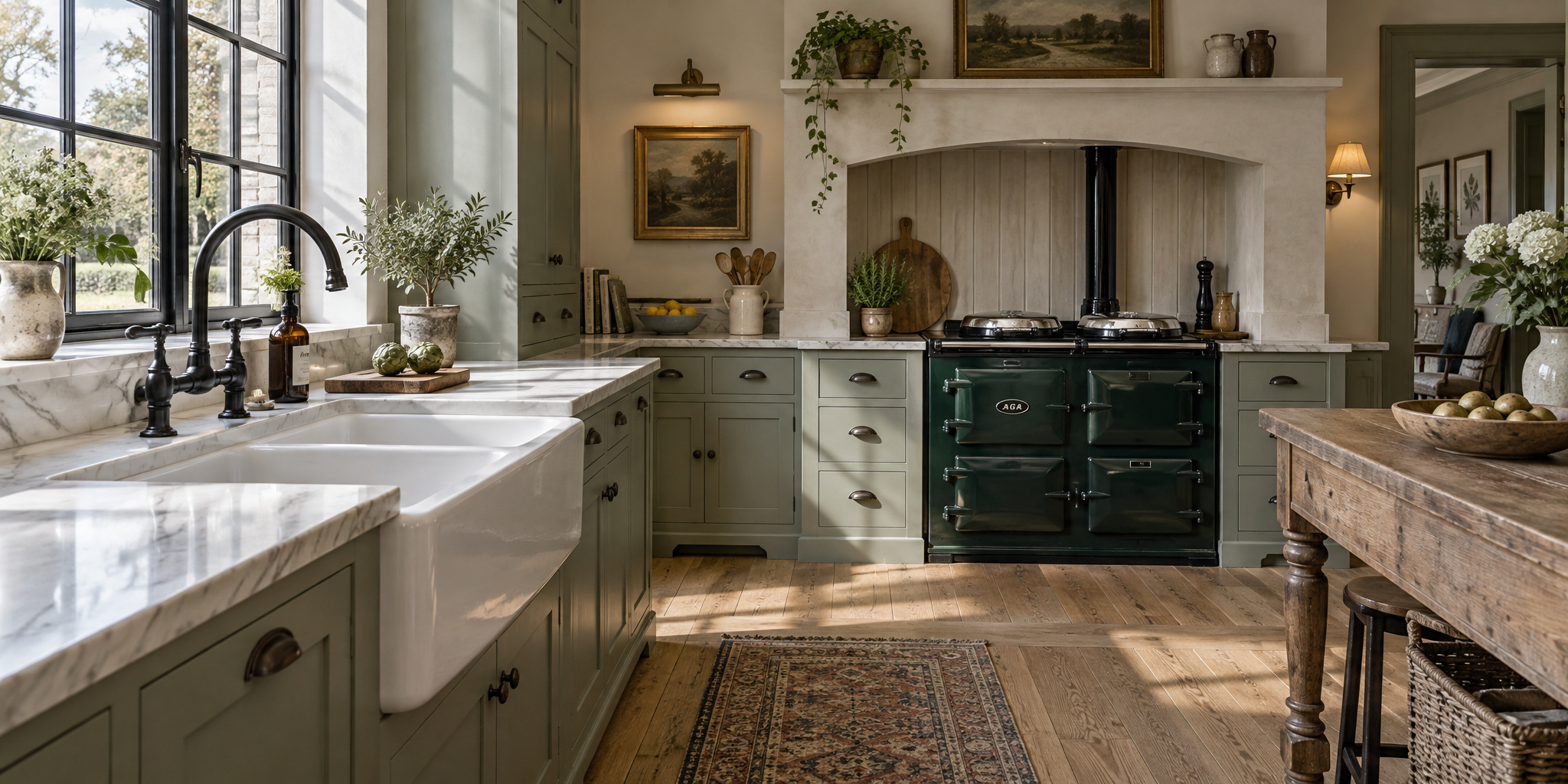

Few objects in the British home inspire such devotion as the Aga. It is heavy, expensive, slow to heat, and utterly indifferent to the conventions of modern kitchen design. Yet it refuses to disappear. If anything, its appeal has strengthened among homeowners who value the very qualities that make it unfashionable.
The Aga has been declared obsolete many times. Each time, it has outlasted the prediction.
A Brief History
The Aga was invented in Sweden in 1922 by the Nobel laureate Gustaf Dalén, who wanted to create a stove that required minimal attention and could cook reliably for a family. It arrived in Britain in 1929 and was soon adopted by country houses, farmhouses, and anyone with the space and the budget.
Its design has changed remarkably little. A cast iron body, a ceramic enamelled finish, two large hotplates, and a pair of ovens that maintain different temperatures continuously. It is always on. It does not have dials or settings in the conventional sense. That constancy is the source of both its charm and its controversy.
Why People Love It
The case for the Aga is not rational in the way that a spreadsheet is rational. It is emotional, sensory, and deeply practical all at once.
It is always ready. There is no preheating, no waiting, no temperature to set. The Aga is warm when you walk into the kitchen in the morning and warm when you return in the evening. Cooking becomes a matter of placing a pan rather than planning ahead.
It warms the room. In a large, cold country kitchen, the Aga is a radiator, a hearth, and a stove in one. It creates a gravitational centre, the place where people gather, dry their coats, and put the kettle on.
It cooks differently. The radiant heat of the hotplates and the gentle, even warmth of the ovens produce results that devotees insist cannot be replicated. Slow-cooked stews, crisp roast potatoes, and perfect toast are part of the liturgy.
It lasts. An Aga is built to outlive its owner. Many are still in service after forty or fifty years, and refurbishment is straightforward. In a culture of disposable appliances, that durability is increasingly rare and increasingly valued.
It looks like nothing else. The enamelled front, the chrome lid, the sheer mass of the thing. An Aga is not merely an appliance. It is furniture, architecture, and a statement of values.
The Criticism
None of this means the Aga is beyond reproach, and the criticisms are worth taking seriously.
It is expensive to run. An Aga runs continuously, and that costs money. In an era of high energy prices, the running cost is a genuine concern, particularly in a household that is out all day.
It heats the kitchen in summer. The same warmth that is welcome in January becomes oppressive in July. Many Aga owners simply cook less in summer, or use a separate hob.
It requires expertise. Cooking on an Aga is a skill. The hotplates have different zones, and the ovens cannot be adjusted with a dial. New owners often need instruction, and some never adapt.
It is heavy and difficult to install. An Aga weighs hundreds of kilograms and requires a solid base, proper ventilation, and often structural reinforcement. Installation is a project in itself.
It is not for small kitchens. A compact London flat is not Aga territory. The appliance demands space and a room built around it.
Why It Is Returning
Given these drawbacks, why is the Aga enjoying a revival?
Part of the answer lies in the broader return to durable, repairable, characterful objects. Homeowners who have grown tired of appliances that fail after five years are drawn to something that can be serviced indefinitely.
Part of it lies in the revaluation of the kitchen as a living space. The Aga is not merely a cooker. It is a hearth, and the hearth has always been the heart of the home. In an age of induction hobs and smart appliances, the Aga offers something older and more grounded.
Part of it lies in the models themselves. Modern Agas include electric and dual-fuel versions that are far more efficient than the traditional oil or gas models. Some can be switched off or run at lower output, addressing the running cost objection directly. The brand has adapted, however reluctantly, to the expectations of a new generation.
And part of it is simply cultural. The Aga is a symbol of a certain kind of home, and symbols endure.
The Practical Considerations
Anyone considering an Aga should think carefully about a few things.
Which fuel? Traditional models run on oil or gas. Electric and dual-fuel versions are more efficient and better suited to modern homes. The choice affects running costs significantly.
How will you use it? A household that cooks every day and spends time in the kitchen will get more from an Aga than one that eats out and works long hours. The appliance rewards presence.
What is the kitchen like? The Aga needs space, ventilation, and a solid floor. It should be the centre of the room rather than an afterthought.
What are the running costs? Estimate them honestly, and compare them with your current appliances. The Aga’s advocates often underplay this. Its critics often overplay it.
Is there an alternative? Range cookers from other manufacturers offer some of the Aga’s benefits at a lower cost. A wood-burning stove in the kitchen provides warmth and atmosphere without the cooking commitment.
Final Point
The Aga refuses to disappear because it offers something that modern appliances cannot. Not efficiency, not convenience, not flexibility. Something older and more elemental: warmth, permanence, and a sense of the home as a place of continuity.
It is not for everyone nor for every kitchen. It is not even, by most measures, a sensible purchase.
That is why the Aga is still with us, and why it will probably still be with us when the next generation of smart appliances has been forgotten.