
Jewellery making has been one of the UK’s most popular handmade crafts for years, and it’s only getting bigger. More people are turning it into a proper side hustle or just doing it because they enjoy it. Either way, if you’ve looked at a crystal supplier’s website for more than five minutes, you’ve probably felt your eyes glaze over. Flatbacks, chatons, hotfix, non-hotfix, SS sizes, PP sizes, bicone beads, sew-on stones.
All you wanted was to make a pair of earrings, and now you’re drowning in jargon. Here’s the thing though: once you get your head around a few basics, it all clicks into place pretty quickly.
What All Those Crystal Names Actually Mean
The number of product types is usually the first thing that throws beginners off. So here’s a quick rundown of the main ones.
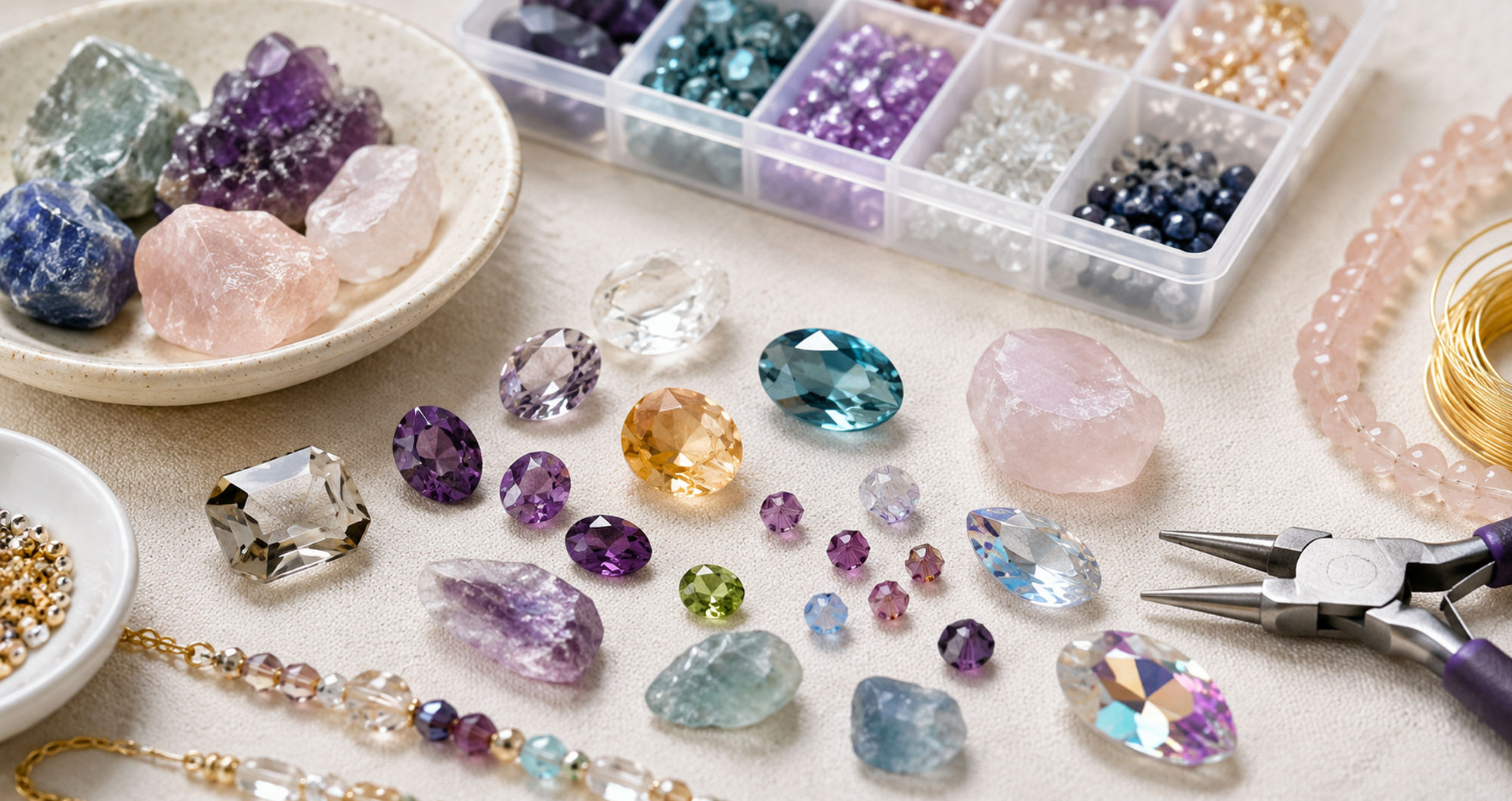
- Beads are probably what you’re picturing already. They’ve got holes drilled through them so you can thread them onto wire, cord or headpins. Bicone beads are that classic diamond shape you’ll spot in most crystal jewellery. Round beads are self-explanatory. And briolettes are faceted teardrops that look brilliant as earring drops.
- Pendants are bigger focal pieces with a single hole at the top, meant to hang from a chain or a bail. You’ll mostly find hearts, teardrops and pear shapes.
- Chatons are pointed-back round stones that sit inside metal settings. If you’ve seen a ring or brooch with a sparkling round crystal held in place by a claw or bezel, that’s a chaton doing its job. Fancy stones work the same way but come in shapes like ovals, navettes and cushions.
- Sew-on stones have two or more holes so you can stitch them straight onto fabric. They’re more of a dancewear and bridal thing than everyday jewellery, but they can look incredible on fabric-based pieces like cuffs or chokers if you want a bit of drama.
- Flatbacks are flat on one side, faceted on the other, and designed to be glued onto surfaces. In jewellery, people often use them to decorate earring bases, hair accessories or resin pieces.
Which Format Suits Which Piece
This is where beginners tend to burn through the most cash, buying the wrong format for the wrong project.
- For earrings, beads and pendants will get you the furthest. A simple pair of drop earrings only needs two briolette pendants, two headpins, two jump rings and a pair of ear wires. You can also go with chatons set into stud settings, which is dead easy.
- For necklaces, beads are what you’ll want for a strung design, and pendants work best as a single focal piece on a chain. Bicone beads strung with spacer beads between them make a classic crystal necklace that looks way more expensive than it actually costs to put together.
- For bracelets, beads threaded onto stretch cord or wire are the easiest way to start. Bicones and round beads both work nicely here.
- For embellishment on fabric jewellery, sew-on stones and flatbacks are your best bet. Flatbacks need a strong adhesive like E6000 or a specialist crystal glue, while sew-ons get stitched directly in place.
How Crystal Sizing Works
Crystal sizes are measured differently depending on the format, and this trips up a lot of newcomers.
Flatbacks use the SS system (stone size). SS12 is about 3.1mm, SS16 is roughly 3.9mm, SS20 is around 4.7mm, and so on. The numbers don’t map neatly to millimetres, so you’ll want a size chart bookmarked somewhere.
Chatons use the PP system (Pearl Plate) for smaller sizes. PP24 is about 3.1mm, PP31 is around 3.9mm. Once you get into bigger chatons, they’ll switch to SS sizing or just be listed in millimetres.
Beads and pendants are typically listed in millimetres, which makes things a lot simpler. A 4mm bicone bead is small and delicate. A 6mm bicone is a solid all-rounder. An 8mm is a statement piece.
The main thing to remember: don’t assume you know how big a crystal will be just from the size number. Always check the actual millimetre measurement before placing an order.
Pick the Right Quality for What You’re Selling
If jewellery making is purely a hobby for you, budget crystals from any supplier will do fine. But as soon as you start selling your pieces, the quality of your components becomes tied to your pricing.
Someone paying £30 or more for a handmade necklace will notice if the crystals are cloudy, unevenly cut or flaking their coating after a couple of wears. Buyers at that price point will often ask outright what you’ve used, and the answer changes what you can charge. If you’re working with genuine Swarovski crystals, say so in your listings and on your labels, because the name carries weight with customers and plenty of sellers claim it without it being true. Whatever you use, be accurate about it. Getting caught describing glass as Swarovski will do far more damage to a small brand than honest mid-range components ever could.
You’ll also find mid-range options from Czech and Austrian manufacturers that offer decent sparkle at a lower price point. These can work well for craft fair stock or lower-priced lines where you need to keep your costs down.
Test Colours Before You Commit
One of the biggest mistakes beginners make is ordering a full pack of crystals in a colour they’ve only ever seen on a screen. Monitors display colours differently, and a “light rose” on your laptop might look nothing like it does in person.
A lot of crystal suppliers now offer sample services where you can order individual stones or small sample sets. That way, you can hold the actual colour in your hand, see how it catches the light and compare it against your other materials before you drop £20 or more on a full pack. It’s a small cost upfront that can save you from being stuck with stock you’ll never use.
You should also grab one or two crystals in a few different effects while you’re at it. An AB (aurora borealis) coating adds a rainbow shimmer that completely changes the look. Shimmer and golden shadow effects each give off a different mood. Comparing these side by side will help you develop a colour palette that’s distinctly yours.
Your First Order Won’t Be Your Last
Getting into crystal jewellery is all trial and error, and there’s nothing wrong with that. Buy small quantities, mess around with different formats and effects, and don’t pressure yourself to stock every colour going from day one.
Most experienced makers started with a handful of colours and gradually added more over time. The terminology gets easier with every order, and before you know it you’ll be rattling off chaton sizes and flatback article numbers without thinking twice.