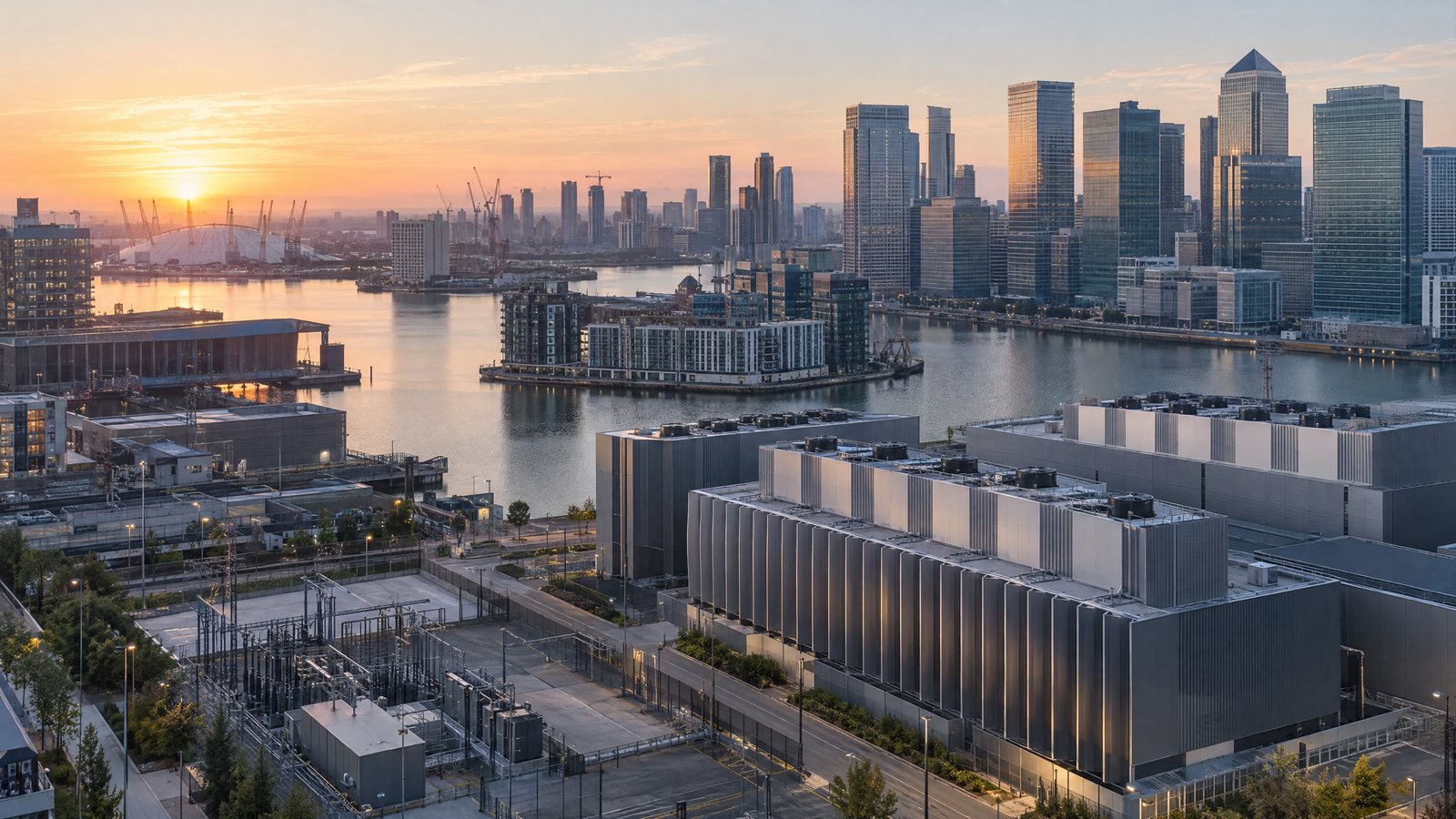

A parent company and its data-centre subsidiary have completed the purchase of an estate in London’s Docklands for more than £220m, securing a site for an expansion beside their existing campus. The acquisition brings together a substantial property holding, secured power capacity and planning consent for a new data centre.
The estate covers 1.1 million square feet and has 65 MVA of power capacity secured. It also has planning consent for a 376,000-square-foot data centre, with the planned facility intended to support AI-ready, high-density computing. The purchase is complete, but the future facility should not be confused with a finished or operating development.
The transaction transfers the estate from its previous owners to the two acquiring companies. Its consideration is more than £220m, rather than an exact £220m. That distinction reflects the stated value of the completed purchase without assigning a more precise price than the available details establish.
Land, power and planning
The acquisition provides a site next to the buyers’ existing Docklands data-centre campus. That location places the proposed expansion alongside an established operation, rather than on a separate, unrelated site. However, the purchase itself does not establish when the new facility will be built or when it might begin operating.
The size of the estate and the scale of the consented data centre describe different parts of the development. The 1.1 million-square-foot figure relates to the acquired estate as a whole. The 376,000-square-foot figure relates to the data centre for which planning consent has been secured.
Those figures should not be treated as interchangeable. The purchase covers the larger property holding, while the planning consent concerns a smaller data-centre scheme within it. The available details do not establish how the remainder of the estate will be used, so the acquisition should not be described as a plan to turn every square foot into computing space.
The secured 65 MVA capacity is another distinct element. It is part of the basis for the planned AI-ready, high-density facility, but it is not evidence that a new data centre is already drawing that power. Secured capacity and an operating facility are separate stages of the expansion.
Likewise, planning consent establishes permission for the stated data-centre scheme. It does not, by itself, show that construction has been completed. The confirmed development is the land purchase, accompanied by the stated power capacity and consented plan.
A separate project is already being built
The subsidiary also has an adjacent project under construction. That work is separate from the newly acquired estate and its planned facility. Keeping the two projects distinct is important: construction activity at the neighbouring development does not establish that the newly purchased site has reached the same stage.
The existing campus, the adjacent construction project and the proposed facility on the acquired estate therefore represent three different positions. One is already established, another is being built, and the third is supported by a completed purchase, secured capacity and planning consent.
The AI-ready description applies to the intended new facility. It sets out the type of development envisaged for the site, rather than confirming that AI computing is already taking place there. No opening date or construction timetable for that facility is established by the supplied transaction details.
For now, the purchase clears a property hurdle for the Docklands expansion. The buyers have completed the acquisition of the estate, with the stated power provision and consent in place. The next steps towards a built and operating data centre remain separate from that completed commercial transaction.