


Gen Z workers were also the most insistent on employers offering up perks to increase office attendance, new data shares
The COVID pandemic undoubtedly changed the way we work and one of the biggest lingering effects is that many people may now work from home all or some of the time.
The five day week in the office is not as common as it once was, and research has shown it’s a big deal for workers as a new survey reveals almost half would quit their job if they were told to come into an office five days a week.
The research from flexible office broker Office Freedom surveyed working adults from across the country to find out present attitudes toward working in 2024.
Being made to come into an office wouldn’t sit well with the majority of respondents – when asked their response to the statement: ‘Being told to come into the office five days a week again would make me quit my job’, almost half agreed at 48.2%.
The minority disagreed with the statement (24.4%) while 27.5% neither agree nor disagree.
To what extent, if at all, do you agree or disagree with the following statement: Being told to come into the office five days a week again would make me quit my job?
- Agree (NET) – 48.2%
- Strongly agree – 16.6%
- Somewhat agree – 31.6%
- Neither agree nor disagree – 27.4%
- Disagree (NET) – 24.4%
- Somewhat disagree – 13.7%
- Strongly disagree – 10.7%
The data also offered a generational breakdown of who is most likely to attend the office five days a week, with Gen Z workers the least likely to. A third of those aged 18-24 revealed they head into the office Monday-Friday (33.9%), compared to 44.5% for Millennials (25-34 year olds), 53.5% for 35-44 year olds and 58.2% for 45-54 year olds.
Those belonging to the oldest age category of 55% garnered the highest percentage of those heading into the office five days a week at 66.5%.
As well as being the most office shy, Gen Z workers were revealed to be more insistent on workplaces offering perks in order to increase office attendance.
Overall, nearly half of Brits believed employers should be offering benefits for office working. It was found that 49.7% agreed with the statement: ‘I think employers should be offering perks to encourage workers into the office more each week.’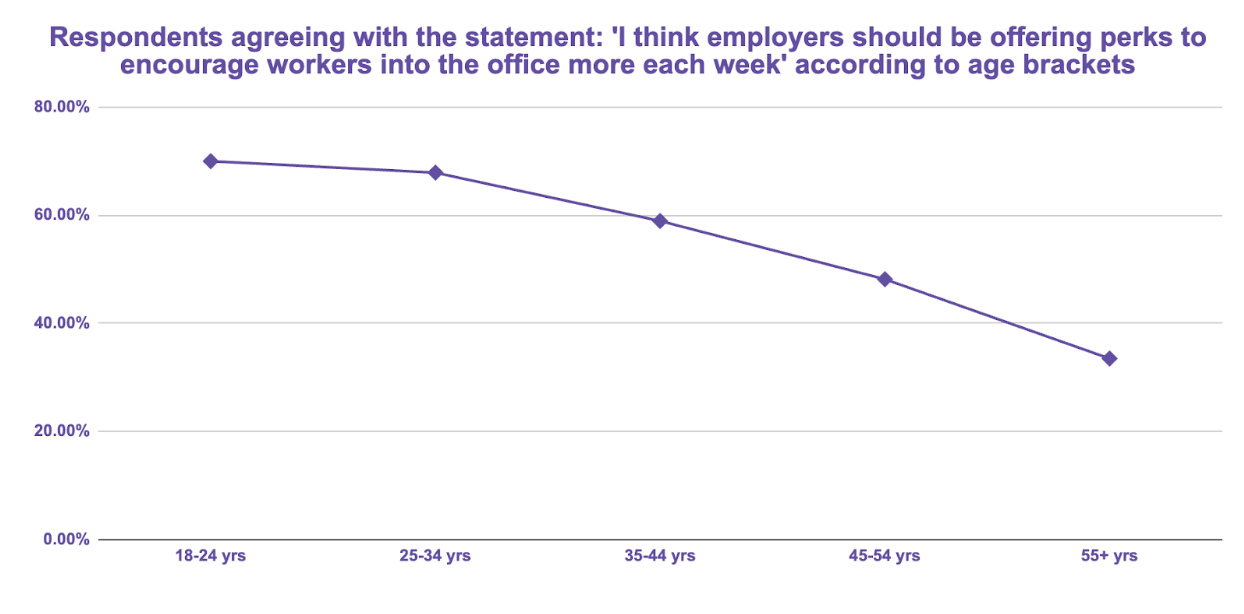
Under half (49.7%) agreed with the statement, while 17.17% disagreed and 33.2% neither agreed nor disagreed.
When looking at the age breakdown in the survey results, there was an interesting correlation to be found in the age of the respondent and their attitude towards the notion of offering ‘perks’.
A staggering 70% of respondents in the 18-24 bracket agreed benefits should be offered up, in stark contrast to 33.5% of those in the older 55+ category.
When it came down to the most popular perks that could be offered to entice workers into the office, it found that early finishes came out on top with almost half of respondents (49.5%) plumping for the option.
What perks, if any, would encourage you to come into the office more each week? (ticking all that apply)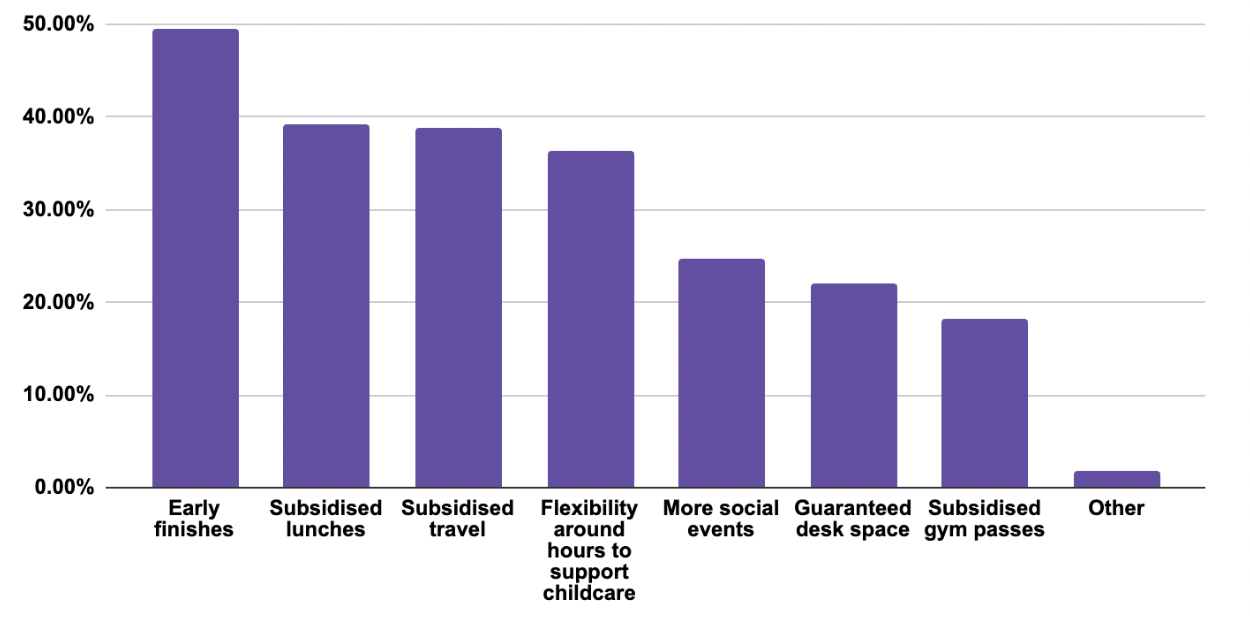
Subsidised lunches came in second (39.2%), with subsidised travel in third (38.8%) and flexibility around hours for childcare in fourth (36.4%).
More social events (24.6%) ranked fifth, while 22% were after guaranteed desk space in fifth closely followed up by subsidised gym passes at 18.2%.
Richard Smith, spokesperson for Office Freedom, shares: “Attitudes toward working environments have transformed over the past few years as working from home has become much more a reality for many office workers in a way it wasn’t pre-pandemic.
“It’s not surprising people would like the option of being able to work from home as well as an office, but that almost half of respondents would be willing to quit their jobs is a testament to how hybrid working is strongly sought after.
“It’s interesting to see that younger workers believe perks should be offered by employees, as it shows a clear attitude difference across the generations and emphasises the complete overhaul in the way we work over the past few years.”
Feature image by cottonbro studio on Pexels







