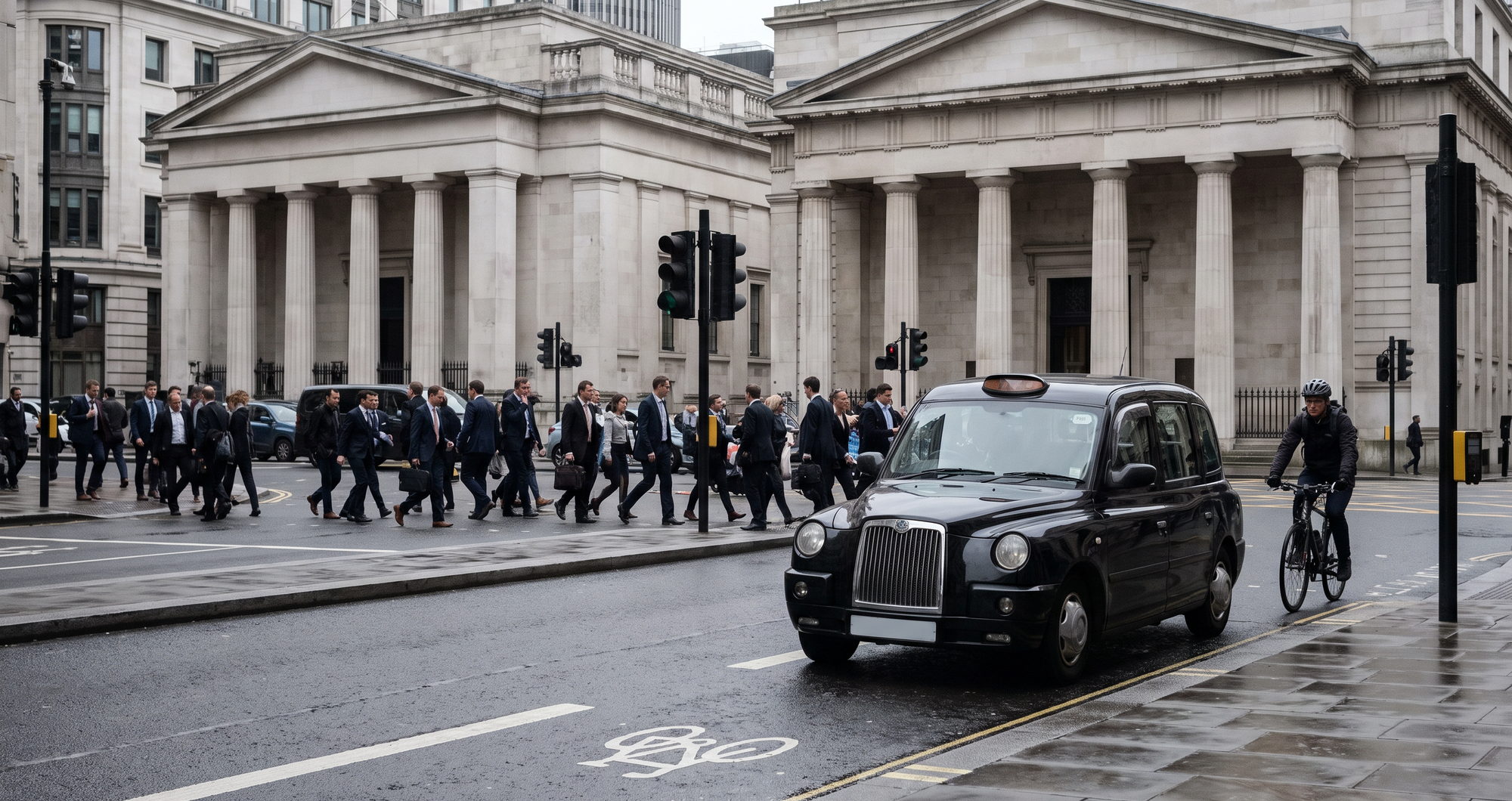

Officers at the City of London Corporation have recommended that licensed taxis keep their weekday east-west access through Bank Junction permanently, converting a trial that began in July 2025 into a settled arrangement. The recommendation goes to the Corporation’s planning and transportation committee on 10 November.
Taxis have been barred from the junction between 7am and 7pm on weekdays since 2017, when the Corporation restricted motor traffic in the middle of the Square Mile. Licensed cabs were given the east-west route as a trial, and that trial is due to end in January 2027.
What the consultation found
Nearly 4,000 people responded to the consultation on the trial. Of those, 88 per cent supported making east-west cab access permanent. Among cyclists who replied, 72 per cent opposed it, a division the officers’ report records without resolving.
On collisions, officers found no recorded incident involving a taxi anywhere in the junction during the trial, and two on the east-west corridor. Those figures sit behind the recommendation, which rests on the argument that cab access has not produced the safety problems opponents predicted.
The casualty numbers are less clear cut. The junction averaged 5.67 casualties a year between 2022 and 2024. Between August 2025 and March 2026 the annualised rate was nine. Officers note that a single collision in 2023 depressed the earlier baseline, which they say makes the comparison less reliable than the raw totals imply.
Both sets of figures carry caveats. A three-year average is sensitive to individual incidents, and the trial window is short enough that one bad month can move the annualised rate. The trial also covers a different mix of traffic, with cabs restored along one axis while most other vehicles stayed out during working hours. Officers put the figures to the committee without resolving the difference between them.
The safety argument
Simon Munk of the London Cycling Campaign warned that more vehicles in the junction mean worse road safety. Paul Brennan of the Licensed Taxi Drivers’ Association urged the committee to adopt the recommendation.
Bank Junction has been the Square Mile’s most contested piece of traffic management since 2017, when most motor traffic was barred during weekday working hours. Allowing cabs back along one axis was a significant relaxation of that settlement, and the decision now is whether it becomes part of the permanent layout.
If the committee adopts the recommendation, east-west access will continue when the trial lapses in January 2027, and the arrangement will no longer be time-limited. If it does not, the route closes to cabs and the position before the trial returns.
What it means
For cab drivers the vote determines whether a route through the centre remains available during working hours, which matters most for fares that begin or end close to the junction. For passengers with luggage, mobility impairments or small children, it decides whether a taxi can complete a journey that would otherwise end a few streets away.
Cyclists and pedestrians face a different question: whether the traffic volumes recorded during the trial hold once the arrangement is no longer being watched as an experiment. The officers’ report offers a comparison that points both ways, and the committee will have to choose which reading of the casualty data it accepts before the trial clock runs out in January. The committee meets on 10 November, which leaves a little over two months before the trial is due to lapse.