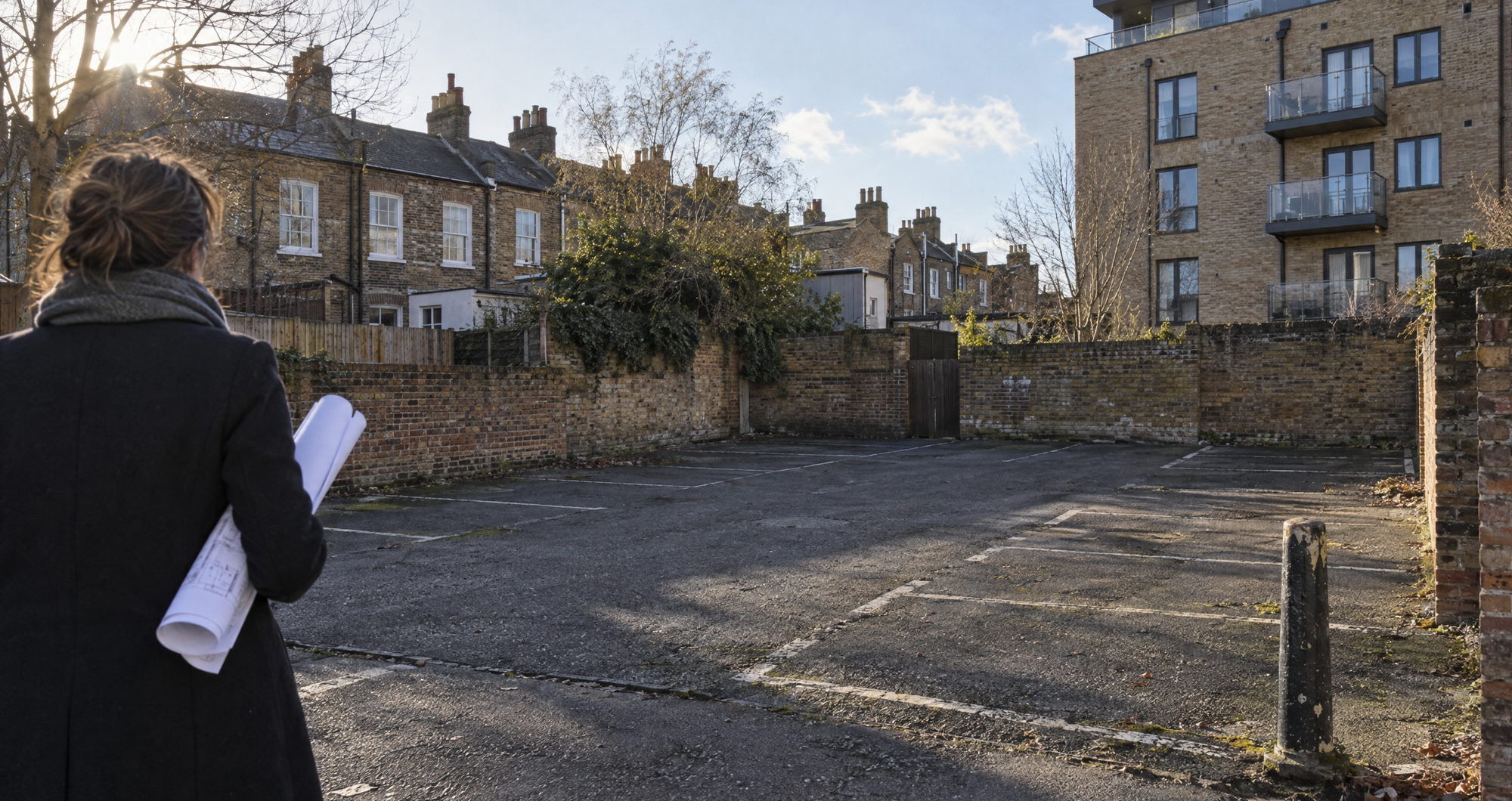

Camden’s planning committee resolved to grant permission on 5 November 2026 for 16 council homes on the former Hadley Street car park in Camden Town. The site is council-owned land that had been given over to parking, and the scheme comes forward under the borough’s New Homes for Small Sites programme.
The development is arranged in two buildings and mixes seven one-bedroom flats, three two-bedroom homes, five three-bedroom homes and one four-bedroom home. Two of the one-bedroom flats will be fully wheelchair accessible, and six of the 16 homes will have three or more bedrooms.
All 16 will be council homes, let through the borough’s housing register rather than sold. That distinguishes the scheme from a market development of the same size, where the tenure of each flat would be set by the builder.
The permission includes better lighting across the site, a planted courtyard, herb gardens and secure storage for residents. Those elements were part of the application rather than conditions added by members. On a tight urban plot, they account for much of the open space the scheme will provide.
A resolution to grant is not the same as a completed permission. Conditions attached to the consent have to be discharged and a Section 106 agreement completed before building work can begin.
Small sites, family homes
The small sites programme exists to bring forward underused council land, including car parks and garages, for housing that would not otherwise be built. Camden consulted residents through a call for ideas interactive map, and the plots it identified are the ones now arriving at committee.
Sixteen homes is a modest number against the borough’s wider ambitions. Camden’s Community Investment Programme is aiming for 4,850 new homes, including 1,800 for social rent. Of those, 1,780 have been delivered so far, 70 per cent of them affordable, or roughly 1,250 homes.
The figures do not say how many of the 1,780 are for social rent, so the distance to the 1,800 target cannot be read directly from them. What they do show is that seven in ten of the homes built so far are affordable.
Hadley Street is a live example of the approach councils are being pushed towards. The plot is already developed land in council ownership, so the scheme takes no greenfield space, and it puts family homes on a site that would otherwise stay a car park.
Camden’s case for building on plots like this is straightforward: the land is already in public ownership, and the alternative is continued parking.
What happens next
The decision now passes to the legal stage, where the Section 106 agreement and the conditions are settled. Only when both are complete does the consent take effect and a start on site become possible. The agreement will set out the obligations that run with the permission, and it has to be signed before work starts.
For the households eventually nominated to the flats, the practical effect is a wait covering that legal work and then construction. The two accessible homes will be allocated through the council’s lettings arrangements, and neighbours will see a parking site replaced by two residential buildings around a courtyard.
Whether the small sites model can be repeated at scale is the open question. Each plot carries its own constraints, and each requires the same sequence of design, consultation, committee resolution and legal completion before a single home is built.