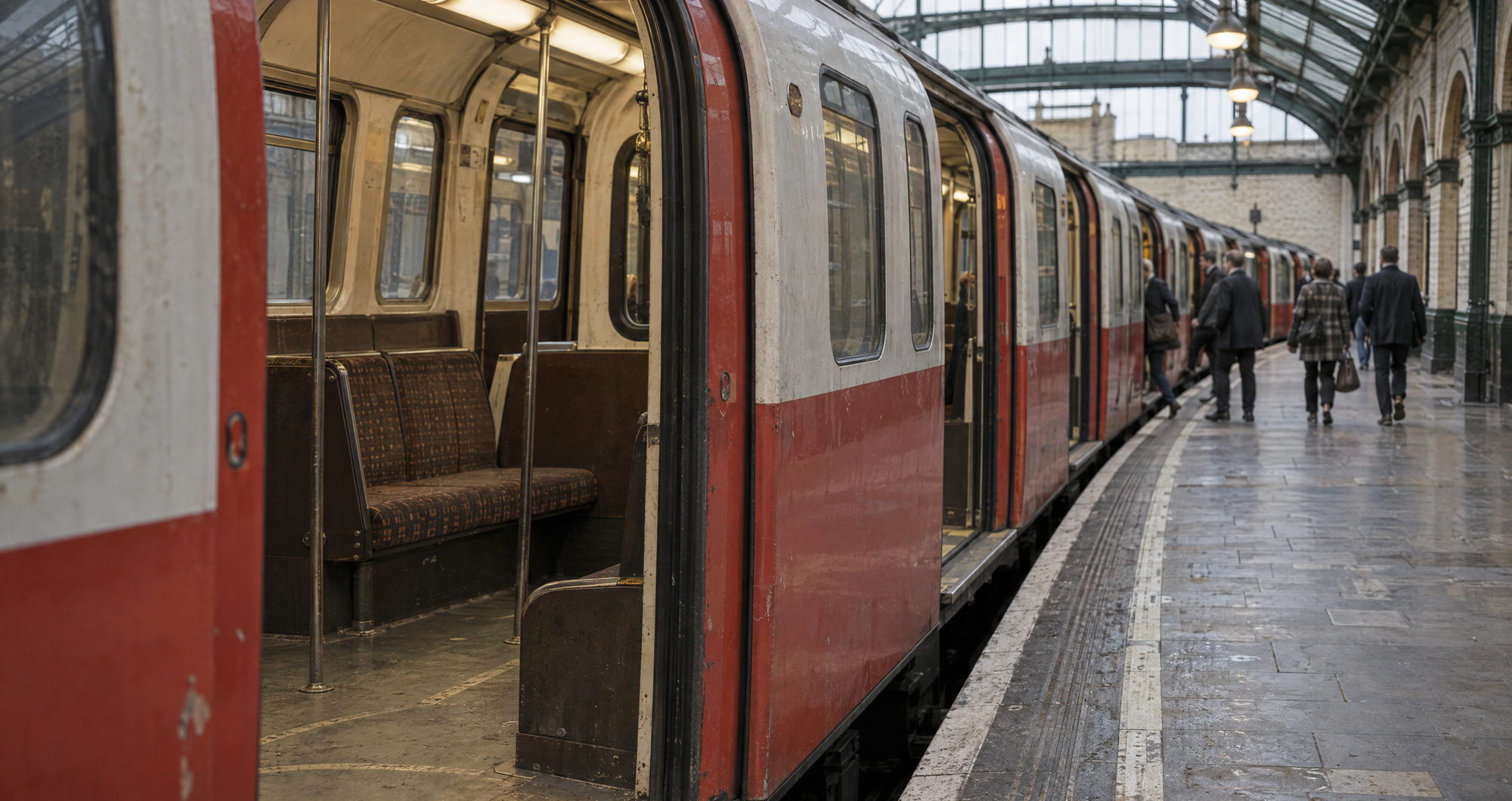

The London Assembly has called on the Mayor to confirm whether Transport for London exercised its option to add Bakerloo line trains to the Siemens Deep Tube contract, after the production-continuity deadline of 1 November passed without a public answer. The motion was agreed unanimously on 6 November.
Its fleet dates from 1972, which puts the trains nearly 20 years beyond their original design life. The Bakerloo carries about 87 million passengers a year, and the Assembly motion describes it as the worst-performing line on the network in 2025-26.
Reliability in numbers
About 88 per cent of scheduled kilometres ran on the line in 2026-27 so far, against about 97 per cent in the three years from 2016-17 to 2018-19. The gap between those two figures is the measure the Assembly uses for the decline it says passengers now experience daily.
Peak frequency has been reduced in stages, according to the motion. It puts the figure at 22 and 21 trains an hour in 2013, falling to 20 in September 2023 and to 18 in spring 2026. On that basis the Assembly says passengers now see about 75 per cent of the service promised under the 2016 timetable. Each of those steps is small enough to pass unnoticed in a timetable, which is the substance of the Assembly’s complaint: a passenger waiting on a platform sees the gap in front of them, not the cumulative difference between 22 trains an hour and 18.
The motion characterises those reductions as having been made quietly, a description that is the Assembly’s rather than Transport for London’s. The figures in the motion are drawn from Transport for London’s own performance data.
Why the date matters
That date, 1 November, was the Mayor’s own stated deadline for adding Bakerloo stock to the Siemens order without a break in production. Missing it does not close off new trains, but it makes them slower and more expensive to secure, because a gap in the manufacturing line has to be reopened and rescheduled. The motion therefore treats the deadline, rather than the eventual delivery date, as the decisive moment. A fleet ordered inside an existing production run can be built to a schedule already set; one ordered after a break has to be rescheduled, which is the difficulty the Assembly is pointing to.
The timing explains why the Assembly has chosen to put the question on the record now, at the point when the option lapsed rather than at the point when trains would arrive. The decision point is not the delivery date but the order date, and the order date is the one that has just passed.
Alongside the question to the Mayor, the motion calls on Transport for London to publish transparent performance data for the line. Neither request can be enforced, but both place the Mayor and the operator on the record ahead of the next funding discussion. Keeping 1972 trains in service beyond their design life has a cost that falls in two places. Maintenance teams spend longer on faults that would be routine on newer stock, and passengers absorb the rest in delays and in a timetable written around what the fleet can manage on a bad day.
For the roughly 87 million passengers who use the Bakerloo in a year, the immediate prospect is more of the same: an ageing fleet, a timetable set around what the trains can reliably deliver, and crowding at peak times on a line that runs through the West End and north-west London.
What the Mayor’s answer will establish is whether new trains have been ordered, deferred or abandoned. Until that is confirmed, the Assembly’s central question, whether the option was taken before production moved on, has no public answer.