

Britain throws away around 22 million pieces of furniture a year, and roughly half of it is still perfectly usable. Here is what to look at before you spend, whether you are buying a bed, a sofa or a single chair.
There is a particular kind of regret that comes eighteen months after a furniture delivery. The wardrobe door no longer closes flush. The sofa has developed a dip on the side everyone sits on. The dining chair creaks when you lean back, and you have started, without discussing it, to seat guests elsewhere.
None of this is bad luck. It is almost always visible at the point of purchase, if you know where to look — and most of us do not, because furniture showrooms train us to shop for colour, and the things that determine whether a piece survives a decade are all hidden behind the fabric and inside the carcass.
The scale of the problem is not small. Research cited by the North London Waste Authority puts the number of furniture items discarded in the UK at around 22 million a year, equating to roughly 670,000 tonnes according to WRAP — and WRAP’s own study of bulky waste found just under half of the furniture arriving at household waste centres was reusable in its current condition or with only slight repair. A great deal of what we throw out was never broken. It simply stopped being nice enough to keep.
Start with cost per year, not price
The single most useful reframing is to stop comparing prices and start comparing cost per year of expected life.
A £400 sofa that sags in four years costs £100 a year. A £1,600 sofa that is still comfortable at fifteen, and can be reupholstered at twenty, costs closer to £80 — and it will have been better to sit on for every one of those years. The arithmetic is not always so tidy, but the habit of doing it changes what you buy. It also explains why the cheapest option so often turns out to be the expensive one.
The rough dividing line in the trade is construction material. Chipboard and composite panels typically fail in three to five years of real household use; solid timber, properly jointed, will run to fifteen or twenty and beyond. That gap is the whole argument.
Bedroom: judge it from the inside
Bedroom furniture is the category where the difference between good and poor construction is most concealed, because everything is judged by the front of the door and the finish of the top.
Open a drawer and take it fully out. Look at the corners: dovetailed or dowelled joints are a sign of a maker expecting the piece to last; stapled butt joints are not. Look at the drawer base — solid or ply, sitting in a groove, rather than a thin panel pinned to the underside. Check the runners. Metal soft-close runners on a well-made drawer will glide with a light push at any point across the width; a drawer that has to be pushed dead centre to close is one that will eventually jam.
Then check the back of the unit. A tacked-on hardboard sheet is what keeps cheap carcasses square, and when it works loose the whole thing racks. Solid-backed or panelled construction costs more and shows why.
For wardrobes, one measurement matters more than any other: internal depth. A coat hanger is around 45cm across, so anything under about 58 to 60cm of usable internal depth will not take clothes hung front-facing, and you end up with a rail that only works side-on. Plenty of slim wardrobes are sold without this being mentioned.
Bed frames deserve a look at the slats. Sprung beech slats in a fitted holder support a mattress better and prolong its life; widely spaced, loose slats on a metal lip do neither, and most mattress warranties quietly specify a maximum slat gap of around 7cm.
Sofas: the frame is the whole product
Everything else on a sofa can be repaired or replaced. The frame cannot, economically, so it is the thing to interrogate.
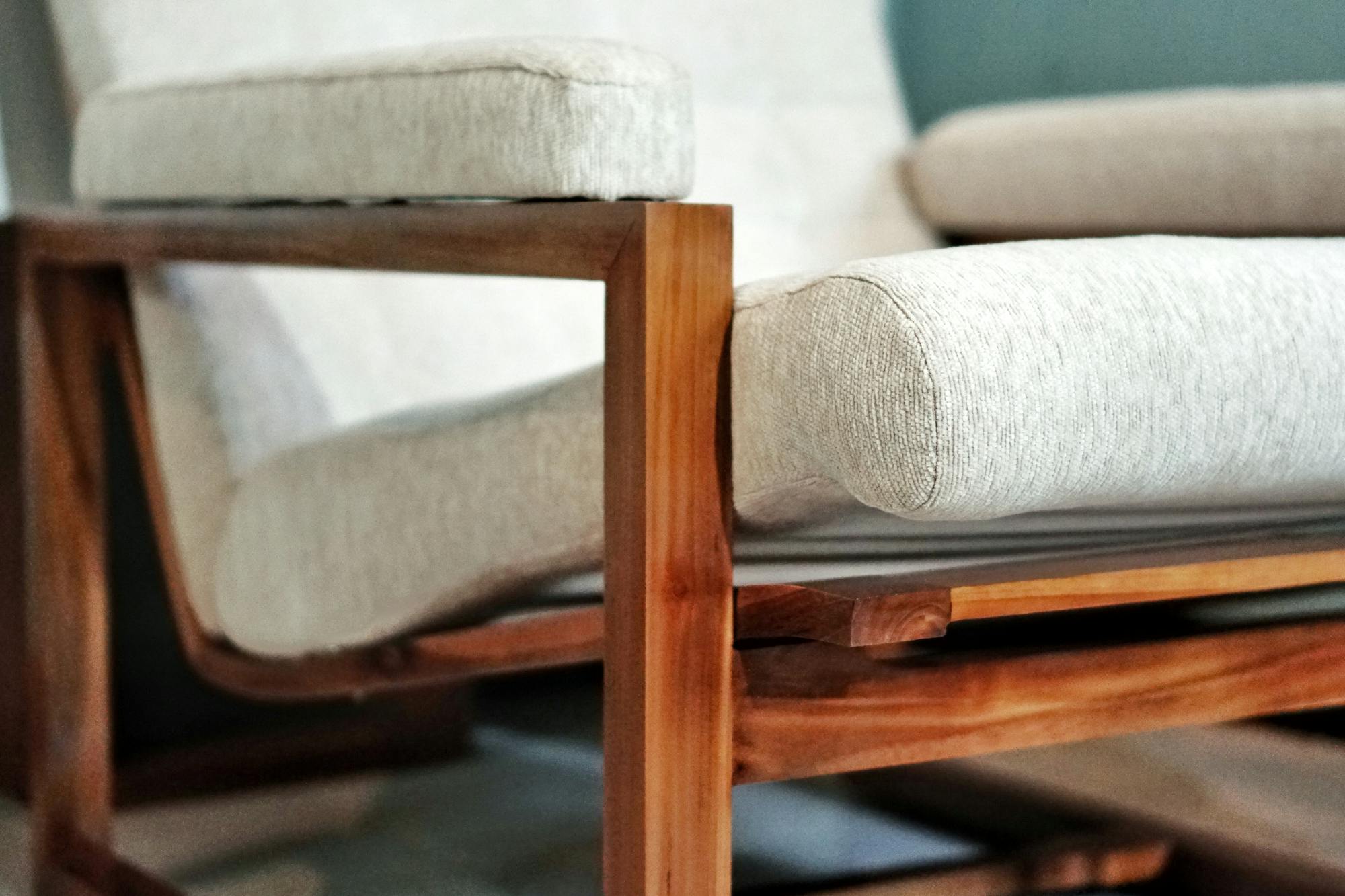
Ask what it is made of. The answer you want is kiln-dried hardwood, jointed and glued with corner blocks, rather than stapled softwood or particleboard. Kiln drying matters because timber that has not been dried to a stable moisture content will move in a centrally heated room, and a moving frame loosens every joint attached to it.
Next, the suspension. Serpentine springs are the standard on most quality British upholstery and are perfectly good. Eight-way hand-tied springs are better and much rarer at ordinary prices. Elasticated webbing alone is a cost-saving. If nobody in the showroom can tell you which of the three is under the cushion, that is itself an answer.
For fabric, ask for the Martindale rub count. The bands are widely used and easy to apply: below 10,000 is decorative only; 10,000 to 15,000 suits light domestic use such as an occasional chair; 15,000 to 25,000 covers general domestic use including a family sofa; and 25,000 to 30,000 is the heavy-duty band for households with children, pets or a recliner mechanism that rubs the fabric against itself every time it moves. Above roughly 40,000, the extra durability makes little practical difference in a living room, whatever the marketing suggests.
Two more checks. Removable, washable covers add years to a sofa’s socially acceptable life, which is the life that usually ends first. And every piece of upholstered furniture sold in the UK must carry a permanent label showing compliance with the Furniture and Furnishings (Fire) (Safety) Regulations 1988 — if it is missing on a second-hand or imported piece, walk away.
Chairs: the most under-thought purchase in the house
Chairs get bought on looks more than any other category, and they are the items most punished by physics. A dining chair takes the full weight of an adult leaning back on two legs, thousands of times.
Grip the back of a dining chair and try to twist it gently. Any give at the joint between back and seat is the beginning of a wobble that will not get better. Look for a solid timber frame with mortise-and-tenon or dowelled joints and corner blocks under the seat.
Then the measurements, which quietly decide whether a chair gets used. Dining tables generally sit at 73 to 76cm high, and a seat height of 45 to 47cm leaves the 28 to 30cm of clearance most adults need to sit comfortably with legs under the table. Armchairs are governed by seat depth: around 50 to 55cm suits upright sitting and reading, while anything past 60cm is designed for lounging and will leave shorter sitters unable to use the backrest without a cushion behind them.
Sit in it for longer than feels polite. Five minutes in a showroom tells you more than any product description.
The mistake that ruins otherwise good purchases
Access. It is mundane and it accounts for an enormous share of failed deliveries.
Most modern UK internal doors are 762mm wide, and a great many Victorian and Edwardian hallways are narrower still, with a turn at the bottom of the stairs that no three-seater will negotiate. Measure the doorways, the tightest turn, the stairwell and any awkward landing, and compare them against the sofa’s diagonal depth rather than its width — that is the dimension that gets it through a door on its side.
Then ask the retailer two questions: do the legs unbolt, and does the delivery team assemble in the room? Sofas built with removable legs and knock-down backs will go places fixed-frame models cannot, and for a flat conversion or a period terrace this can be the deciding factor between two otherwise identical pieces.
Buy fewer things, better
The practical version of all this is unglamorous. Buy one good chair rather than three cheap ones. Ask what the frame is made of and how the drawers are joined, and treat vagueness as information. Choose fabric you can clean and shapes you will not tire of, because the aesthetic lifespan usually expires before the structural one.
And when something does need to go, remember that half of what reaches the tip could have been used again. Charity reuse networks, local marketplaces and reupholsterers all exist, and a good frame is worth recovering long before it is worth replacing.
Furniture bought this way costs more at the till and less over a decade. It is also, on almost every measure, nicer to live with in the meantime.







