
When you unbox a new portable charger, you naturally want to know if it is ready to use immediately. The answer is yes, most portable chargers arrive with a partial charge, typically between 30% and 50%. This specific level is intentional, designed to balance immediate usability with safety regulations and battery health.
This guide explains why your battery arrives half-full, how to accurately check its status, and the essential care tips for your first charge.
Do Portable Chargers Come Pre-Charged?
New power banks are rarely fully charged or completely dead. Instead, manufacturers intentionally ship them with a partial “storage charge” to ensure safety and battery health.
Why Are They Not Fully Charged?
There are three specific logistical and scientific reasons why portable charger manufacturers limit the initial charge of lithium-ion batteries.
- Shipping Safety Regulations: Lithium-ion batteries are chemically active. International shipping regulations, specifically those from the International Air Transport Association (IATA), strictly dictate that lithium batteries shipped via air cargo must not have a charge exceeding 50%. This limit significantly reduces the risk of fire if the package is damaged during transit.
- Battery Health: Lithium batteries degrade fastest when stored at extreme temperatures. Keeping a battery at 100% for months on a warehouse shelf causes high internal stress, which reduces the battery’s lifespan. A 40-50% charge is the chemical ideal for long-term storage.
- Self-Discharge: Batteries naturally lose energy over time, and this happens faster when they hold a high charge. If a unit sits in storage for too long, this continuous drain can eventually drop the battery below safe voltage levels.
5 Ways to Check If Your Power Bank Is Fully Charged
Knowing how to interpret the battery level is essential. Different brands use different indicators, but here are the five standard methods to check your power status.
- The LED Indicator Lights: You will usually see a row of 4 or 5 small LED dots. Press the power button to check. If 2 out of 4 lights turn on, the device is roughly 50% charged. When you plug it into a wall outlet, the lights will usually blink. Once all lights remain solid and stop blinking, the device has reached 100%.
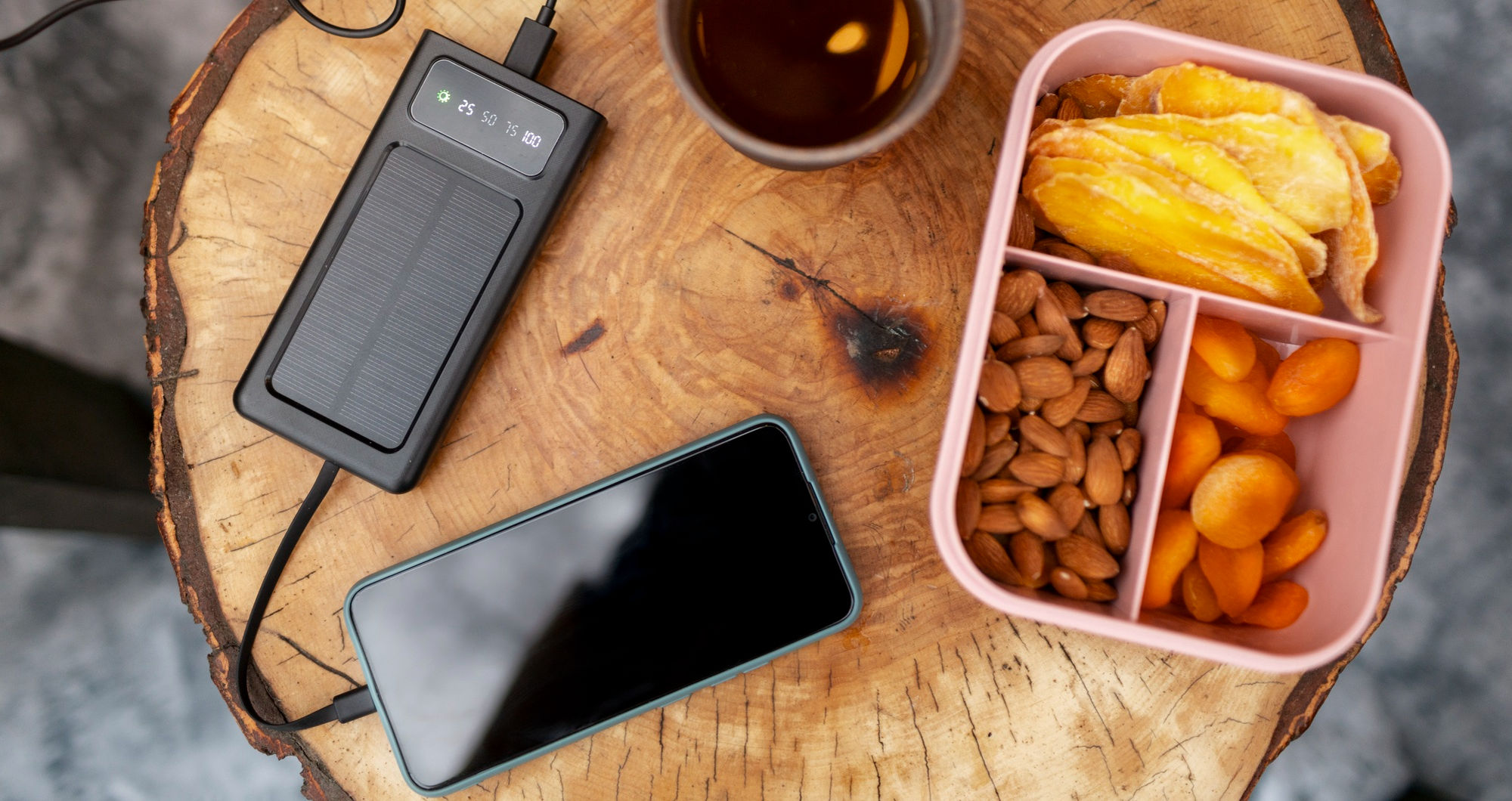
- The Digital Percentage Display: For example, RORRY’s high-end products are equipped with LED or LCD screens, feature an LED or LCD screen. This is the most accurate method as it eliminates the guesswork of counting dots. You simply press the button to read the exact number. When fully charged, the screen will display “100”.
- Colour-Coded LED Status: Compact or older portable chargers often use a single light that changes colour to indicate status. Typically, Red indicates low power, Blue or Amber indicates medium power, and Green or White indicates a full charge. You should check your specific user manual, as these colour codes can vary between manufacturers.
- The Touch or Shake Test: Some modern power banks utilise motion sensors to maintain a sleek, button-less design. To check the level, simply give the power bank a gentle shake or tap the touch-sensitive surface. The indicators will light up momentarily to show the current level.
- The Charging Performance Test: You can estimate the charge by performance. For example, a standard 10,000mAh power bank holds enough energy to charge a modern iPhone roughly two times when full. If you plug your phone in and the power bank dies after charging your phone only halfway, the unit likely arrived with less than 25% charge.
How to Charge a Portable Charger for the First Time (And How Long?)
While you can use the factory charge immediately in an emergency, it is better to charge the device to 100% before your first extensive use. This process helps calibrate the power management chip, ensuring that the LED lights or digital display accurately reflect the true battery capacity in the future.
The charging time depends entirely on the battery capacity and the wattage of your wall adapter. A small 5,000mAh battery will take about 1.5 to 2 hours using a fast charger. A medium 10,000mAh unit takes 3 to 4 hours, while a large 20,000mAh bank can take over 6 hours. Always use a high-speed USB-C wall adapter, as using an old 5W adapter will result in significantly slower charging times.
For detailed instructions on how to charge a power bank and how long it takes, please refer to “How to Charge a Power Bank? (Detailed steps)“.
Do Portable Chargers Come With a Charger and Cable?
This is a frequent point of confusion for first-time buyers.
- The Cable: Yes. Almost all portable chargers include a short USB cable in the box to recharge the power bank itself.
- The Wall Adapter: No. Most manufacturers do not include the AC wall plug to reduce e-waste and packaging size. You are expected to use the same wall adapter you use for your smartphone.
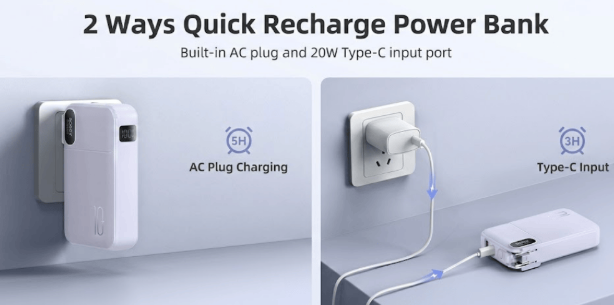
- Integrated Wall Plug Solutions: Some plug-in power banks have built-in foldable AC power plugs. This allows you to plug the entire power bank directly into a wall outlet to recharge it, eliminating the need for an external brick or cable.
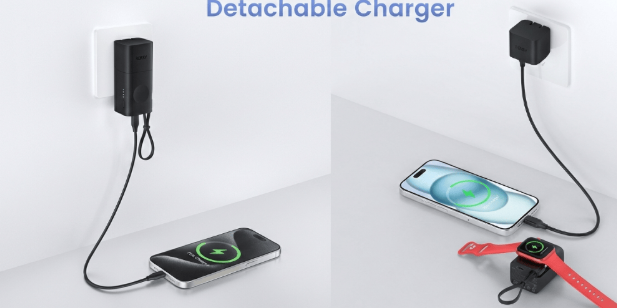
- Built-in Output Cables: Similarly, devices like specific RORRY models feature built-in output cables. This means you do not need to carry extra wires to charge your phone, offering a true “grab and go” experience.
How to Store a Portable Charger When Not in Use
If you plan to put your power bank away for a few months, proper storage is critical to prevent the battery from failing. Follow these three simple steps:
Charge to 50-60%: Avoid storing the battery at 0% or 100%. Storing at 0% risks the voltage dropping too low, damaging the battery cells. Storing at 100% accelerates capacity loss. The best level is roughly half-charged.
Find a Cool Spot: Keep the device in a cool, dry place away from direct sunlight or heat. High temperatures degrade lithium-ion batteries rapidly. Room temperature (around 20°C / 68°F) is ideal.
Perform Regular Maintenance: Lithium-ion batteries naturally lose charge over time. To prevent the battery from draining completely, recharge the power bank every 3 to 6 months.
Conclusion
Most portable chargers arrive with a 30-50% safety charge. While you can use this immediately, it is best to fully charge the device before your first trip. For example, RORRY offers a variety of power banks and charging methods, allowing you to easily manage your power needs in any situation. Just remember to recharge the device every few months if you store it for long periods.
Feature Image by freepik