

The European Commission has presented a new strategy for the Arctic, placing security and resilience alongside climate action, economic security and support for people living in the region. The framework is intended to guide cooperation with northern neighbours as climate change and geopolitical competition reshape the Arctic.
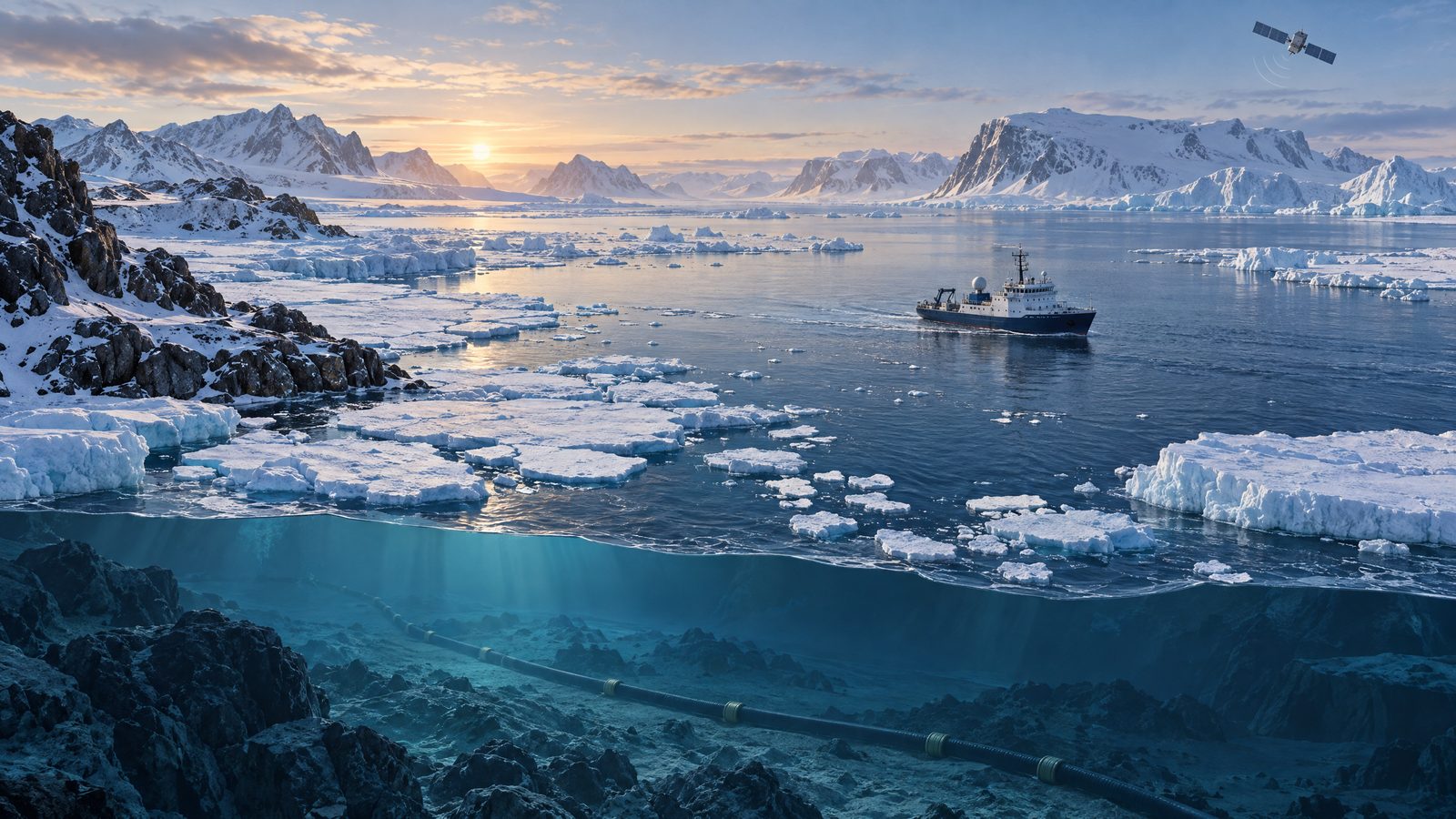
The document identifies four priorities. The first is to strengthen security and preparedness, protect critical infrastructure and improve Europe’s ability to operate in Arctic conditions. This work is to be supported by a maritime security hub. A first step is an Arctic Cable Hub intended to monitor, protect and help repair submarine cables in the North Atlantic and Arctic. The strategy also points to closer observation of maritime activity and the expansion of satellite-based monitoring.
These proposals address infrastructure that is increasingly important to communications and transport. They are policy measures, not evidence that a new cable route has already been built or that all proposed projects have secured funding. The strategy sets out a direction for cooperation and further work rather than reporting completed construction.
A second priority is responding to accelerating climate change. The Commission proposes stronger climate research and support for effective responses. The Arctic is warming nearly four times faster than the global average. The consequences reach beyond environmental change: shifting conditions affect ecosystems, local livelihoods and communities, while also influencing access and activity across the region.
The strategy’s economic-security pillar includes a new EU polar research hub and reinforcement of the European Polar Coordination Office. The intention is to improve coordination and knowledge in a region where changing environmental and strategic conditions are increasingly connected. The approach is intended to promote a stable and forward-looking Arctic through close cooperation with regional partners and communities.
The fourth priority focuses on people. The Commission proposes support for Arctic local governments as they address shared challenges. More than half a million EU citizens live in the Kingdom of Denmark, Finland and Sweden, countries with territory in the Arctic. The strategy therefore treats the region not only as a matter of external security, but also as a home to communities whose daily lives are affected by changes in climate, infrastructure and economic opportunity.
The announcement marks an update to the EU’s Arctic policy, which was last revised in 2021. The new framework reflects a changed setting shaped by climate change, geopolitical tensions, strategic competition, military activity and new shipping routes. The document aims to combine preparedness with research, economic security and cooperation rather than treating these concerns in isolation.
Security features prominently in the practical proposals. A maritime security hub is designed to bring together information from different sources, while the planned cable hub gives undersea infrastructure particular attention. That hub’s planned remit includes monitoring and protection as well as assistance with repairs. Satellite observation is another strand of the wider effort to improve awareness of conditions across a vast and difficult-to-access region.
At the same time, the strategy’s climate and community priorities acknowledge that greater security cannot be separated from the environmental and social changes underway. Research is intended to strengthen understanding of those changes, while support for local governments is meant to help communities respond to common pressures. The economic-security measures add a research and coordination dimension to that agenda.
The European Union describes itself as part of the Arctic, with residents in Denmark, Finland and Sweden. Its proposed framework relies on cooperation with Arctic partners and communities. The announcement does not itself settle the delivery details for each initiative; subsequent work will determine how the proposed hubs, research coordination and local-government support are put into practice.
For now, the central change is the adoption of a broader framework that places four connected priorities at the centre of EU engagement in the Arctic: security, climate, economic security and people. Its implementation will show how those commitments translate into practical cooperation in a region undergoing rapid environmental and strategic change.







