


AI has changed what customers expect. They want fast delivery, accurate stock, and clear updates. So businesses need systems that share data without delays.
That’s where an Odoo–Shopify connector helps. It links Shopify (your online store) with Odoo (your back office). Because the connector reduces manual work, it supports real digital transformation.
This blog explains what the connector does, why it matters in the AI era, and how UK industries benefit.
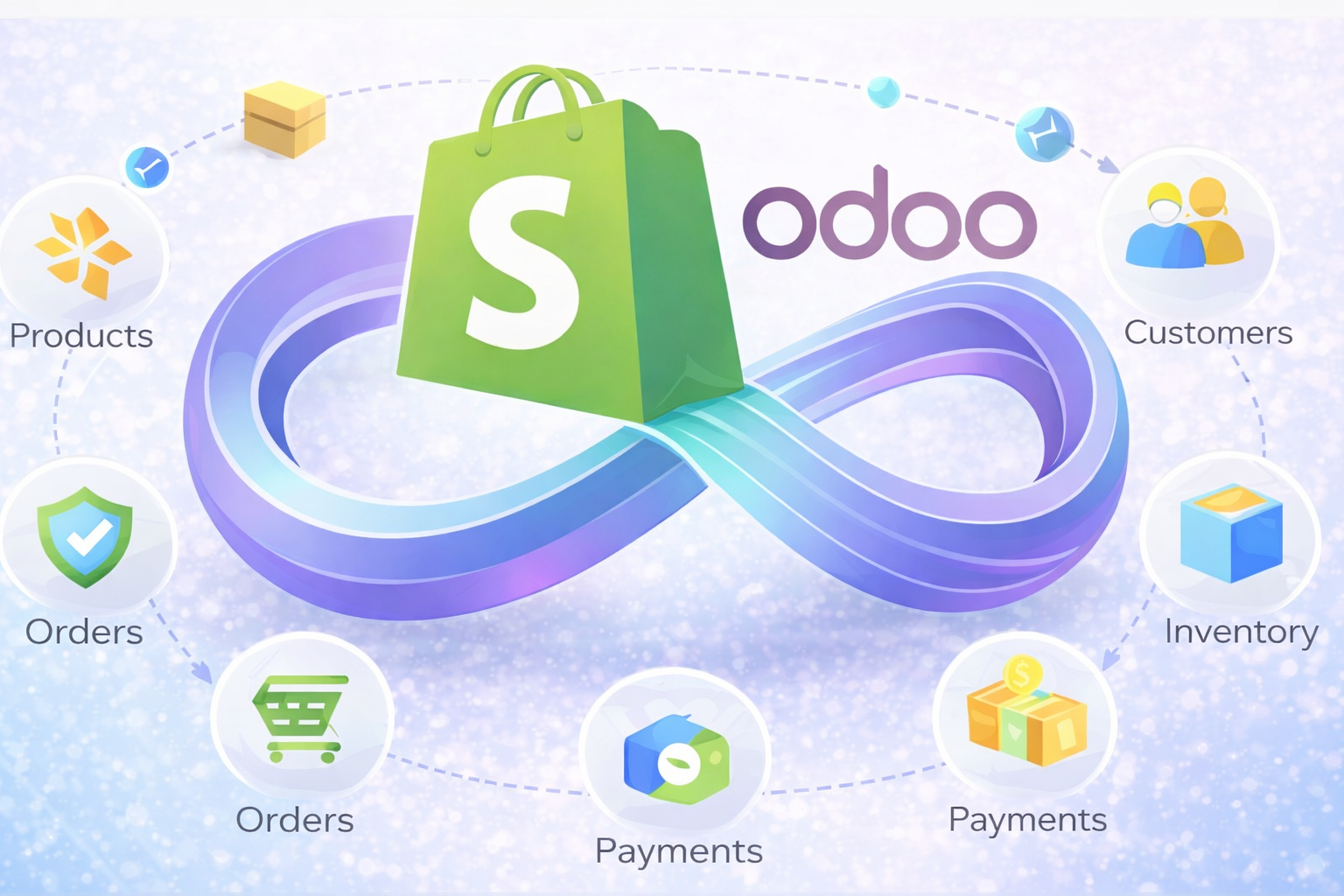
What Odoo and Shopify each do best
Shopify runs your storefront, checkout, and order capture. Odoo manages key operations like inventory, sales, invoicing, and reporting. So a connector turns two separate tools into one flow.
Also, this setup reduces “two versions of truth.” Your store team and ops team stop working from different numbers.
What a connector actually does
A connector moves business data between Shopify and Odoo. In other words, it syncs what you sell, what you stock, and what you ship.
Most connectors cover:
- Products and variants
- Stock and locations
- Orders and payments
- Customers and addresses
- Fulfilment status and tracking
- Refunds and returns
This sounds simple. However, the setup rules decide the outcome.
Why connectors matter more in the AI era
AI needs clean, connected data. So the connector’s real value is not “AI features.” Instead, it builds a reliable data pipeline.
When Shopify and Odoo stay aligned, you get:
- One view of demand (orders, cancellations, refunds)
- One view of supply (stock, warehouses, lead times)
- One view of finance (invoices, credits, reconciliations)
As a result, AI tools can forecast better and flag issues sooner. But AI will not fix broken mapping. It will scale the errors.
Why UK businesses should care even more
The UK has extra pressure points. VAT, shipping tax rules, and audit needs can expose weak integrations fast. So a connector should not just “sync orders.” It should sync them correctly.
Here are common pain points in the UK:
- Mixed VAT rates in one basket
- Discounts that change VAT totals
- Shipping lines that need the right tax logic
- Partial refunds that must stay traceable
Therefore, treat this as an ops and finance project, not a quick plugin install.
A “free connector” usually means
An open-source module you install and maintain: A Free Odoo Shopify connector connects your storefront with your back office, so orders, products, customers, and stock can move between systems without manual work. However, the real value depends on how well it handles day-to-day realities like SKU mapping, variant rules, refunds, discounts, shipping lines, and split fulfilments.
The choices: middleware, dedicated connector, or bespoke build
1) Middleware setup
Middleware can connect systems quickly. Also, it works well for early pilots.
However, costs can rise with volume, and deep ERP logic can be hard.
2) Dedicated connector
A dedicated connector usually supports richer mapping and better sync controls. So it often suits serious operations.
However, it needs tighter version control and careful configuration.
3) Bespoke integration
A custom build gives full control. So it fits high volume and complex rules.
Meanwhile, it also helps if you need strict governance and audit trails.
What to check before you install anything
A connector fails in predictable ways. So use this checklist first:
- Does it handle retries without creating duplicate orders?
- Does it log errors clearly, with a queue you can reprocess?
- Can it map SKUs and variants without duplicates?
- Does it support your warehouse and location setup?
- Can it handle partial fulfilments and split shipments?
- Does it import refunds and returns cleanly?
- Can it manage tax, discounts, and shipping lines correctly?
- Does it store access tokens safely, with proper permissions?
- Is there an upgrade path and active maintenance?
How industries benefit in real terms
Retail and D2C brands
Retail moves fast. So accurate stock sync reduces overselling.
Also, fulfilment updates cut “where is my order” tickets.
Manufacturing and spare parts
Variants and SKUs can explode in count. So, strict SKU rules matter.
Meanwhile, faster order data helps planning teams react sooner.
Wholesale and B2B sellers
Many firms use Shopify for ordering and Odoo for invoicing and stock control. So the connector reduces re-entry work and billing errors.
Omnichannel sellers
If you sell online and offline, stock conflicts hurt margins. So you need one clear stock source with defined rules.
A Staged Approach
Use this approach, which will reduce risk.
- Decide the system of record for products, stock, orders, and customers.
- Set your VAT and pricing rules early. Also, define shipping tax logic.
- Start with a pilot store or a limited catalogue.
- Sync orders first. Then test refunds and cancellations.
- Add inventory sync next. However, start with one warehouse if you can.
- Test edge cases: discounts, mixed baskets, partial refunds, split shipments.
- Monitor logs daily for two weeks. So you catch issues early.
Conclusion
A free Odoo–Shopify connector can drive real digital transformation because it connects work that usually sits in separate tools. So orders, stock updates, customer details, and fulfilment status move between Shopify and Odoo without constant manual entry. That improves speed and accuracy, and it helps teams work from the same data. As a result, reporting becomes clearer, and AI-driven forecasting or alerts can run on cleaner inputs.
Success is also easier when you set a few rules upfront. Define what syncs, map SKUs and taxes correctly, and test real cases like discounts, partial refunds, and split shipments. Then assign someone to watch sync logs and handle updates. With that structure in place, the connector stays stable and delivers value as you scale.







