


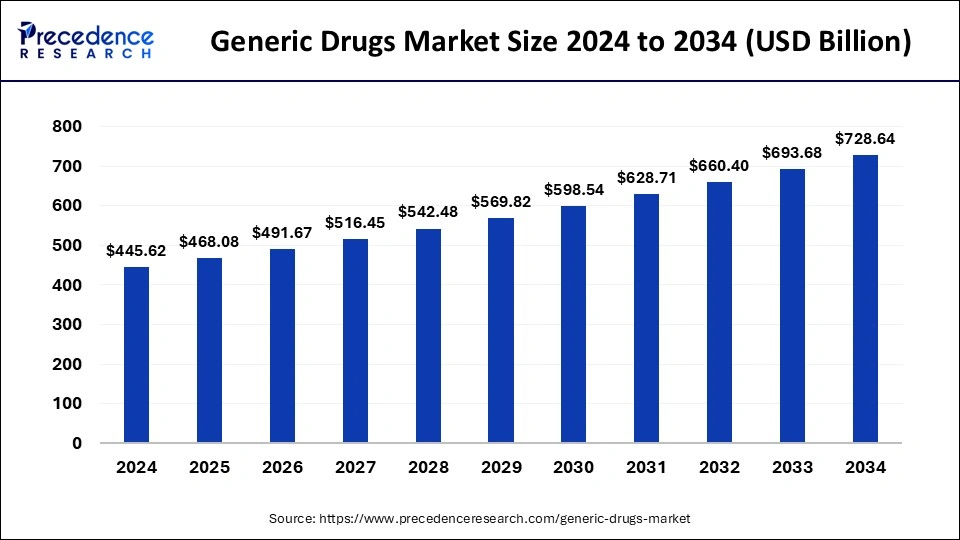
The generic drugs market is experiencing substantial growth, driven by the increasing need for affordable healthcare solutions and the expiration of patents on several blockbuster drugs. According to a Precedence Research report, the global generic drugs market is projected to reach USD 728.64 billion by 2034, up from USD 468.08 billion in 2025, demonstrating a compound annual growth rate (CAGR) of 5.04%.
Generic Drugs Market Key Findings:
- North America dominated the global market by holding more than 39% of the market share in 2024.
- The pure generics segment contributed the highest revenue share in 2024.
- The oral segment accounted for the major revenue share in 2024.
- The simple generic segment captured the highest revenue share in 2024.
- The oncology segment is expected to expand at a significant CAGR during the forecast period.
Affordability remains the cornerstone of the industry’s expansion, particularly as healthcare costs strain global economies. Governments worldwide are actively promoting generics through initiatives such as India’s Pradhan Mantri Bhartiya Janaushadhi Pariyojana, which aims to make low-cost medicines accessible to all. Patent expirations of blockbuster drugs, including biologics and oncology treatments, are further accelerating market opportunities, enabling generic manufacturers to introduce cost-effective alternatives swiftly.
North America currently leads the market, with the U.S. alone expected to account for $146.04 billion by 2025, driven by an aging population and insurance reforms favouring generics. Meanwhile, the Asia-Pacific region is emerging as a powerhouse, with India dominating production and China investing heavily in healthcare infrastructure through its Healthy China 2030 plan. These regions are pivotal in meeting global demand for affordable medicines, particularly in low- and middle-income countries.
Despite its growth, the industry faces challenges such as price erosion due to intense competition and supply chain vulnerabilities exposed by global disruptions. Consumer scepticism about generic efficacy, especially for complex drugs like biosimilars, also poses hurdles. However, advancements in manufacturing technologies, including AI and automation, are enhancing quality control and scalability, positioning the sector for sustainable growth.
Key players like Mylan N.V. (Viatris), Teva Pharmaceutical, and Pfizer are leveraging mergers, R&D, and biosimilar innovations to maintain market dominance. As chronic diseases rise globally, the generic drugs industry is poised to become a linchpin of equitable healthcare, provided it addresses regulatory, logistical, and perceptual challenges effectively.
Role of Government Initiatives in Boosting Generic Medicines Sector
Numerous governments are actively promoting the use of generics through regulatory reforms, price control measures, and subsidised healthcare schemes, significantly enhancing market access and driving volume sales. In response to this growing demand, generic pharmaceuticals contract manufacturing has emerged as a vital strategy for pharmaceutical companies seeking to scale production efficiently while maintaining cost-effectiveness.
For instance, in India, the government’s Pradhan Mantri Bhartiya Janaushadhi Pariyojana (PMBJP) scheme promotes affordable access to generic medicines through a wide network of stores. To meet the supply needs of this initiative, many pharmaceutical companies collaborate with contract manufacturers who are approved by the Central Drugs Standard Control Organization (CDSCO). These manufacturers handle large-scale production of high-demand generics, such as paracetamol, amoxicillin, and atorvastatin, allowing brand owners to fulfil government tenders without investing in additional production capacity.
Major Key Trends in the Generic Drugs Market:
- Patent Expiry of Branded Drugs: The continuous expiration of patents on high-cost branded medications is opening substantial opportunities for generic drug manufacturers, fuelling market penetration and competitive pricing strategies.
- Rising demand for affordable healthcare: With growing healthcare expenditure and limited insurance coverage in many countries, there is an increasing preference for cost-effective treatments, boosting the demand for generic pharmaceuticals.
- Expansion in Emerging market: Countries in Asia, Africa and Latin America are witnessing rapid growth in the generic drug sector due to improved healthcare infrastructure, rising population and growing awareness of low-cost therapeutic alternatives.
- Growth in chronic disease prevalence: The increasing burden of chronic conditions like cardiovascular disorders, diabetes, and oncological diseases is driving long-term demand for generic formulations that ensure treatment continuity at lower costs.
- Biosimilar Expansion: The growing development and approval of biosimilar drugs, which are generic versions of biologics, is becoming a significant trend, especially in oncology and immunotherapy market, contributing to broader market diversification.
- Technological advancements in manufacturing: Innovations in pharmaceutical manufacturing processes, including automation and quality assurance systems, are enhancing the efficiency, safety, and scalability of generic drug production.
- Strategic collaboration and merger: Companies are increasingly engaging in partnerships, acquisitions, and joint ventures to strength their global distribution networks, expand product portfolios, and improve market competitiveness.
Limitations & Challenges in Generic Drugs Market
- Stringent regulatory requirements: Generic drug manufacturers must comply with rigorous regulatory approval processes to demonstrate bioequivalence, quality, and safety, often leading to delays in product launches and increased compliance costs.
- Price Erosion and Intense Competition: With multiple players entering the market for the same generic compound, price wars are common, leading to reduced profit margins and challenges in maintaining financial sustainability.
- Raw Material Dependency: Many generic drug producers rely heavily on active pharmaceutical ingredient (API) imports, particularly from countries like China and India. Any disruption in supply chains or geopolitical tensions can adversely impact production.
- Patent Litigation Risks: While attempting to launch generics post-patent expiry, companies often face patent infringement lawsuits from branded drug makers, which can lead to legal battles, financial penalties, or market entry delays.
- Perception and Trust Issues: In certain markets, consumer and physician scepticism towards the efficacy and safety of generics persists, hindering widespread acceptance and adoption, especially in rural and under-informed regions.
- Manufacturing Quality Concerns: Some generic manufacturers, particularly in low-cost markets, struggle with maintaining consistent production quality, leading to regulatory warnings, recalls, or loss of market authorisation.
Advancing Access: Innovations and Insights in Generic Drugs Market
The generic drug sector is evolving rapidly with the adoption of advanced pharmaceutical technologies aimed at improving the efficiency and consistency of bioequivalent alternatives to branded drugs. Key progress has been made in formulation and manufacturing processes, allowing for the development of complex generics, including drug-device combinations and targeted delivery systems, thereby addressing a border range of therapeutic demands.
- A recent national survey featured in the Journal of general internal medicines sheds light on consumer attitudes towards generics. While most patients view generic medications as safe and more affordable, only around 38% prefer them over brand-name versions. This highlights persistent gap between perceived value and actual preference, suggesting a continued need for education and awareness to boost acceptance. These trends reflect both the progress and the perception challenges facing the generic drug industry, reinforcing the importance of innovation and outreach in expanding access to cos-effective healthcare solutions.
Generic Drugs Market Top Companies and Strategic Insights:
| Company | Key Strengths | Strategic Focus |
| Mylan N.V. (Viatris) | Broad generic portfolio, global reach | Expansion via mergers and specialty drugs |
| Abbott Laboratories | Diverse generics and diagnostics | Innovation in biosimilars and generics |
| ALLERGAN (AbbVie) | Specialty generics, branded generics | Focus on specialty and biosimilars |
| Teva Pharmaceutical Industries | Largest global generic manufacturer | Joint ventures, complex generics, biosimilars |
| Eli Lilly and Company | Biosimilars and innovative generics | Pipeline expansion in biosimilars |
| STADA Arzneimittel AG | European generics leader | OTC and generic medicine expansion |
| GlaxoSmithKline Plc. (GSK) | Biosimilars and specialty generics | Biopharmaceuticals and generics balance |
| Baxter International Inc. | Generic injectables and biosimilars | Hospital-focused generics |
| Pfizer Inc. | Strong branded and generic portfolio (via Sandoz) | Biosimilars and global generics growth |
| Sandoz International GmbH | Leader in generics and biosimilars | Innovation in biosimilars and global expansion |
Recent Breakthroughs in Global Generic Drugs Market
- In February 2025, major U.S. retailers, including H-E-B, Kroger, Albertsons, and Walgreens, filed an antitrust lawsuit against Takeda Pharmaceutical Co. Ltd. and TWi Pharmaceuticals Inc. The suit alleges that these pharmaceutical companies conspired to delay the release of a generic version of Takeda’s heartburn medication, Dexilant, through an unlawful reverse payment agreement.
Set up a meeting at your convenience to get more insights instantly! https://www.precedenceresearch.com/schedule-meeting







