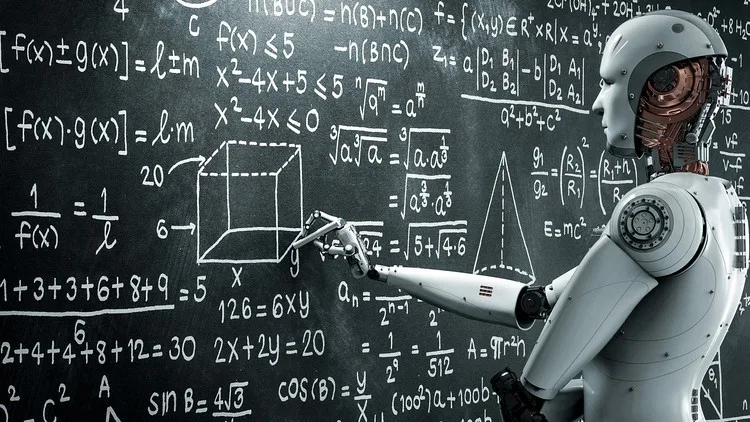

Once upon a time, math was a chalkboard, a teacher in spectacles, a sea of sleepy eyes. But now? Now it’s algorithms are teaching algorithms. A student sitting alone with a tablet can access problem-solving guidance that adapts, predicts, encourages, and—when necessary—pushes. Artificial Intelligence (AI) is no longer a distant concept lurking in science fiction. It’s right here, rewriting the rules of how we learn math.
Pause for a second. Think about it. You’re solving algebra, and the software knows when you’re stuck before you realise it. It nudges you, not with a red “X,” but a gentle hint based on your behaviour. That’s not magic. That’s machine learning—AI in action.
The Personalised Problem-Solver
Personalisation isn’t a luxury anymore. It’s the default.
Traditional classrooms often struggle to cater to both the quick and the cautious learners. Enter AI. Systems like Squirrel AI in China or Carnegie Learning in the U.S. tailor math instruction in real time, adjusting difficulty and approach to fit the student. According to a report by HolonIQ, the global AI education market is projected to reach $25.7 billion by 2030, much of it driven by adaptive math platforms.
How? Let’s say a student repeatedly struggles with factoring quadratic equations. The AI doesn’t just note the error—it analyses patterns, revises the upcoming problems, and may even offer visual aids or gamified exercises to reinforce the concept. The student is no longer behind—they’re just on a custom trail.
If at some point in the learning process the student encounters an insurmountable problem, he can use a math solver. Math Solver for Chrome – AI Math Problem Solver is now available for free. You can also use math solver for Chrome to speed up the solution process, double-check your solution, and expand your knowledge of available methods for solving different problems.
Error? No. Data Point.
In the past, making a mistake meant one thing: wrong. Try again.
With AI, errors are data points. Rich, juicy, meaningful data points. Every incorrect answer tells the system something—your hesitation with fractions, your overconfidence in geometry, your aversion to word problems. AI thrives on this. It dissects each misstep not to punish, but to understand.
For example, consider an AI-powered tutoring system using Bayesian Knowledge Tracing (BKT) or Deep Knowledge Tracing (DKT). These systems track the probability that a student has learned a specific concept based on their previous answers. If confidence dips below a certain threshold, it adapts accordingly—reviewing or rephrasing without repeating.
No shame, no “Try harder,” just a shift in direction.
Visual Thinking Meets Symbolic Logic
Math is more than numbers. It’s structure, pattern, symmetry, movement.
AI leverages this through advanced visual tools. For students who are visual learners, symbolic algebra can be translated into graphs, animations, and even interactive puzzles. GeoGebra, powered increasingly by AI features, allows students to manipulate equations and see immediate graphical changes—a dynamic instead of static experience.
And for those intimidated by notation-heavy math, natural language processing (NLP) tools now explain complex formulas in plain English. AI bridges the gap between what math looks like and what it means.
One click, and a student sees not just the “how” but the “why.”
Feedback: Immediate, Non-Judgmental, Precise
AI doesn’t need sleep. Or lunch breaks.
It offers instant feedback, 24/7, across devices. And not just yes/no. We’re talking step-by-step diagnostics. According to research from McKinsey, AI-supported tutoring systems can reduce a student’s learning time by 20–60% compared to traditional methods.
Why does that matter? Because waiting two days to learn you misunderstood an equation is too late. Instant correction enables immediate conceptual recovery.
The Teacher’s New Toolkit
Let’s be clear: AI isn’t here to replace teachers.
It’s a co-teacher. An assistant with infinite patience and a memory for everything.
Educators can use AI dashboards to see which students are struggling, what concepts need reinforcement, and where time is being lost. They can assign AI-driven practice tasks tailored to class performance while spending human time where it matters most—guidance, creativity, motivation.
For educators and students interested in exploring how these technologies work, enrolling in a comprehensive course in machine learning can provide the skills needed to create, understand, and apply AI models for education.
Some schools in Singapore and Finland have already integrated AI tools in math education with observable improvements in engagement and performance metrics.
In short: Teachers teach better when AI handles the grunt work.
Accessibility and Equity (Or at Least the Hope of It)
Education inequality is an age-old issue. AI might be one of the few technologies capable of narrowing the gap.
With mobile access and low-cost AI tools, a child in a rural village can receive the same quality math instruction as one in a top-tier urban school. OpenAI’s models, and similar systems, are already powering tools used in developing countries for math education.
This isn’t just disruption. It’s redistribution.
Of course, there are caveats—device access, digital literacy, language availability. But the direction is promising.
The Ethical Equation
Let’s not get too dreamy. There are risks.
Who owns the learning data? What if the AI is biased in what it teaches or how it assesses? Could students become over-reliant on digital scaffolding and underdevelop critical problem-solving grit?
These are the questions educators, policymakers, and developers are actively grappling with. Learning math with AI is powerful—but it’s a tool, not a god.
As AI becomes more integrated into curricula, these conversations must evolve as quickly as the technology itself.
Conclusion: A New Numeracy
The way we learn math is being rewritten—not erased, but remixed.
Instead of static textbooks and fixed timelines, we now have systems that learn us as we learn them. AI-driven math education is personal, responsive, and—perhaps most importantly—engaging in a way few imagined twenty years ago.
It’s not about calculators getting smarter. It’s about us getting smarter—faster, deeper, and maybe even with a little joy.
Call it the age of algorithmic education, or just call it the future. One thing’s certain: the way we learn math will never be the same.
And maybe that’s the most elegant equation of all.