
Moving a person between a home, ambulance, hospital, clinic, or care facility is never purely a logistics task. Pain, weakness, confusion, restricted movement, stairs, narrow doors, uneven paths, limited space, and time pressure can increase the risk of falls, staff injury, and loss of dignity.
Patient transport equipment can help control some of those risks, but it cannot make an unsuitable transfer safe by itself. A safe system also depends on clinical assessment, route planning, trained staff, communication, compatible vehicles and buildings, inspection, cleaning, and a clear contingency plan. Equipment should therefore be treated as one part of a broader safe patient handling programme.
Why the Issue Extends Beyond Emergency Ambulances
Patient movement now occurs across emergency response, hospital discharge, rehabilitation, scheduled appointments, long-term care, and recovery at home. For a person with limited mobility, the practical ability to enter, leave, and move through their environment is part of whether the care plan can work safely.
Begin With the Person and the Route
Before choosing a device, staff should consider the person’s condition, weight, body dimensions, ability to sit upright, pain, cognition, cooperation, infection status, and need for monitoring or clinical intervention. They should then examine the route: stair geometry, landings, corners, thresholds, lifts, floor surfaces, gradients, weather exposure, vehicle access, and space for operators.
This route assessment helps determine whether the movement can proceed, which device is suitable, how many trained operators are needed, and what alternative is available if conditions change. Manufacturer limits and organisational policy must be followed. A rated load is not permission to use a device in every environment or with every patient.
Stair Chairs: Useful, but Highly Route-Dependent
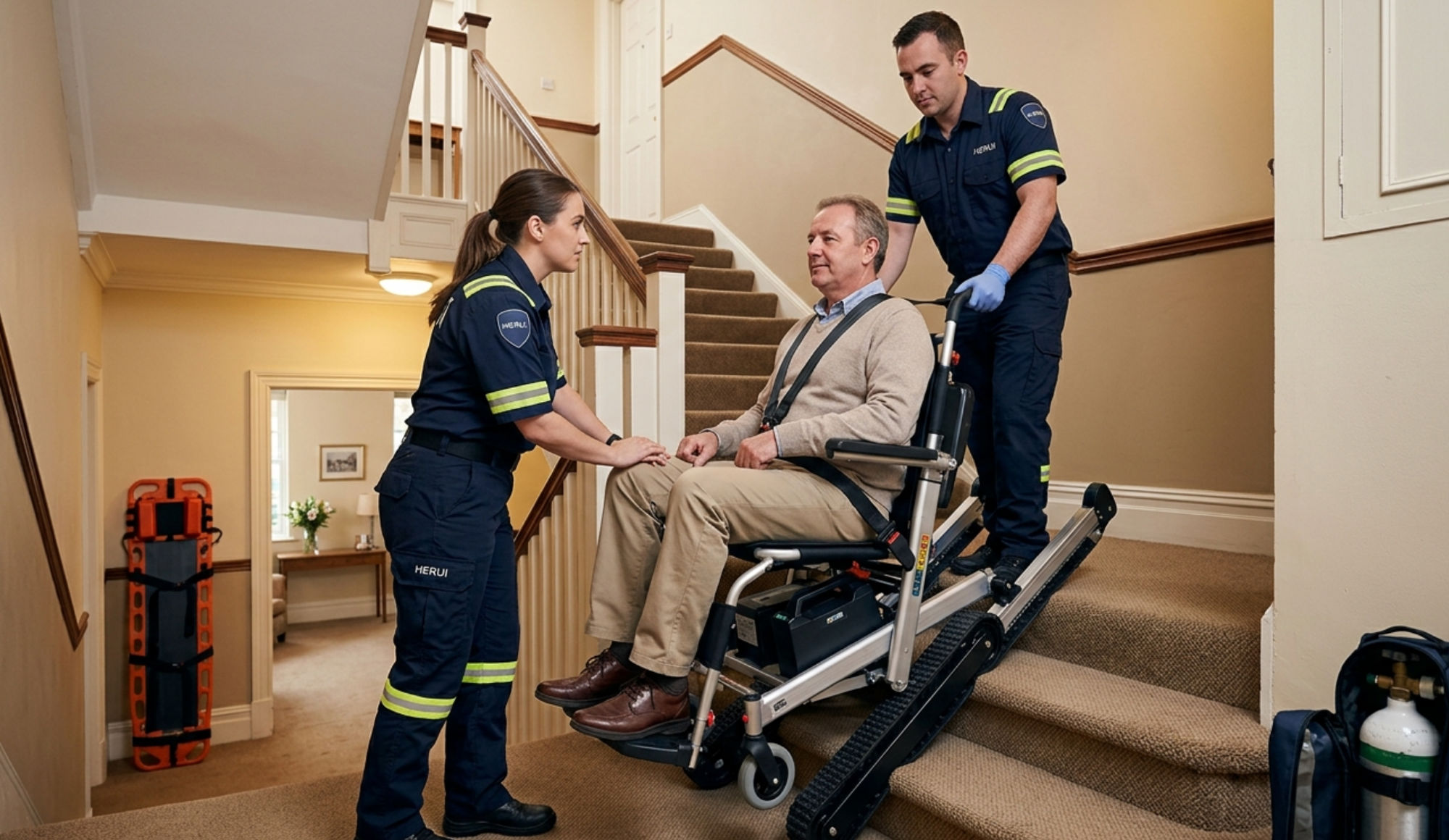
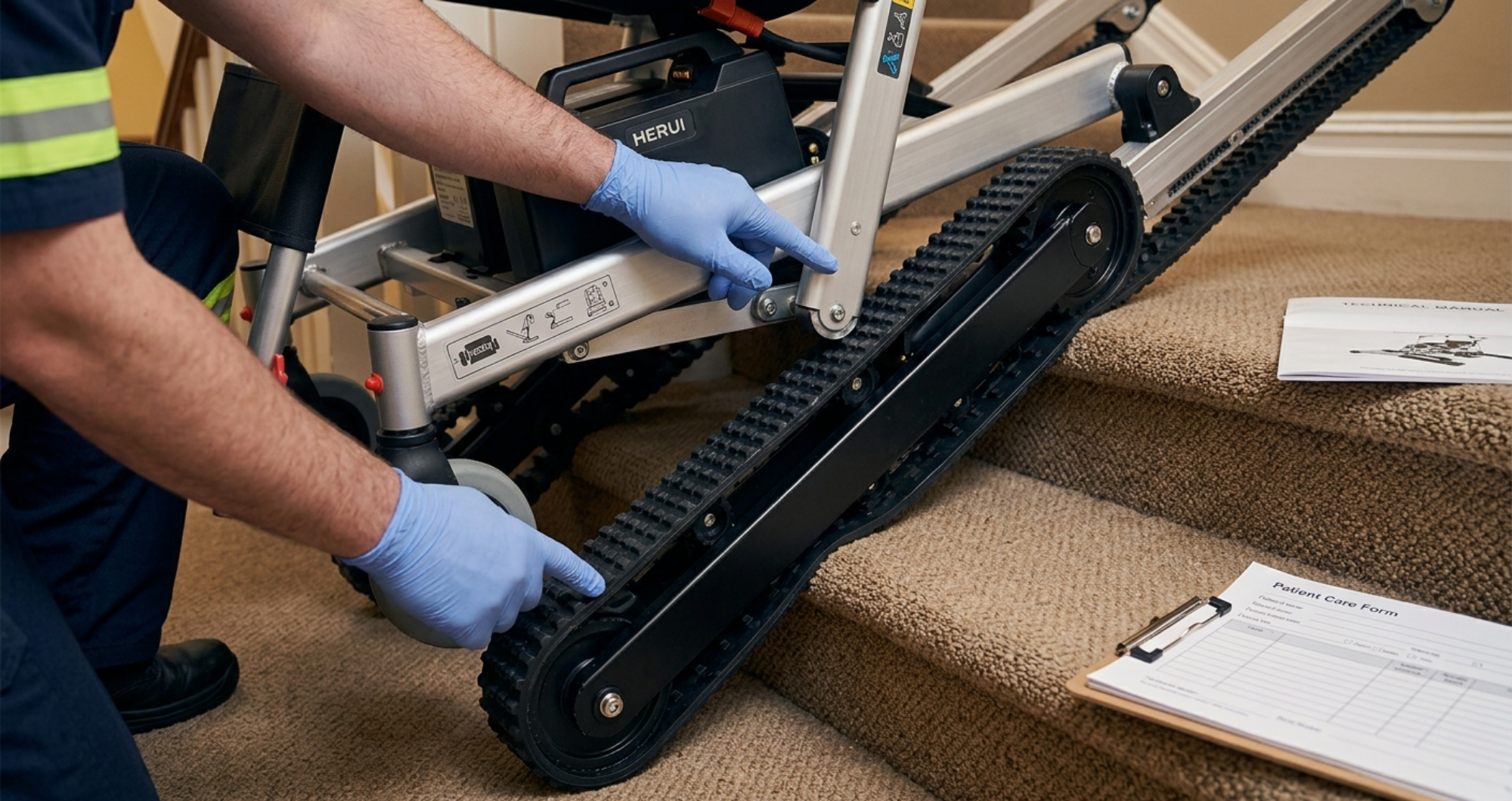
Stair chairs are designed to move a seated person through stairways where a conventional wheeled stretcher cannot travel. Manual models depend more heavily on operator control and lifting. A powered stair chair may use tracks or another assisted mechanism to manage ascent or descent. Examples of powered stair-chair configurations show differences in frame design, tracks, controls, batteries, handles, restraints, wheels, and folded dimensions; these features need evaluation against the intended staircase and operating procedure.
A stair chair is not appropriate for every person or staircase. Services should check whether the patient can tolerate the required seated position, whether the stairs are within the device’s limits, and whether operators have space to maintain safe posture and control. Narrow winders, irregular treads, weak surfaces, clutter, poor lighting, or inadequate landings may rule out a planned method.
What to Check Before Using a Stair Chair
- Patient assessment, consent or best-interest process, restraints, posture, and comfort.
- Stair width, angle, tread depth, surface condition, landings, turns, and obstructions.
- Rated load, device weight, braking or track behaviour, handles, wheels, and manual backup procedure.
- Number and competence of operators required by policy and the specific route assessment.
- Battery status where applicable, pre-use inspection, communication commands, and emergency stopping plan.
- Safe storage, cleaning, charging, fault reporting, and removal from service when defects are found.
Claims about single-operator use require particular caution. The appropriate staffing level depends on the person, route, device, task, and local policy. Training should include supervised practical use on representative stairs, not only reading instructions or watching a demonstration.
Ambulance Stretchers and the Handover Chain
An ambulance stretcher supports movement to and from a vehicle and may include height adjustment, a backrest, side rails, restraints, wheel locks, a folding undercarriage, and a mattress. Powered functions may reduce some manual effort, while manual systems may be simpler to maintain. Neither approach is universally safer; suitability depends on the vehicle, loading height, fastener, patient group, staffing, and maintenance capacity.
Different ambulance stretcher configurations illustrate why the stretcher and vehicle must be considered as one system. Dimensions, undercarriage operation, wheel position, loading interface, restraint layout, capacity, and fastening compatibility should be verified rather than assumed from a generic product name.
Selection Framework for Common Transfer Situations
The table below is an initial planning aid. Clinical judgement, local policy, manufacturer instructions, and a route-specific risk assessment should determine the final method.
Transfer situation
Equipment to consider
Potential benefit
Essential checks
Stairs and tight landings
Manual or powered stair chair
Controlled seated movement where appropriate
Patient position, stair geometry, load, restraints, staffing and training
Ambulance loading
Manual or powered transport stretcher
Stable transfer and vehicle loading
Vehicle fastener, loading height, capacity, brakes and backup operation
Confined-space removal
Folding, scoop, basket or chair-type device
Access where a wheeled cot may not fit
Clinical need, immobilisation, carry team, straps and route hazards
Routine facility movement
Suitable transport chair or stretcher
Repeatable movement between departments
Route, flooring, patient needs, cleaning, storage and inspection
Compatibility Matters at Every Handover
Non-emergency and urgent-care transport can involve moving people between homes, appointments, hospitals, and care facilities. These journeys may be less time-critical than emergency response, but they still require a reliable handover chain and an appropriate level of clinical oversight.
Human Factors and Training
Many incidents arise not from a single broken component but from a combination of workload, distraction, unfamiliarity, poor communication, awkward space, and assumptions about what another person will do. Standard commands, role allocation, pre-movement briefings, and a deliberate pause before critical steps can reduce avoidable confusion.
Training should cover assessment, contraindications, pre-use checks, restraints, braking, loading, stairs, cleaning, charging, and fault reporting. Competence should be observed in practice and refreshed when equipment or procedures change.
Cleaning, Inspection, and Maintenance
Transport devices move between uncontrolled environments and clinical spaces, so cleaning and infection prevention require attention. Procedures should cover mattresses, cushions, belts, handles, controls, tracks, wheels, joints, and other areas where contamination may remain. The cleaning product must be compatible with the device materials, and equipment must be dry and ready before reuse.
Inspection schedules should cover safety-critical parts and vehicle interfaces. Records should identify faults, repairs, replaced parts, and return-to-service approval. Suspect equipment should be quarantined until assessed.
Governance Questions for Healthcare Providers
- Who owns the equipment, maintenance record, training programme, and replacement decision?
- Which patient and route conditions are outside the device’s approved use?
- What pre-use checks are mandatory, and how are faults reported and escalated?
- Is there an alternative transfer plan when the patient, route, weather, lift, vehicle, or device changes?
Frequently Asked Questions
Is a powered stair chair suitable for every staircase?
No. Stair angle, width, tread, surface, landings, turns, obstructions, patient needs, operator space, and manufacturer limits must all be checked. Some routes require a different plan.
Does powered equipment remove manual-handling risk?
No. It may reduce particular lifting or loading forces, but staff still position, steer, restrain, monitor, clean, store, and sometimes manually recover the device. New risks involving batteries, controls, weight, or unfamiliar operation also need management.
How should services compare transport equipment?
Compare equipment against the same person-and-route scenarios. Review compatibility, usability, training, cleaning, inspection, maintenance, documentation, and contingency arrangements—not only price, capacity, or the number of powered functions.
Conclusion
Modern patient transport equipment can support safer emergency, clinical, non-emergency, and home-based care, but safety does not come from the device alone. It comes from matching the person, route, equipment, operators, vehicle, building, and procedure; then maintaining that system through training, inspection, cleaning, communication, and review.
The most useful question is therefore not “Which product has the most features?” but “Can this complete transfer be carried out safely, consistently, and with dignity under the conditions in which it will actually occur?”