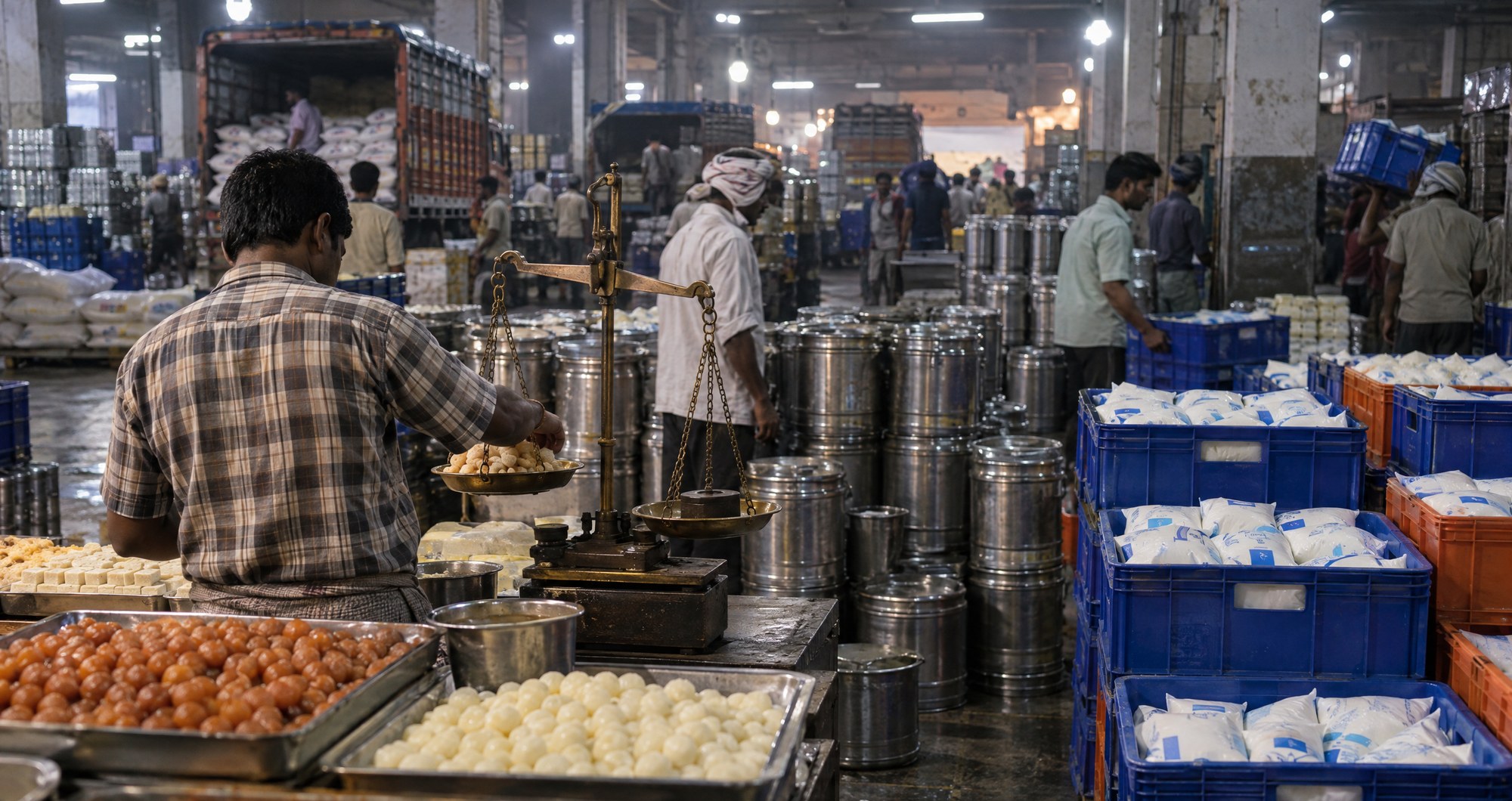

India’s food safety regulator has seized nearly 3,280 tonnes of banned or non-compliant food and suspended more than 1,100 licences during a nationwide enforcement drive around the festival season. The Food Safety and Standards Authority of India said the goods were worth about 81.8 crore rupees, with dairy products, sweets, oils and festive hampers among the items seized.
The operation ran from 1 September to 5 November 2026 across states and union territories. Announcing the results on Saturday 7 November, the regulator said it had inspected 56,431 food establishments alongside state food safety authorities. The inspections resulted in improvement notices, sealed premises, licence suspensions and cancellations, as well as prosecutions.
The drive followed a directive to states to strengthen surveillance before Diwali, when demand for dairy products and sweets peaks and adulteration typically rises. Its findings put figures against a persistent consumer concern: whether food bought during one of the busiest trading periods meets the required standards.
Seizures and licence action across the supply chain
The regulator reported a precise seizure total of 3,279.57 tonnes, valued at about 81.80 crore rupees. The products covered a broad range of everyday foods and seasonal purchases, including milk, paneer, ghee, sweets, bakery items, chocolate, ice cream and savoury snacks, alongside oils and festive hampers.
Those categories show that the enforcement effort was not confined to sweets or dairy, although both were central to the pre-Diwali surveillance directive. Packaged treats, bakery goods and other products also featured in the seizure totals released by the authority.
Officials issued 10,047 improvement notices and sealed 314 premises. They suspended 1,133 licences and cancelled a further 52. The authority also said 410 prosecutions had been initiated. These are separate measures, and the published totals should not be added together as a count of distinct businesses facing action.
The figures describe enforcement steps taken during the operation, rather than the final outcome of every case. In particular, the initiation of a prosecution does not establish guilt. The information supplied does not include court decisions or a breakdown showing how the different measures overlapped at individual establishments.
Testing figures leave part of the picture unresolved
Food safety authorities collected 43,939 samples during the drive. Of those, 23,648 had been analysed, and 2,273 were found not to meet standards. That amounts to about 9.6 per cent of the samples analysed, not 9.6 per cent of all food sold or all establishments inspected.
The distinction matters because the inspection, sampling and seizure totals measure different parts of the operation. An establishment inspection is not the same as a laboratory test, while the weight of seized goods does not show how many individual products or businesses failed checks.
The reported figures leave 20,291 collected samples outside the analysed total. Their results are not included in the findings announced on 7 November. The eventual testing picture therefore remains incomplete, and the current failure rate cannot be treated as a final rate for all samples collected during the drive.
Nor does the description of seized food as banned or non-compliant establish that every item posed the same risk. The authority’s aggregate figures do not specify the reason for each seizure or identify how much of the total fell into each product category.
Festival demand sharpens a longstanding concern
Food adulteration remains a chronic consumer grievance in India. Labelling, testing capacity and enforcement of cold-chain requirements are uneven, making the festival operation part of a wider challenge rather than a complete account of food safety conditions across the country.
The timing was significant. Dairy products and sweets experience peak demand before Diwali, and the regulator’s directive sought stronger surveillance during that period. Publishing the scale of inspections and seizures provides a visible record of action, although those totals alone cannot demonstrate that consumer confidence has improved.
The authority has adopted an increasingly public enforcement posture this year. Earlier action included measures against e-commerce platforms and a ban on a Nestlé dairy whitener after a sample taken at a Delhi hotel was ruled unsafe. That earlier finding was separate from the festival drive’s aggregate results.
The outstanding issues now concern the samples not included in the analysed total and the outcomes of the 410 prosecutions initiated. No timetable for those results or proceedings is included in the information supplied. For now, the announcement establishes the scale of the regulator’s intervention, while leaving the final testing and legal outcomes unresolved.