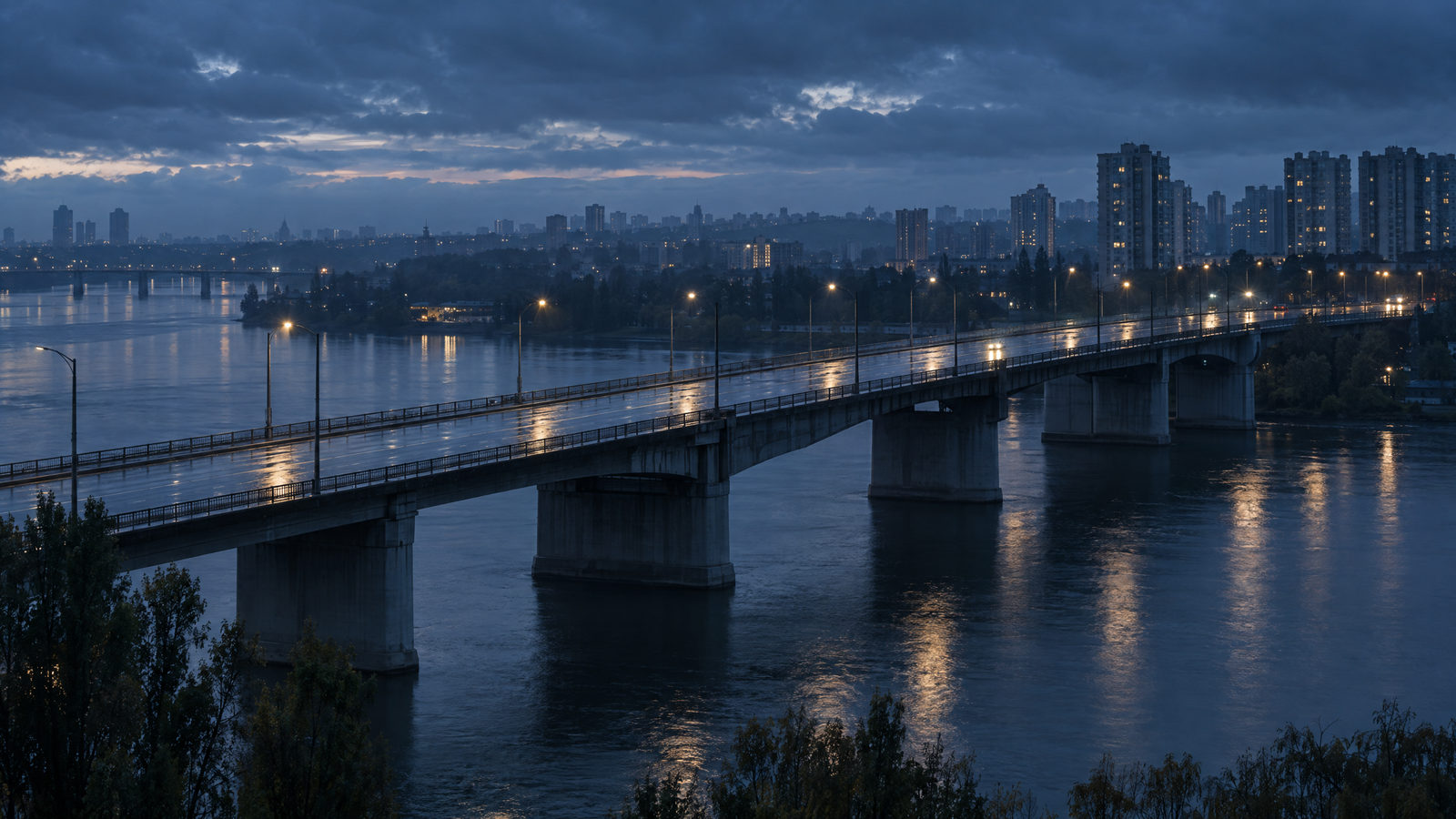

A Russian strike on Kyiv’s Northern Bridge over the Dnipro on 3 October stopped traffic from the city’s left bank towards the centre, adding a new disruption to crossings already affected by attacks in the previous two days. Kyiv Mayor Vitali Klitschko said the road surface and the overhead wires used by trolleybuses were damaged. His account describes the damage and closure; the precise military purpose of the strike has not been independently established.
The Northern Bridge is one of the links between the two sides of a capital divided by the river. The practical consequence was immediate: drivers, buses and emergency services had fewer routes available while air-raid warnings continued. The attack followed repeated strikes on the Southern Bridge, which had already caused closures and long queues, as well as restrictions affecting other crossings. It therefore represented more than another isolated hit on infrastructure; it placed further pressure on movement across Kyiv during an active air campaign.
Russian statement and Ukrainian account
Russia’s foreign ministry said on Saturday that its armed forces would continue what it called large-scale retaliatory strikes on military targets in Kyiv and other Ukrainian cities. It again told foreign nationals and diplomatic staff not to remain in or travel to Ukraine. The ministry said the strikes were a response to what it described as Ukrainian attacks on Russia’s civilian population and infrastructure.
Russia’s defence ministry said the Northern Bridge was used to support troop movements and deliveries of military cargo. That is a Russian military assertion, not an independently verified finding. The bridge also serves ordinary city traffic, and Kyiv’s mayor described damage to its surface and trolleybus equipment. Neither the Russian statement nor the Ukrainian account settles the legal or factual questions around the target.
President Volodymyr Zelenskyy, speaking in an interview published the same day, said Ukraine would step up attacks on Russian oil refineries in response to the shift he says Russia has made in its aerial campaign. He said refinery targets help finance Russia’s war effort and that Ukraine would respond to attacks on its energy system. He also said Ukraine would not indiscriminately strike civilian infrastructure.
Zelenskyy said Ukrainian intelligence had obtained documents that, in his view, showed a broader Russian policy of attacks intended to pressure people to leave Kyiv and other cities before winter. Russia has not accepted that characterisation. Moscow says it is striking military targets and frames its actions as retaliation. Both governments deny deliberately targeting civilians, and neither side’s account should be treated as an independent verification of the other’s conduct or intent.
Why the development matters
The new strike adds a transport dimension to the persistent risk already posed by drones and missiles. Damage to a crossing can delay commutes, slow the movement of services and concentrate traffic on remaining routes even if the structure is not permanently closed. Repairing a road surface or restoring trolleybus wires may be technically straightforward in some circumstances, but can be difficult while alerts, fresh strikes and safety checks interrupt access.
It also links two connected but distinct strands of the war. Russia’s public warning and the attack on a major crossing signal an effort to maintain pressure on Kyiv. Ukraine’s stated refinery policy signals its intention to continue hitting assets it regards as supporting Russia’s war economy. These are declarations and reported actions in an escalating conflict, not evidence of a settlement or a new agreed limit on attacks.
For residents, the immediate issue is whether safe, reliable movement can be maintained as winter approaches. For diplomats and aid organisations, Russia’s warning does not alter the need to assess security conditions independently. For the wider conflict, the episode underscores how infrastructure that enables daily civilian life can become central to competing military narratives, while the human and operational consequences unfold on the ground.