


Predatory dating scammers may have cost the UK public more than £400m in financial loss across just five years, according to Action Fraud reports.
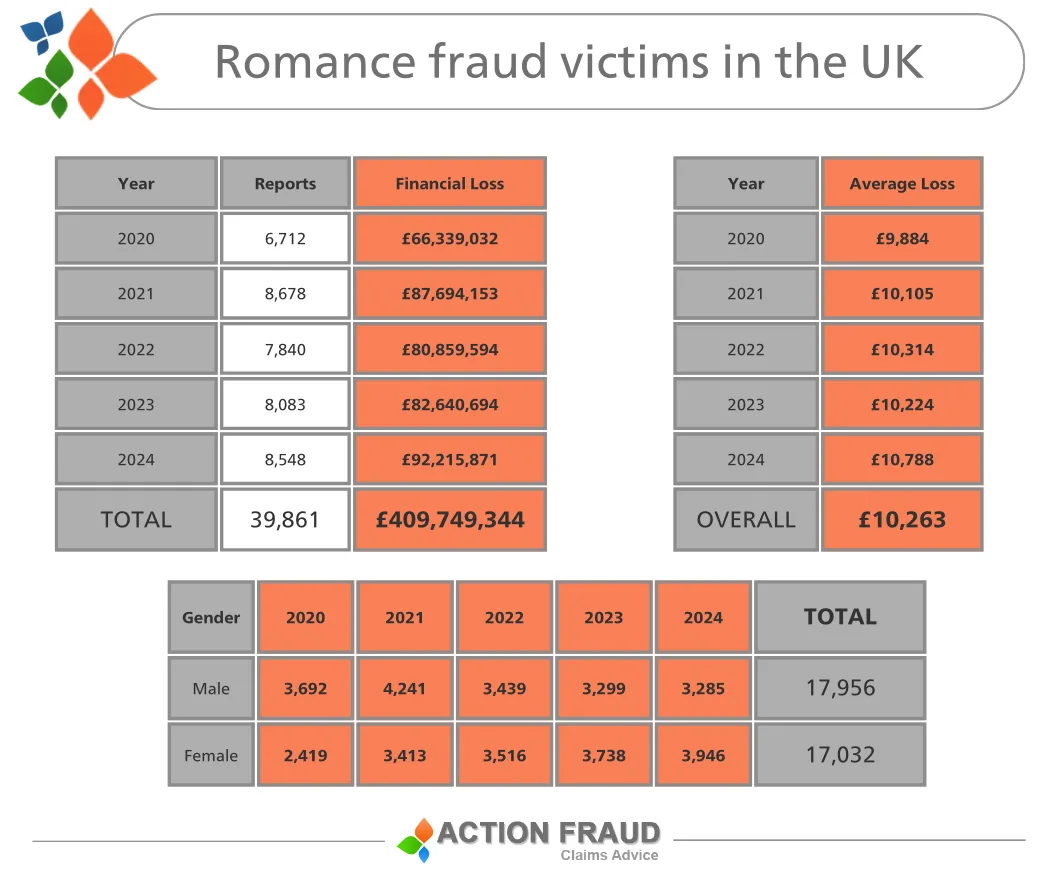
Data gathered by Action Fraud Claims Advice – not to be confused with the national reporting centre – indicates that nearly 40,000 crime reports were submitted between January 2020 and December 2024.
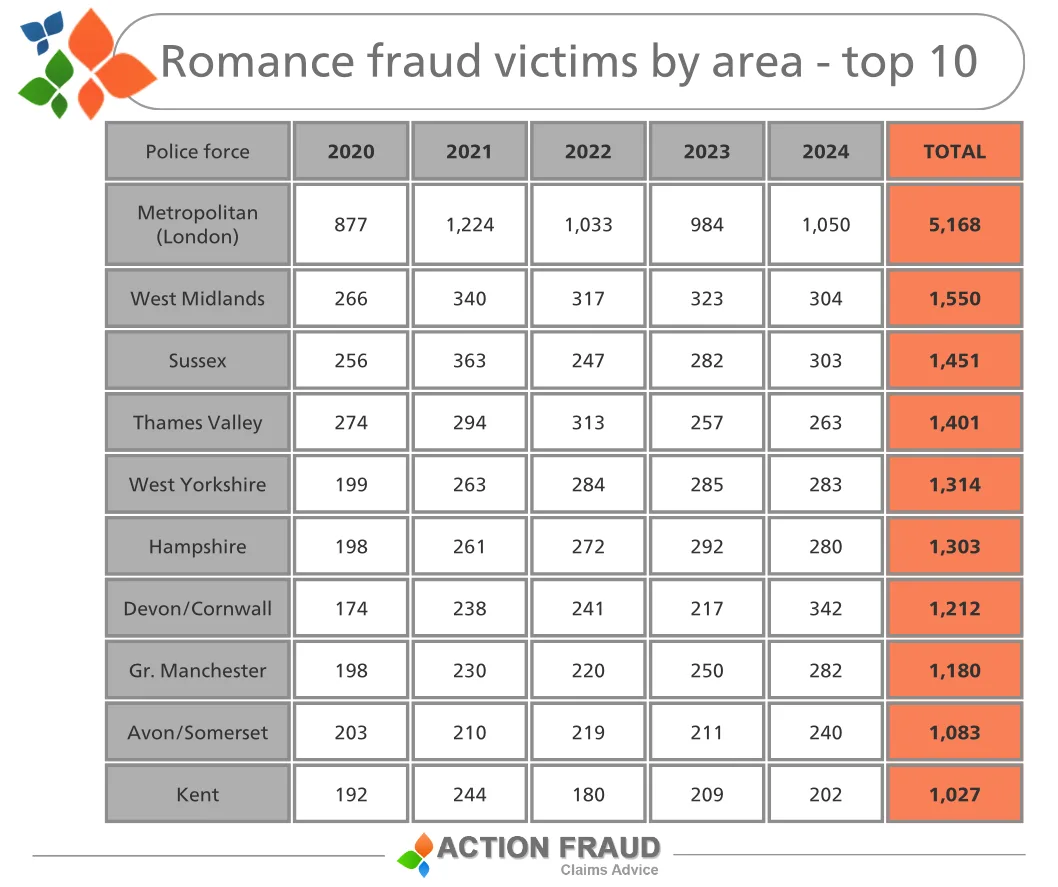
The data suggests that Londoners were by far the most commonly affected group, with more than 5,000 reports sent to Action Fraud.
Over 1,000 cases last year
Action Fraud’s data breaks down reports by geographical area according to police force, meaning that reports from Greater London–the area under the Met Police’s remit–are considered to be from the ‘Metropolitan’ area.
The figures show that Greater London residents were reporting dating scams at a much higher rate than anywhere else in the UK. In total, 5,168 reports were made to Action Fraud from the Metropolitan region, at a rate of around 2.8 per day.
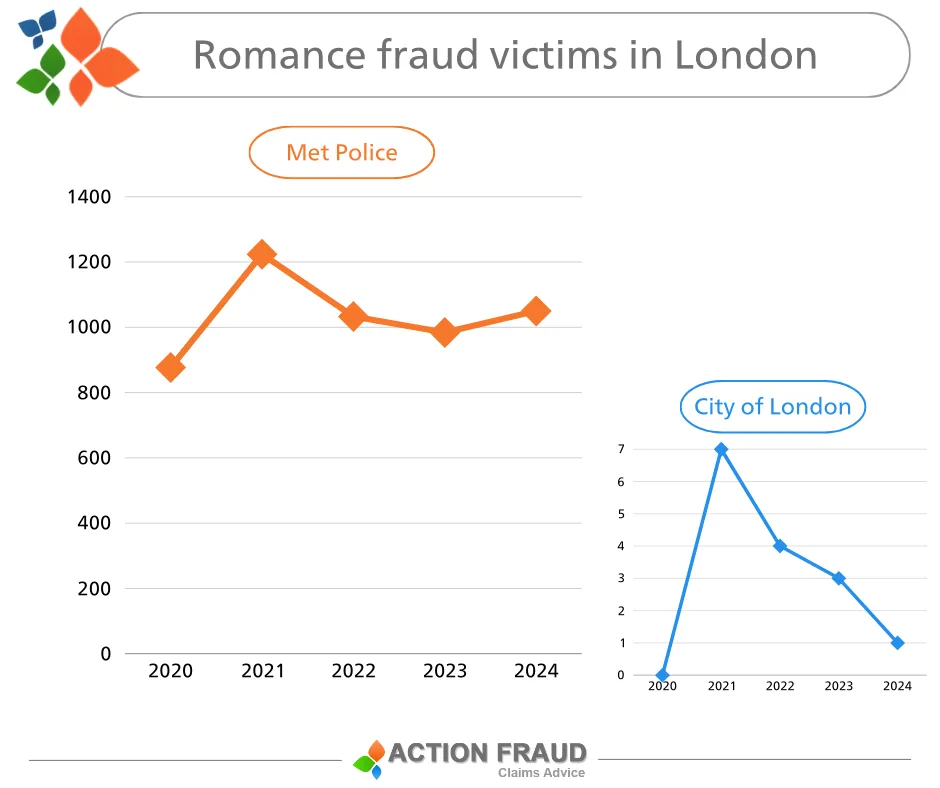
It is the only region where more than 1,000 reports of romance fraud were made in one calendar year–and it happened three times.
A dating scam was flagged on 877 occasions in 2020. The following year, in which online relationships became much more commonplace because of lockdown restrictions, saw a worrying 40% increase in cases. 1,224 reports came from Greater London in 2021, the most prolific individual year from any region at any time in the past half-decade.
There was a slight drop to 1,033 cases in 2022, and then again to 984 the year after. However, a total of 1,050 cases for 2024 means that reports are once again trending in a concerning direction.
Elsewhere in the nation
Second on the list is the West Midlands, with a much smaller–yet still significant–1,550 cases. Sussex (1,451), Thames Valley (1,451) and West Yorkshire (1,314) were all significantly affected.
Once again, the geographical breakdown proves that there were no exemptions when it came to dating scams. 14 Guernsey residents fell victim to romance fraud, while there were 16 reports from the Isle of Man and 22 from Jersey.
Dating fraud has increasingly become a cause for concern in Devon and Cornwall, with reports in the region rising by 97% over five years.
Other significant jumps in reports came in Cleveland (up 86%) and Nottinghamshire (up 67.5%).
39 of 48 police forces saw the number of reports rise by at least 10% over the five-year period.
Reports in Northern Ireland and Scotland went up by a third between 2020 and 2024.
Meanwhile, there were only 15 cases in the City of London, with the small sui generis borough having just one report from their area in 2024.
And while Thames Valley Police’s area of remit had the fourth-highest number of reports, it was one of only a few boroughs that saw fewer cases in 2024 than in 2020.
Scam victims losing over £10,000 on average
Based on national reports, the financial damage caused by romance fraud is estimated to be a massive £409,749,344 – though the true cost could be much higher.
The UK figures mirror London’s, in that 2021 was when report numbers were at their highest. There were 8,678 cases overall, with people reporting a loss of £87,694,153–that works out at £10,105 per person.
While the caseload has not returned to that peak, the 8,548 cases sent to Action Fraud in 2024 is an increase of 465 on the year before, and 708 on the 7,840 reports from 2022.
In total, victims of dating fraud are losing nearly 40% more money than they were five years ago. The estimated loss, which is based on self-reporting, was £66,339,032 in 2020, at an average of £9,884 per report.
Last year, the final figure was £92,215,871, or £10,788 per report.
While Valentine’s Day may appear an ideal time for a scammer to prey upon lovelorn members of the public, the data suggests that romance fraud is a year-round threat.
Reports between 14th February and 14th March only exceeded the monthly average once–that was in 2021, when complaints of crime came in at a rate of nearly 27 per day.
Shocking figures show dating scams spare nobody
What is most telling about the data is that no group can be considered safe from romance scams.
Where the victim’s gender was recorded, 17,956 (51%) identified themselves as female, and 17,032 (49%) identified as male.
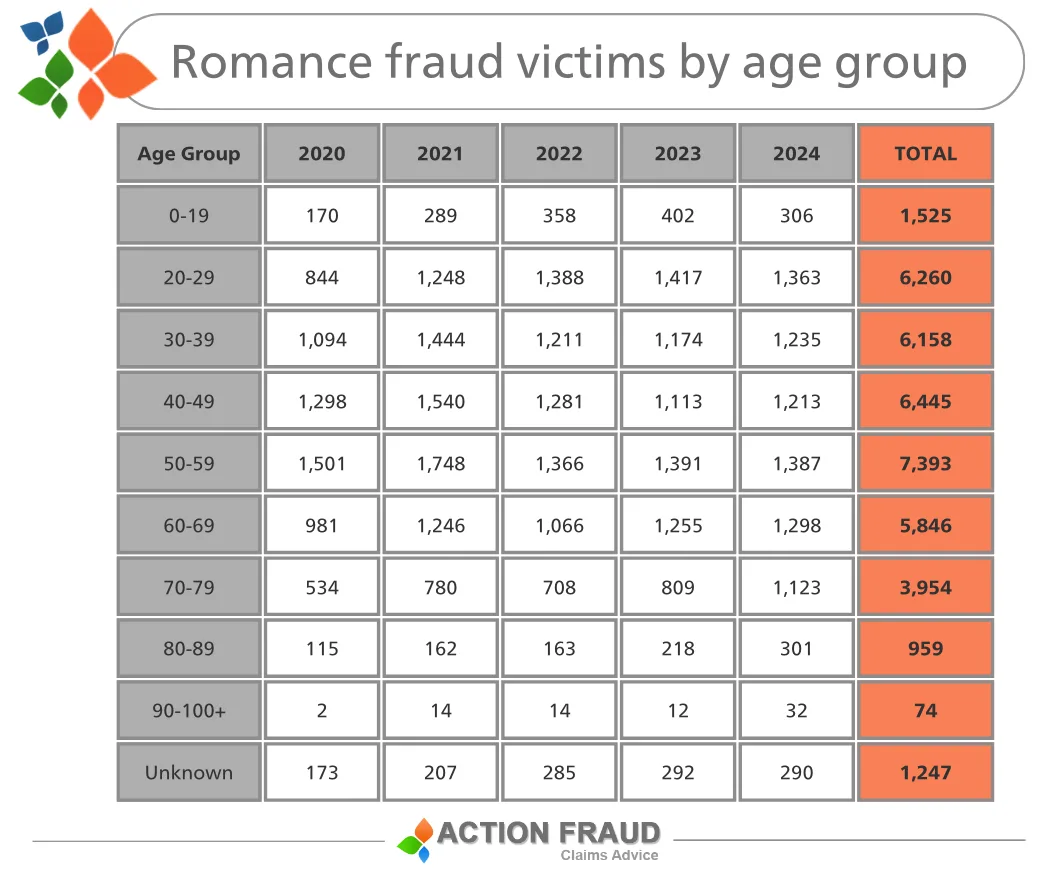
While a victim was more likely to be middle-aged, with 50-59 year-olds scammed on 7,393 occasions (followed by 40-49 year-olds, who reported 6,445 crimes), every age group was represented in the figures.
This includes 73 victims aged between 90 and 99, and even one victim understood to be at least 100 years old.
Shockingly, 53 victims were aged up to nine years old, and a further 1,472 were under the age of 20.
It is another symptom of a growing epidemic of child exploitation online. The NSPCC reported in September that the need for counselling due to online grooming and ‘sextortion’ has grown significantly.
“Romance fraud is a devastating crime”
Victim Support is an independent charity that offers specialist help for victims of crime, including fraud. The charity told Action Fraud Claims Advice that the psychological effect of romance fraud should never be overlooked.
Lisa Mills, Senior Fraud Manager at Victim Support, said:
“Romance fraud is a devastating crime. For victims, it isn’t just a question of losing large sums of money. The psychological and emotional impact of being deceived by someone you trusted deeply can knock your confidence and sense of self-worth enormously.
“Sadly, there is so much shame and stigma around romance fraud, with many victims too embarrassed to open up to their friends or family about what has happened, leaving them even more isolated.
If you have been a victim, you are not to blame – fraudsters are skilled manipulators who use social engineering to manipulate thousands of people every year. Get in touch with Victim Support for free, confidential support via our 24/7 Supportline [08 08 16 89 111] or live chat service.”
The government is hopeful that measures rolled out under the Online Safety Act 2023 will prompt tech firms to help protect the public online, with Ofcom producing its first codes of practice and guidance in December.
Fraud is among the ‘priority’ crimes that social media and search services must make every effort to protect users against, according to the Act.
Action Fraud Claims Advice is a new support service that offers free advice to victims of romance fraud. It works with fraud recovery experts who are experienced in helping clients reclaim lost funds.
Victims of dating scams can contact Action Fraud by visiting www.actionfraud.police.uk.
Notes
Please bear in mind the following caveats for the data provided:
- The results are based on self-reports and may be subject to discrepancies.
- Underreporting to Action Fraud and omissions of data may mean the true figures are not fully represented.
- Entries are captured by the date of initial report. This means that any updates–including ongoing losses–after the first report are not captured.
- There is no formal agreement with Scotland to report to Action Fraud. Police Scotland remain responsible for the gathering and enforcement of fraudulent activity affecting Scottish victims.
The data was collected following a Freedom of Information Act request sent to Action Fraud. A document containing all data shared in the FOI response is available upon request.
Infographic credit: www.actionfraud.org.uk
Action Fraud Claims Advice must not be confused with Action Fraud, the national reporting service for fraud and cybercrime.
Sources:
NSPCC report on ‘sextortion’ cases: https://www.nspcc.org.uk/about-us/news-opinion/2024/sextrortion-contacts-increase/
Ofcom announcement regarding codes of practice and guidance for Online Safety Act enforcement: https://www.ofcom.org.uk/online-safety/illegal-and-harmful-content/time-for-tech-firms-to-act-uk-online-safety-regulation-comes-into-force/







