


Duna automates much of the paperwork involved in business onboarding. Founded in 2023 by former Stripe executives, the Amsterdam company automates KYB, KYC and AML checks for fintechs, banks and platforms.
Onboarding is only one part of a compliance programme, though. Teams that also need transaction monitoring, tighter policy control or one system for the whole customer lifecycle often start comparing their options.
This guide compares five alternatives. For each, it covers what the platform focuses on and how it compares with Duna.
Key Takeaways
- Duna is built around business onboarding, with ready-made KYB modules, case management and ongoing compliance monitoring.
- Some platforms on this list cover onboarding, customer monitoring, transaction monitoring and case work in one system.
- Enterprise suites like Fenergo and Pega are designed for large banks with complex, multi-jurisdiction requirements.
- Alloy and Taktile appeal to teams that want broad data orchestration or custom decision logic.
- Before you commit, check how each platform handles your own policies, audit trails and data residency.
Why Teams Look for a Duna Alternative
Duna’s Onboard product offers 20+ KYB modules, and the platform supports more than 210 business registries and seven-plus languages.
Its Lifecycle product handles ongoing compliance monitoring and periodic reviews, while Decide provides automated case management and analyst tooling. Together, these products are built around onboarding business customers.
The gaps tend to show up as needs grow. As of October 2026, Duna doesn’t list transaction monitoring on its website, so teams that monitor payments would need a separate system.
Running two systems means customer data, alerts and decisions live in different places. When a regulator asks why a customer was cleared or an alert was closed, piecing that story together takes time.
Other teams want more say over how AI behaves inside their processes. They look for tools where AI agents operate within rules the compliance team has defined and approved.
Comparison Criteria
This comparison uses four criteria, based on information each vendor publishes on its website and in its press releases as of October 2026:
- Lifecycle coverage: onboarding, ongoing monitoring, transaction monitoring and case management in one system.
- Policy control: whether written compliance policies can be turned into rules the team reviews and approves.
- AI governance: independent certification such as ISO/IEC 42001.
- Deployment fit: how quickly a fintech or mid-size institution can go live without a long implementation.
This is not a hands-on product test, and the right fit will vary with each team’s requirements.
5 Duna Alternatives Compared
1. spektr
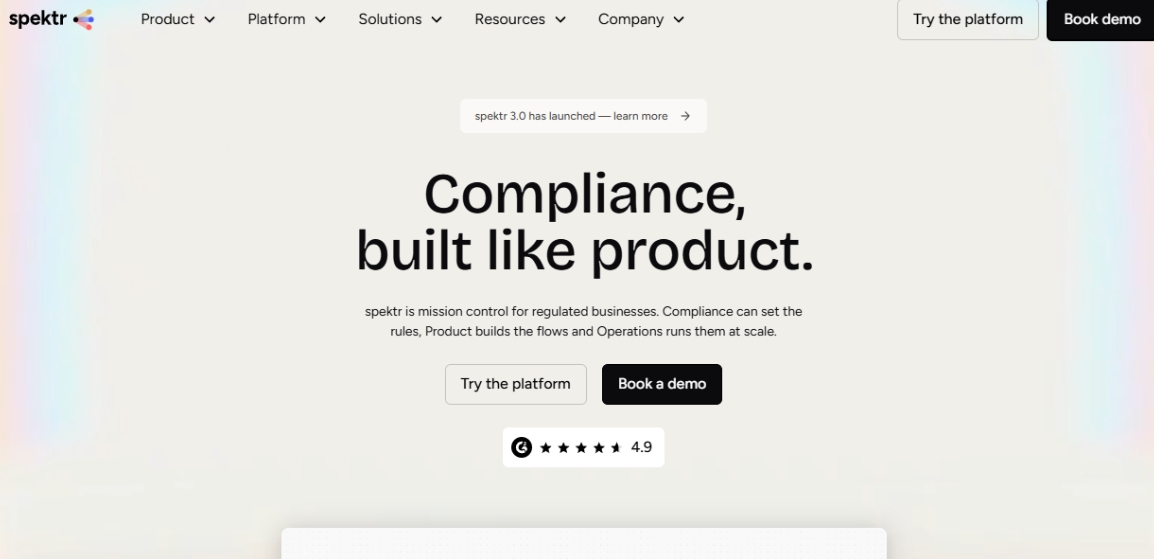
Copenhagen-based spektr is an AI-native compliance platform covering onboarding, customer monitoring, transaction monitoring and case operations in one system. Its 3.0 release in 2026 added a Policy Engine, Transaction Monitoring and Case AI.
Standout features:
- Policy Engine: Turns an institution’s written policies into the rules the platform runs on, so each case shows which policy applied and who approved the outcome.
- Transaction Monitoring: Checks customer activity in real time against detection rules the compliance team builds and controls, without engineering support.
- Case AI: AI agents gather evidence and recommend investigation outcomes, with an analyst approving the final decision.
How it compares to Duna: Both automate KYC and KYB onboarding, but spektr adds native transaction monitoring, with alerts, cases and customer data linked in a single record. It also holds ISO 27001, ISO 27701 and ISO/IEC 42001 certifications.
Best for: Fintechs, payment companies, banks, marketplaces and digital asset firms that want one system from onboarding to case resolution.
2. Alloy
Alloy is an identity and compliance orchestration platform that connects banks and fintechs to identity, fraud and compliance data providers through a single integration. It is headquartered in New York.
Standout features:
- Data orchestration: Pre-built connections to third-party identity, fraud and compliance data providers.
- Perpetual KYB: Ongoing KYB and customer risk assessment, launched in the UK and Europe in January 2026.
- Event-driven reassessment: Automatically re-runs checks when registry updates or watchlist hits occur.
How it compares to Duna: Like Duna, Alloy is strong at routing between data providers. It has been building out its UK and European products since its perpetual KYC launch in autumn 2025.
Best for: Banks and fintechs that want wide data coverage through a single integration.
3. Fenergo
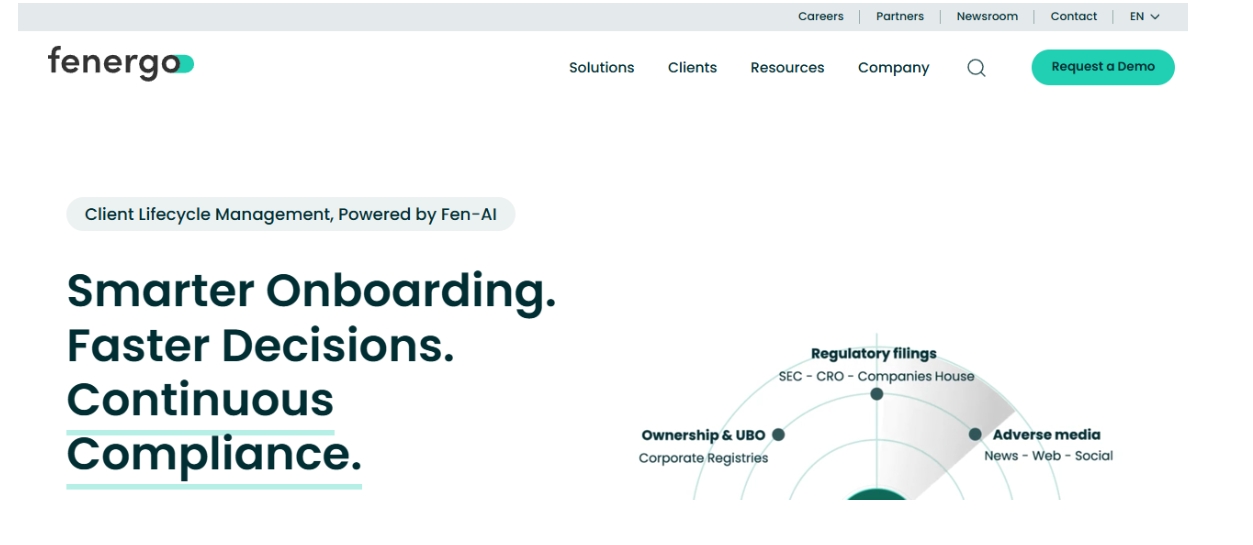
Fenergo is an enterprise client lifecycle management platform. In May 2025, it launched FinCrime OS, which brings onboarding, KYC, screening, ID&V and transaction monitoring onto one platform with six initial AI agents.
Standout features:
- AI agents: Document, Data Sourcing, Screening, Significance, Autocompletion and Insights agents for periodic KYC reviews.
- Command Centre: A single view of financial crime events across the institution.
- Unified transaction monitoring: Alerts sit on the same platform as onboarding, KYC and screening.
How it compares to Duna: Fenergo covers a broader set of lifecycle events than an onboarding-first tool. Its customer base centres on large financial institutions.
Best for: Large banks and asset managers with multi-jurisdiction requirements.
4. Taktile
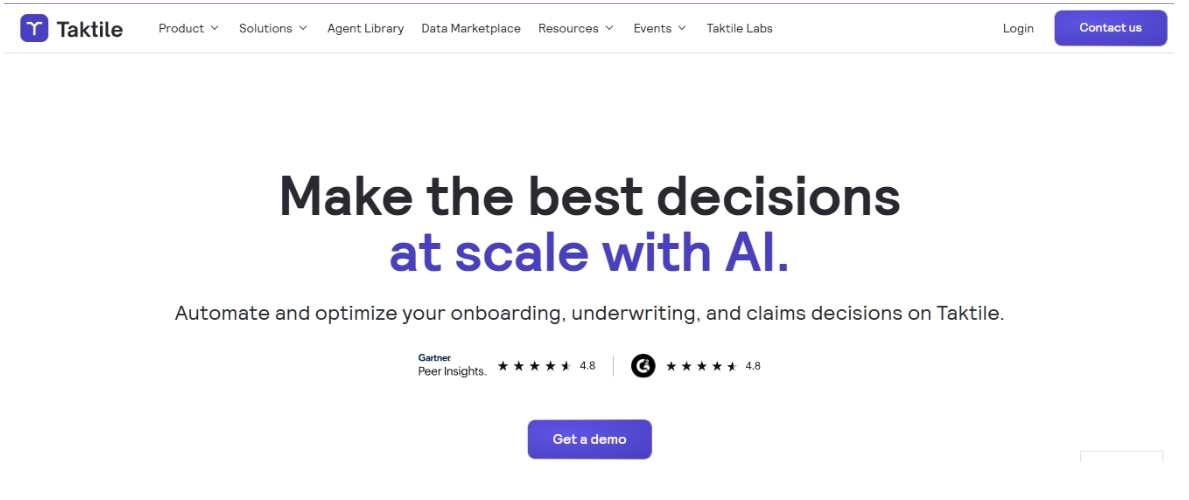
Taktile is a decision platform used for credit, fraud, KYC and onboarding workflows. Teams build their own decision logic in a low-code, visual flow builder.
Standout features:
- Visual decision flows: Pre-built nodes for assembling risk decisions without writing code.
- Configurable AI agents: AI that teams configure inside their decision flows, with explainable outcomes.
- Versioning and simulation: Rule changes can be tested and rolled back before they reach production.
How it compares to Duna: Duna gives teams ready-made onboarding journeys, while Taktile offers a blank canvas. That suits teams with strong in-house risk expertise but means more setup work.
Best for: Fintechs and lenders that want full control over credit, fraud and risk decisioning.
5. Pega
Pega offers client lifecycle management and KYC for large financial institutions. In December 2025, it added agentic AI features to Pega CLM, automating onboarding, document processing, screening and risk assessment.
Standout features:
- Agentic CLM: AI agents across onboarding, document processing and screening.
- Self-Service Hub: Lets customers complete onboarding through guided workflows.
- AI governance: ISO/IEC 42001 certification for Pega Infinity 25.1 and newer.
How it compares to Duna: Pega is built for large banks with complex product lines. It’s designed for multi-product, multi-jurisdiction onboarding, a different scale from Duna’s onboarding-first approach.
Best for: Global banks and wealth managers running compliance across many jurisdictions.

How to Choose the Right Duna Alternative
Start with scope. If you only onboard business customers, an onboarding-focused tool may be enough. If you also monitor payments, a connected platform can reduce the work of reconciling separate systems.
Next, look closely at policy control and audit trails. Ask each vendor to show how a written policy becomes an enforced rule and how an auditor would trace a decision back to its evidence.
Data handling matters too. If you serve customers in the UK or Europe, confirm where data is hosted and how the vendor supports UK GDPR and EU GDPR, since identity checks and privacy rules overlap in tricky ways. UK firms should also check how the platform supports their obligations under the UK Money Laundering Regulations and the expectations of the Financial Conduct Authority.
Finally, run a proof of concept on your own cases. A demo shows the ideal path, but your edge cases reveal how a platform really performs.
Conclusion
Duna is focused on business onboarding. Teams whose needs stretch into transaction monitoring, policy-governed AI and full lifecycle case work may want to compare the platforms on this list.
The right pick depends on your size, your markets and how much you want to build yourself. Shortlist two or three platforms, test them on real cases and let the results guide your decision.
FAQ
What is Duna used for?
Duna is an AI-native business identity platform that automates KYB, KYC and AML checks. Its products cover onboarding, case management, lifecycle monitoring and data orchestration.
Does Duna offer transaction monitoring?
As of October 2026, transaction monitoring isn’t among the products listed on Duna’s website, which focus on onboarding, case management and lifecycle compliance. Teams that need it would require a separate tool or a platform that covers both.
Which Duna alternative fits which team?
Teams that want onboarding, monitoring, transaction monitoring and case operations in one system can compare the platforms above that cover all four. Large banks may lean toward Fenergo or Pega, while teams that want custom decision logic often look at Taktile.
Who uses Duna?
Duna’s customers include Plaid, CCV (Fiserv), Moss, Bol and SVEA Bank, according to the company’s February 2026 funding announcement. It positions itself for banks, fintechs and platforms that onboard business customers.
What should I check before switching compliance platforms?
Map your current processes, then compare lifecycle coverage, policy controls, audit trails, data provider flexibility and data residency. A proof of concept on real cases will surface gaps that demos tend to hide.







