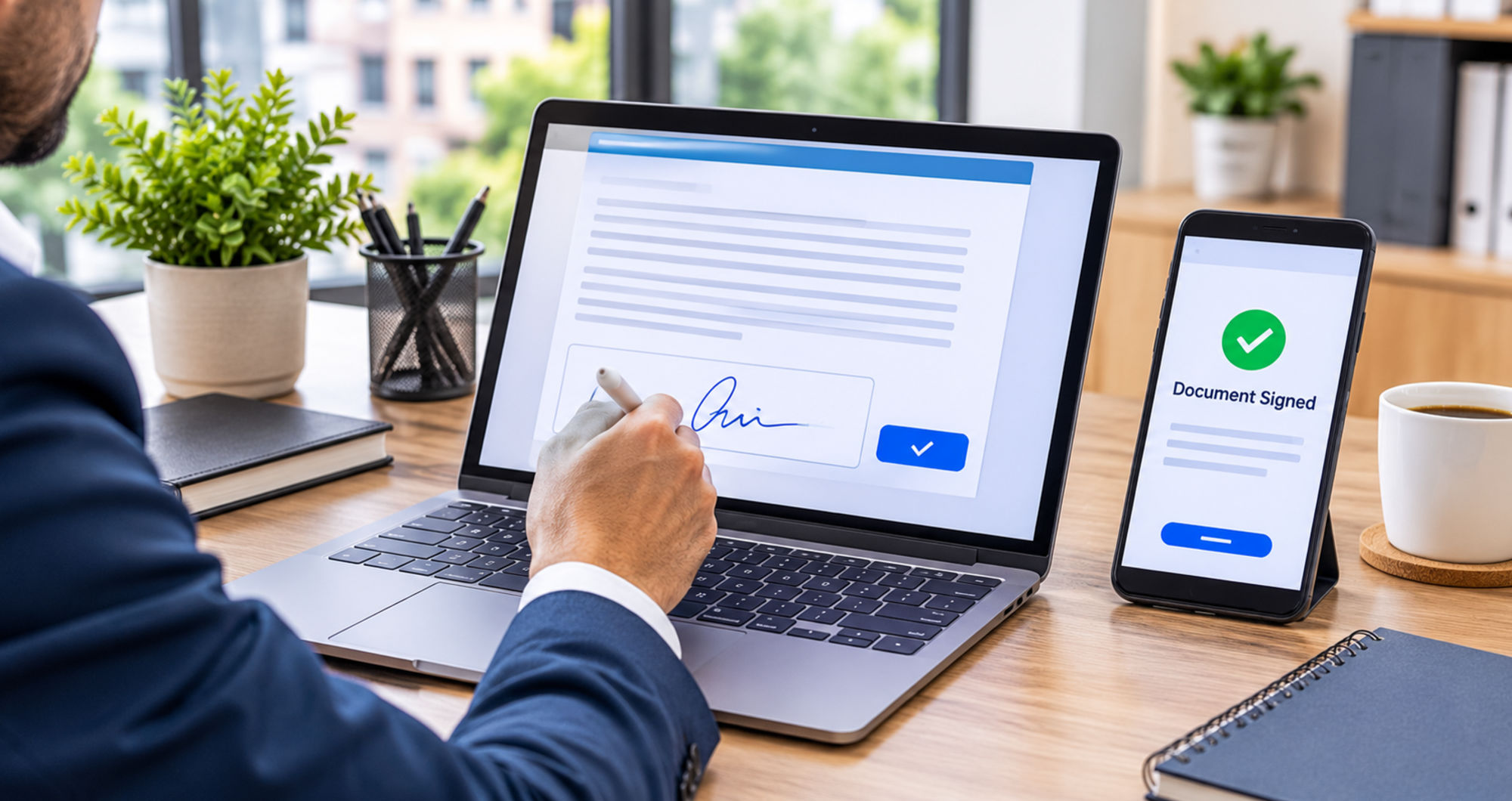

An online signature tool with no sign-up for the recipient works from the sender’s side: you sign in, upload the document, and send it by email. Adobe Acrobat’s request a signature tool gives recipients a secure link to sign in their browser, with no account or software required, and files are deleted unless you sign in to save.
This article is for businesses that want to streamline document signing with online tools that do not make recipients download software or sign up.
When the Recipient Doesn’t Need an Account to Sign a Document
A recipient does not need an account when the sender’s tool emails a signing link and the signer completes the form in a browser. Adobe’s page says signers receive a secure email link, are guided through exactly where to sign, and need no account or software. Zoho says every envelope is sent in an email with an exclusive signing link, and that an account is only required for people in your own organisation who send documents. Check the sender’s settings before relying on it.
- What the signer does: Adobe’s page says the recipient opens the emailed link, reviews the agreement, and signs in seconds for free.
- What the sender does: Adobe’s page says you sign in to upload the file, add recipients’ email addresses, mark fields, and send.
- Everyday documents: Adobe’s page lists sales contracts, NDAs, HR onboarding documents, real estate leases, and vendor contracts as typical uses.
- Final copy: Adobe’s page says Acrobat emails everyone a copy of the completed agreement after signing, and Dropbox says its recipients also receive a copy by email, according to a guide.
- Your own sign-in: Zoho says an account or subscription is only required for people in your organisation who send documents or self-sign.
- Settings can change it: a DocuSign community answer says an admin can require recipients to have an account, so a signer may be asked to log in.
Signer Does Not Need an Account to Sign a Document: What Each Tool States
Signer does not need an account to sign a document in Adobe Acrobat’s request a signature tool, Zoho Sign, SignWell, Dropbox Sign, DocuSign, and PandaDoc, according to each vendor or a guide. Adobe, Zoho, SignWell, and Dropbox each say so on their own pages, while DocuSign says so for documents sent through DocuSign and PandaDoc’s statement comes from a guide. Plan limits and sender settings differ, so compare the table and test a signing link before you send it to a client.
| Platform | Best For | Key Details |
| Adobe Acrobat request a signature | Signing with no account or software for recipients | Recipients sign in any browser from a secure email link; free account allows two requests every 30 days; files are deleted unless you sign in to save |
| Zoho Sign | Teams already using Zoho apps | Zoho says signers need no account or subscription; its free plan is listed as one user with 5 envelopes a month and an audit trail; pricing lists email and SMS one-time passcodes for recipients |
| SignWell | Small teams sending from any device | SignWell’s site says no account is required for recipients and that signing is mobile optimised |
| Dropbox Sign | Teams already in Dropbox | Dropbox’s site says recipients sign securely with no account required; a SignWell comparison lists three signature requests per month on its free plan |
| DocuSign | Teams that need admin controls | DocuSign’s site says you do not need an account to sign a document sent through DocuSign; an admin setting can require login |
| PandaDoc | Proposals that need signing | A guide says PandaDoc states recipients need no account to view or sign, including in-person signers |
- Vendor statements: the no-account claims come from each vendor’s pages or a third-party guide, so test the recipient view yourself.
- Free plan figures: the Zoho and Dropbox Sign limits come from Zoho’s page and a competitor’s comparison, so check current limits before you rely on them.
- Authentication options: Zoho’s pricing page lists recipient authentication such as email and SMS one-time passcodes, and Adobe’s page says Acrobat Pro’s free trial includes e-signatures with advanced authentication.
- Sender-side limits: Adobe’s page says a free account allows two request e-signature transactions every 30 days on a rolling basis.
Signer No Account Required: How to Confirm It Before You Send
Confirm that a signer needs no account by sending a test document to a colleague on a personal email address before you send it to a client. Check three things: that the signing link opens without a login prompt, that the signer sees only the fields you assigned, and that everyone receives the completed copy. Adobe’s page says signers are guided through where to sign, while a DocuSign community answer says an admin login setting can override the default. Fix the setting, then send.
- Test on mobile: SignWell’s site says its signing is mobile optimised, so open the test link on a phone as well as a computer.
- Read the login setting: a DocuSign community answer lists four login requirements, and the stricter two mean you cannot send to anyone without an account.
- In-person signing: a guide says PandaDoc states in-person signers need no account, and its representative opens the document from their own account.
- Keep the record: Adobe’s page says you can track each request and create an audit trail with timestamps, and Zoho lists an audit trail on its free plan.
- Expire stale requests: Adobe’s page says a request can expire on a date you set.
Frequently Asked Questions
Does no account mean no identity check for the signer?
Not necessarily. A signer can skip creating an account and still be asked to verify. Zoho’s pricing page lists recipient authentication through email and SMS one-time passcodes, and Adobe’s page says Acrobat Pro’s free trial lets you collect e-signatures with advanced authentication. Choose the check that matches the document’s risk, and keep the audit trail with the signed copy.
Is a signature from someone with no account legally valid?
Generally, yes. The U.S. ESIGN Act says a signature or contract may not be denied legal effect, validity, or enforceability solely because it is in electronic form, and nothing in that rule requires the signer to hold an account. In the EU, a guide says Article 25 of eIDAS says the same for non-qualified signatures. High-risk documents may need stronger authentication.
What does the sender need if the signer needs nothing?
The sender usually needs an account. Adobe’s page says you sign in to send a request, and Zoho says an account or subscription is required for people in your organisation who send documents. Check plan limits first, since Adobe’s free account allows two requests every 30 days, and compare paid plans if your business sends more.
Can several people sign the same document in order?
Yes. Adobe’s page says you add more email addresses and can assign fields to specific individuals, and that Acrobat supports sequential signing, parallel signing, and bulk send, where each recipient receives their own copy. Zoho says each envelope can contain multiple documents and go to multiple recipients with different roles in a specified order. Pick the order that matches your approval chain.
An online signature tool with no sign-up for the recipient asks the sender to sign in and lets the recipient sign from an emailed link in a browser.