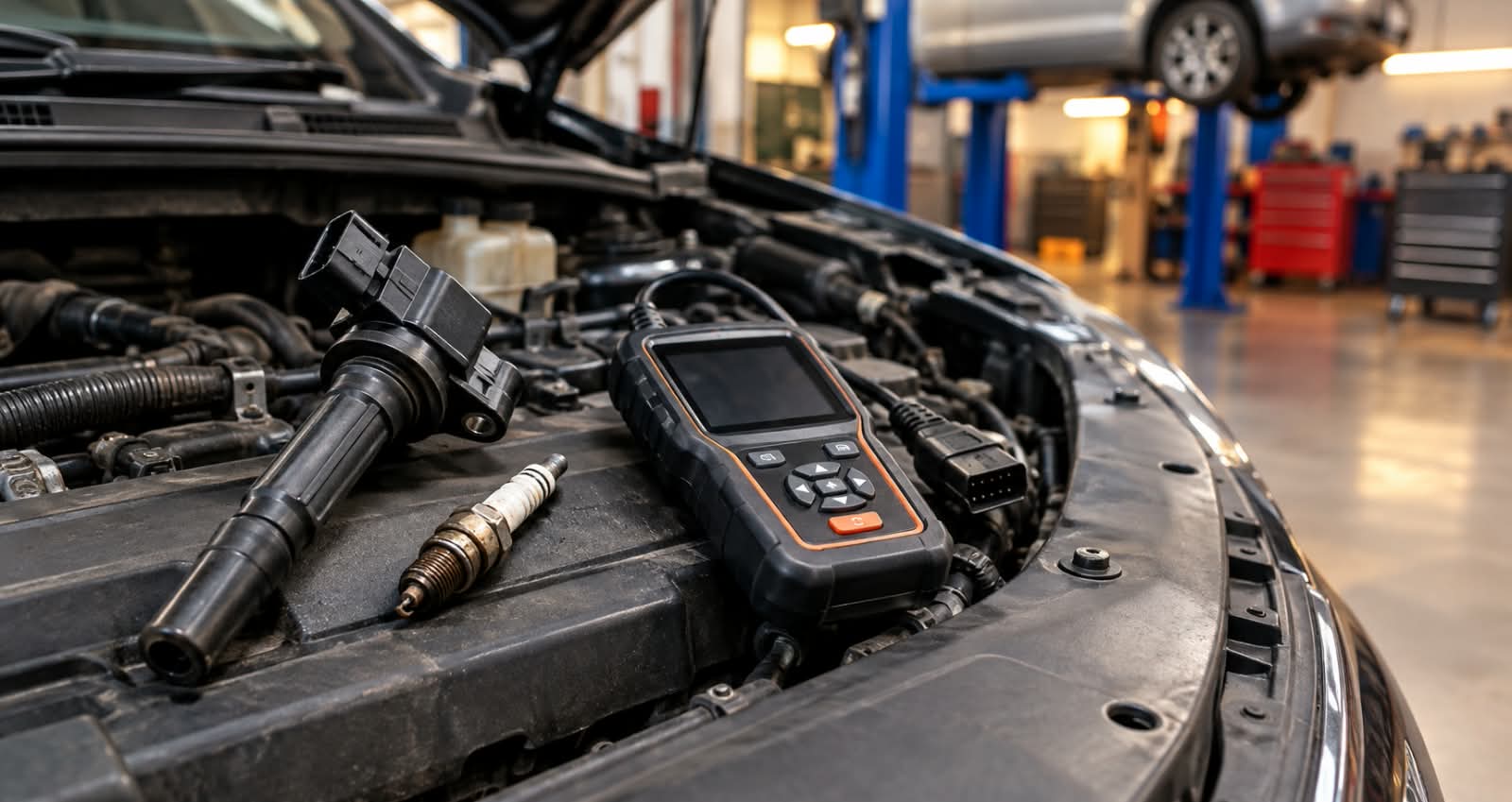

P0420 flags low catalyst efficiency on bank 1. P0352 flags a fault in the ignition coil C primary or secondary circuit. The coil fault comes first because unburned fuel from a weak coil overheats the converter and can trigger the catalyst code. Fix the ignition problem, verify the misfire has gone, then retest the converter before quoting any exhaust work. A flashing engine management light means stop driving; a steady light with these codes means drive gently and book the repair. Skipping the sequence often means paying for a converter twice.
Two codes appearing together after an engine management light is a sequencing problem, not two independent repairs. One of them describes a cause, and the other usually describes a consequence. Getting the order wrong on this pair is one of the more expensive mistakes in drivability work, because the consequence is a catalytic converter.
A p0420 code says the module compared the upstream and downstream oxygen sensor signals and concluded the converter on bank 1 is not storing and releasing oxygen the way it should. That conclusion is only valid when combustion upstream is normal. When an ignition coil is failing, combustion is not normal.
Why This Matters More in the UK
The financial stakes are set by the MOT. Emissions form part of the annual test, and a vehicle with a failing catalytic converter or a live misfire will not pass. That turns a dashboard warning into a deadline rather than a maintenance decision, and it is the main reason drivers arrive at a garage asking for the cheapest route to a pass.
The cheapest route is rarely the first quote. Converter replacement on a modern car runs to several hundred pounds and well beyond that on some models, so ordering the diagnosis correctly is worth real money to the customer. It is also worth noting that driving with a dashboard warning light illuminated can affect an insurance position if the vehicle is later judged to have been in an unroadworthy condition, which is a further argument for booking the work rather than waiting for the MOT.
Read the Warning Light Before Anything Else
The behaviour of the light tells the driver what to do in the next ten minutes. A steady light means a fault is confirmed, but the module does not consider it an immediate threat, so short, gentle driving to a garage is reasonable. A flashing light means an active misfire severe enough to dump raw fuel into the exhaust, and continuing to drive will melt the converter substrate.
Advise the customer accordingly. Recovery costs less than an exhaust system, and this specific code pair is the scenario where that math holds most clearly.
Start With the Ignition Coil Circuit
A p0352 code points at the coil C circuit, which the module identifies by its firing order position rather than by cylinder number on many platforms. Confirm which physical coil that maps to in the service information for the specific engine before you pull anything. Guessing here leads to replacing a healthy component.
Test the circuit in three parts. Check the power feed to the coil with the ignition on, verify the control signal from the module with a scope or a logic probe, and measure the coil primary and secondary resistance against specification. A coil that reads within range when cold can still break down under load and heat, so a running scope capture of the primary waveform is worth the setup time.
Inspect the connector and the harness before condemning the coil. Corroded terminals, a spread pin, or a wire chafed against the rocker cover produce intermittent faults that a new coil will not cure. On coil-on-plug systems, also check the boot and the spark plug. A plug worn past its gap specification raises secondary demand until the coil fails prematurely.
Confirm the Misfire Has Actually Gone
After the ignition repair, clear the codes and drive the vehicle through a full warm-up and a mix of load conditions. Watch misfire counters per cylinder in live data rather than waiting for a code to reappear. Counters that stay at or near zero across idle, cruise, and acceleration confirm the repair.
Also review fuel trims. A cylinder that was misfiring pushed unburned oxygen past the upstream sensor, which the module read as lean and compensated for. Trims should settle back towards normal once combustion is stable. If they do not, there is a second fault, commonly a vacuum leak or an injector problem, and the converter test will be invalid until it is resolved.
Then, and Only Then, Test the Converter
With combustion verified, evaluate the catalyst on its own merits. At full operating temperature and steady cruise, the upstream sensor should switch rapidly while the downstream sensor holds a relatively steady voltage. A downstream trace that copies the upstream trace indicates the substrate has lost its oxygen storage capacity.
Back that up with a temperature check across the inlet and outlet, and rule out an exhaust leak ahead of the rear sensor. A leaking flange or a pinhole in the pipe introduces atmospheric oxygen and produces a catalyst code on a perfectly good converter. This is a frequent false positive on older vehicles, and it is cheap to check. Corrosion around the flange is worth particular attention on cars that have spent winters on salted British roads.
Give the converter a chance to recover before condemning it. A converter fouled by short-term over-fuelling sometimes returns to passing efficiency after several complete drive cycles with clean combustion. That will not save a melted substrate, but it does save unnecessary parts on vehicles caught early.
What This Means for the Repair Order
Quote the ignition repair first and explain why the exhaust decision waits. Customers accept a staged approach when the reasoning is concrete: the module cannot judge the converter accurately while a cylinder is misfiring, so testing it now would mean guessing. Setting that expectation at the counter prevents the difficult conversation later.
Document the misfire counters before and after, the fuel trim values, the oxygen sensor traces, and the converter temperature differential. If the catalyst code returns after the ignition repair, that record is the evidence supporting the second phase of work. If it clears, the same record shows the customer they avoided a converter bill, which is the kind of outcome that brings them back. For drivers, it is also worth asking the garage for that documentation, since it distinguishes a diagnosis from a guess.
For garages running high-volume driveability work, building this sequence into a standard checklist keeps it consistent across technicians. Ignition first, misfire verification second, catalyst test third. The order is the diagnosis.