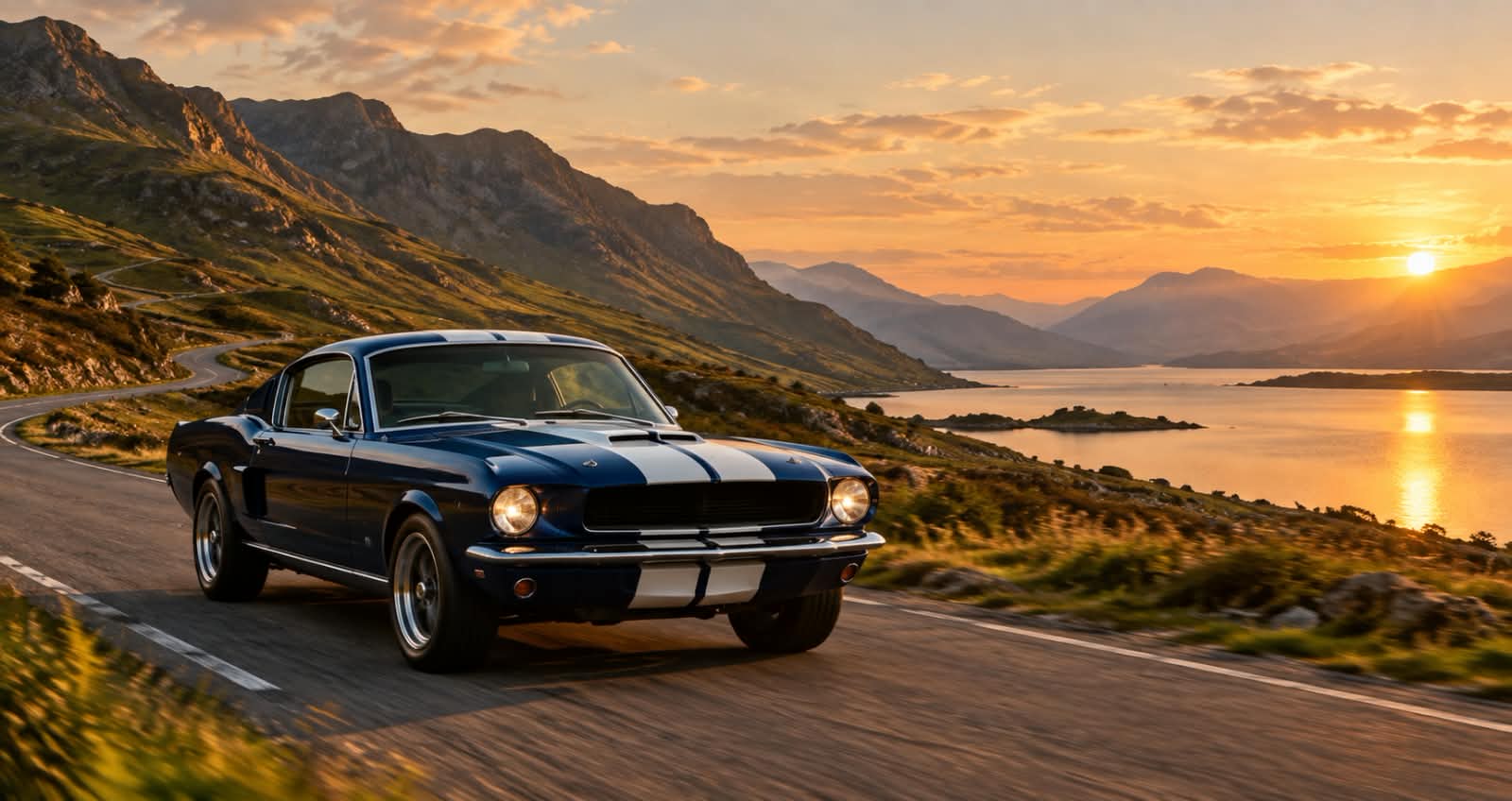

Few cars have managed to straddle the line between everyday usability and raw, visceral performance quite like the Ford Mustang. Decade after decade, it has proven itself not just on racetracks and drag strips, but on long open roads. Whether chasing canyon roads in the American Southwest or crossing the Scottish Highlands on the North Coast 500, the Mustang has always been the car that makes the journey as meaningful as the destination. In 2025 and 2026 that legacy has only grown stronger, backed by real-world adventures, motorsport success and quality recognition that few rivals can match.
The Mustang’s Enduring Appeal on the Open Road
There is a reason the Mustang has remained in continuous production longer than virtually any other American performance car. It speaks to something deeply embedded in car culture: the idea that power and style should be accessible rather than exclusive. Owners don’t just drive Mustangs; they form relationships with them. They plan trips around them, push them to their limits, and come back wanting more. That emotional connection is what separates the Mustang from competitors that may match it on paper but rarely match it in spirit.
That appeal is no longer a purely American story. Ford began selling the Mustang officially in right-hand drive in the UK in the mid-2010s, and it quickly became one of the most visible performance cars on British roads. Before that, classic Mustangs had long enjoyed a devoted following here, and they remain a familiar sight in historic saloon car racing at events such as the Goodwood Revival, where their V8 soundtrack is as much a part of the atmosphere as the cars themselves.
The spirit of the car is perhaps best illustrated through the stories of dedicated enthusiasts who take their cars on extraordinary journeys. One owner recently demonstrated this by completing an epic 5,700-mile Mustang road trip, showing that a carefully built classic Mustang can be more than a show car. It can be a genuine touring machine capable of handling the demands of long-distance travel with confidence. Stories like this are a reminder that the Mustang’s reputation is not theoretical; it is earned mile by mile.
What Makes a Mustang Road-Trip Ready
A road trip of several thousand miles demands more than horsepower. It demands reliability, comfort and the kind of mechanical integrity that comes from thoughtful engineering and quality craftsmanship. The best Mustang builds, whether classic restorations or modern performance variants, share a common DNA: suspension tuning that absorbs long distances without punishing the driver, powertrains that deliver consistent output across varying altitudes and temperatures, and interiors designed to keep occupants comfortable over long stretches.
The same qualities matter on a British touring route. Narrow single-track roads, sharp changes in weather and long days behind the wheel test a car’s composure in different ways from a desert highway, and a Mustang that is set up properly handles both. When all of these elements come together, the result is a car that doesn’t just survive a road trip; it thrives on one.
Performance Validation: From Pikes Peak to the Production Line
The Mustang’s touring credentials are matched by its competitive ones. In recent years Ford has pushed the Mustang name into new performance territory, and the electric side of the family has begun making serious waves in motorsport.
In June 2026, Ford Racing’s Super Mustang Mach-E, a purpose-built electric demonstrator developed from the Mach-E and producing more than 1,400 horsepower, took overall victory at the Pikes Peak International Hill Climb with Romain Dumas at the wheel. It was Dumas’s sixth King of the Mountain title and Ford Racing’s second overall win on the mountain. While the car shares only its name and silhouette with the Mach-E sold in showrooms, the result sent a clear message: the Mustang name is not resting on its heritage, and it is being used to develop the future of performance, whether powered by petrol or electricity.
Pikes Peak is one of the most demanding motorsport venues in the world. The 12.42-mile course climbs more than 4,700 feet through 156 turns, subjecting cars and drivers to extreme conditions that expose every weakness in engineering. Winning outright, not merely in a class, is a statement of capability that resonates far beyond the racing world, and it will be familiar territory for British motorsport fans who follow the hill climb at the Goodwood Festival of Speed.
Quality Recognition That Backs Up the Performance Claims
Performance without reliability is just noise. What makes the Mustang’s story in 2025 and 2026 compelling is that its competitive achievements are backed by measurable quality improvements. According to the 2026 US Initial Quality Study, the Ford Mustang ranked as the top sporty car in its segment, a result that reflects disciplined execution throughout the manufacturing process as well as engineering ambition. Initial quality studies measure the number of problems reported by owners in the first 90 days of ownership, making them a direct reflection of real-world experience rather than controlled test conditions.
Topping that study is significant because it shows Ford has addressed the quality concerns that occasionally shadowed earlier generations of the modern Mustang. Buyers today are getting a car that not only performs at a high level but also holds together with the kind of dependability that justifies the investment, whether it is driven daily, taken on a long-distance tour or kept as a collector’s piece.
Continuation Cars: The Classic Shape With Modern Engineering
Within the wider Mustang world, continuation builders occupy a distinctive space. Revology Cars, for example, specialises in building continuation classic Mustangs, vehicles that capture the styling of the 1960s originals while incorporating modern mechanical components that make them practical for today’s roads. This is not restoration in the traditional sense. The cars are built new using original body designs, paired with modern fuel-injected engines, updated suspension, power-assisted brakes and contemporary electrical systems.
The result is a Mustang that looks as it should, unmistakably classic and faithful to the original proportions, while driving with the confidence of a modern car. For enthusiasts who want the experience of a vintage Mustang without the mechanical anxiety that often comes with genuine period ownership, the continuation approach offers a practical middle ground. UK buyers considering one should bear in mind that these cars are typically left-hand drive and will need to be imported and registered, so it is worth factoring the process and costs into any decision from the outset.
The Community That Keeps the Legend Alive
What truly sustains the Mustang’s status is not a marketing department or any single race victory. It is the community of owners who live with these cars every day. From track days to long-distance tours, from concours lawns to mountain roads, Mustang owners share a common bond that crosses generations and borders. In the UK that community is well established, with owners’ clubs, regional meet-ups and a strong presence at classic car shows, and it continues to create the stories and moments that keep the Mustang relevant in an era of rapidly changing motoring priorities.
Conclusion: A Legacy Built Mile by Mile
The Ford Mustang’s standing in 2025 and 2026 is not accidental. It is the product of decades of refinement, a passionate owner community, bold engineering decisions and a commitment to quality now being recognised by independent studies. Whether it is a 1,400-horsepower electric demonstrator conquering Pikes Peak, a top ranking in initial quality surveys, or a devoted owner covering 5,700 miles in a classic, the Mustang continues to prove that it is more than a car. It is an experience that rewards those who choose to embrace it, on either side of the Atlantic. In a world of increasingly homogenised transport, that distinction matters more than ever.