
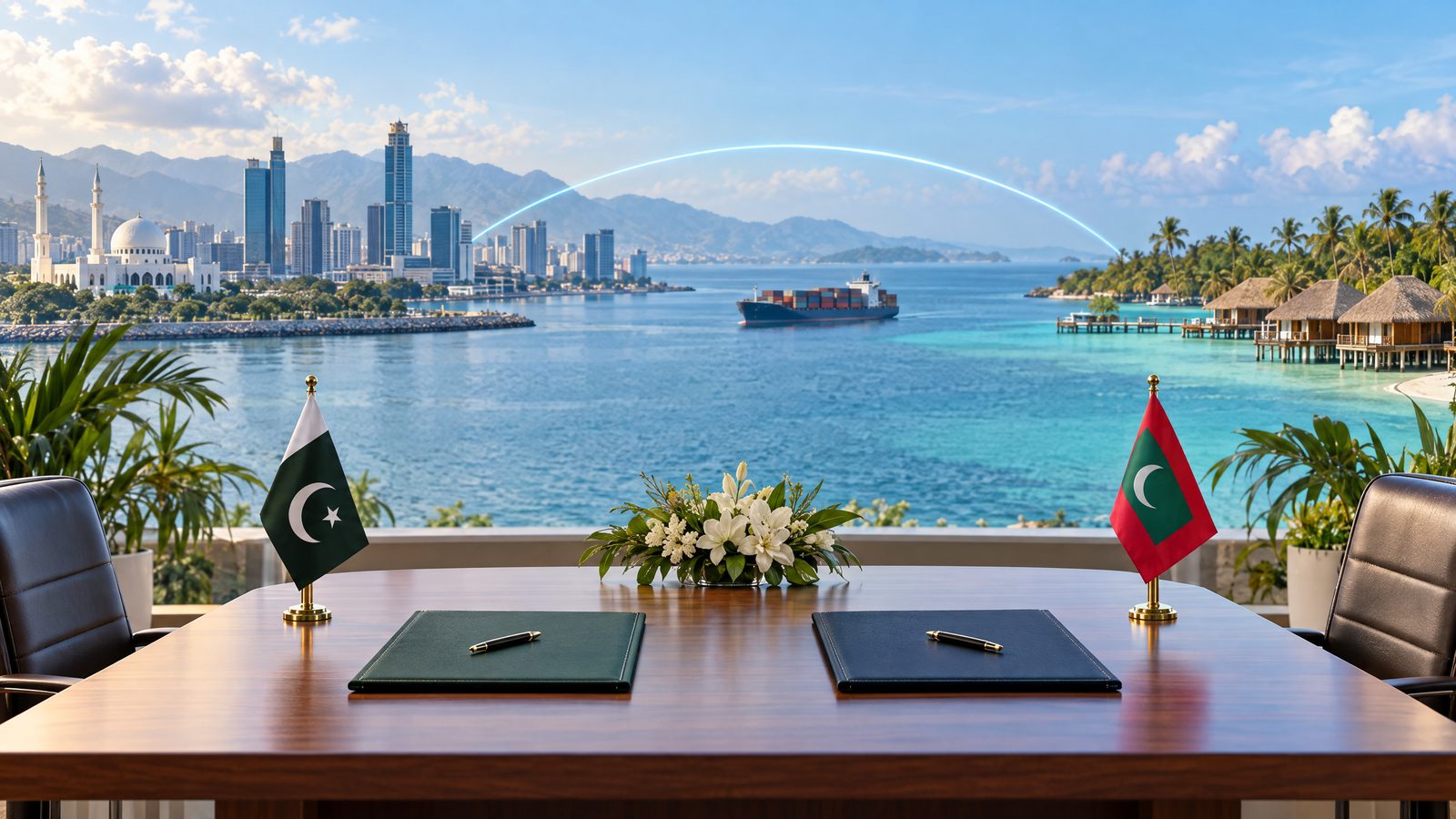

Pakistan and Maldives set $200m trade target after 20 agreements
Pakistan and the Maldives have agreed to seek bilateral trade of US$200 million within two years, setting an ambitious goal alongside 20 memorandums of understanding signed during Maldivian President Mohamed Muizzu’s state visit to Islamabad on 21 October.
The target is an aspiration, not a completed increase in trade. Pakistan’s government put the current value at US$13.4 million, while two regional reports cited US$13.9 million. The discrepancy remains unexplained in the material available, so the figures should not be treated as a settled common baseline. Even using either reported starting point, reaching US$200 million would require a substantial expansion in commercial exchange.
The agreements span health, education, technical training, tourism, civil aviation, agriculture, fisheries, defence, maritime security, law enforcement, social protection, public administration, culture and youth cooperation. Other specified areas include information technology, cybersecurity, artificial intelligence, digital skills and cooperation between food and medicines regulators. The package sets out broad channels for future work; signing documents does not itself establish that projects have begun or that promised benefits have been delivered.
Commitments include education and tree planting
Pakistan announced 20 additional undergraduate scholarships each year for Maldivian students. It also offered food commodities and pharmaceuticals, and said it was ready to expand healthcare cooperation, professional training and capacity building. These are commitments and offers, rather than evidence that new scholarships have already been awarded or supplies delivered.
For the Maldives’ Five Million Tree Initiative, Pakistan said it would provide 100,000 olive cuttings and 100,000 seeds of other plant species over the coming 12 months, subject to seasonal availability. Pakistani experts are also expected to help establish nurseries, with the stated aim of contributing to the production of one million plants over three years. The announcement describes planned support; it does not show that planting or nursery work has taken place.
The leaders also agreed to pursue stronger investment, tourism, food security, pharmaceutical links and private-sector partnerships. They emphasised improved air and maritime connectivity and the early convening of a Joint Economic Commission. President Muizzu said direct flights were under discussion and could support tourism, but no launch date or operational service was announced as part of the agreements.
A Pakistan-Maldives business forum was scheduled for 22 October, the day after the signing. It is intended to bring companies and investors together to explore commercial opportunities. That planned forum is a next step, not a result that can yet be counted as new trade or investment.
A framework that still needs delivery
The visit is the first by a Maldivian president to Pakistan in 11 years and coincides with the 60th anniversary of diplomatic relations between the two countries. The leaders held talks on bilateral ties as well as regional and international matters. President Muizzu was also awarded an honorary doctorate by the International Islamic University in Islamabad during the visit.
The scale of the trade target makes implementation important. The governments have identified sectors and signed cooperation documents, but the public details do not set out a timetable for each agreement, individual project budgets or quantified milestones for reaching the target. A Joint Economic Commission, business-to-business discussions and any future direct air links could provide practical routes for following up, but their effect will depend on subsequent decisions and activity.
For now, the clearest measurable outcome is the signing of 20 agreements and the announcement of several proposed support measures. Whether these arrangements translate into sustained trade growth, student opportunities, professional exchanges or environmental work will become clearer only as the parties report on implementation.







