
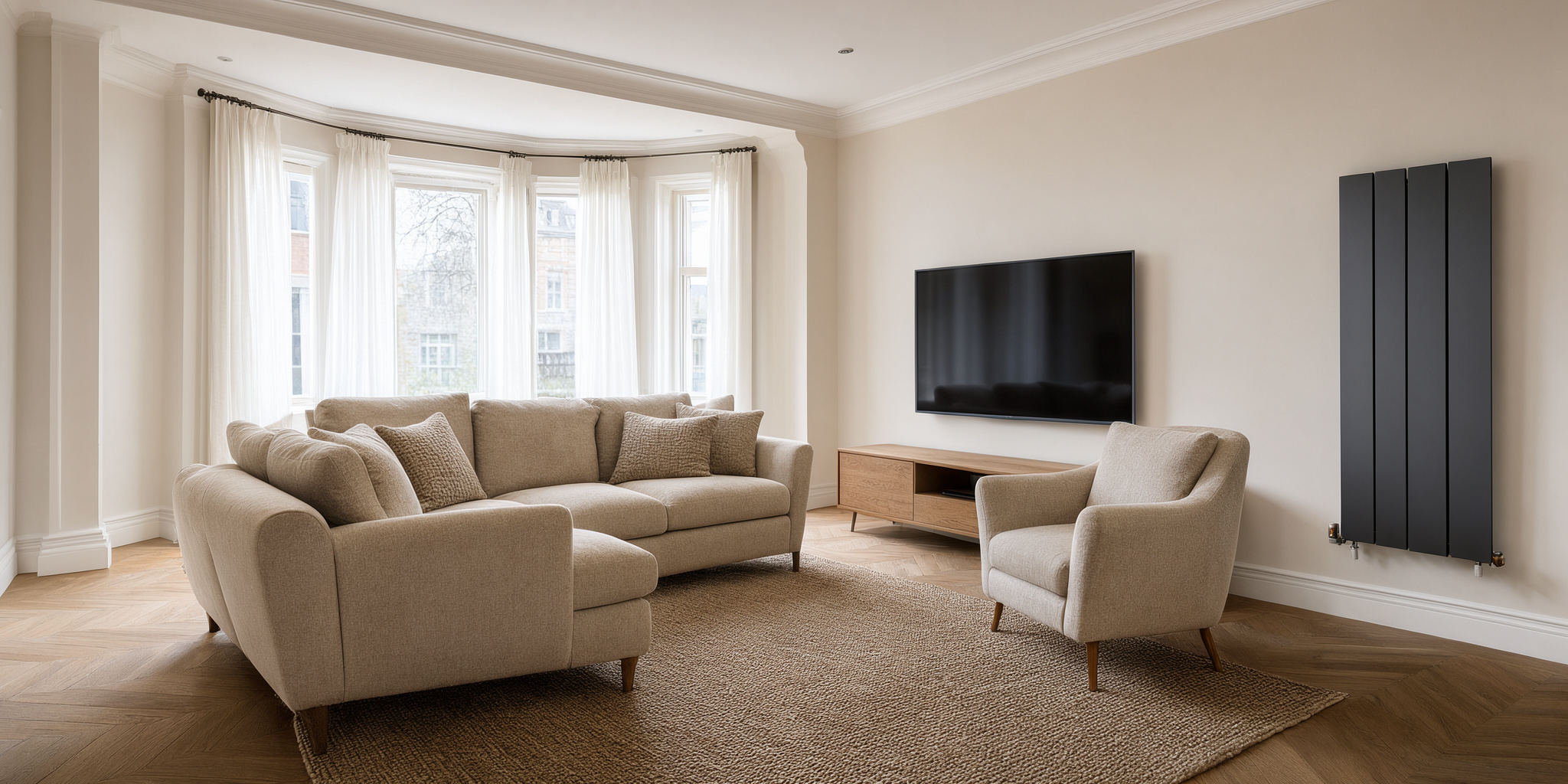

The electric radiator has shed its utilitarian past. For decades it was the appliance of last resort—the chunky, off-white panel in a rented flat, the storage heater that clicked through the night, the thing you hid behind a sofa. Designer electric radiators have changed that, and their return to the home is driven by a combination of aesthetics, control, and a changing energy landscape.
The shift is visible in the showrooms. Radiator specialists now describe a “clear shift towards designer electric radiators” that retain efficient heat retention while looking like contemporary radiators rather than hospital equipment. The category has moved from functional afterthought to deliberate design choice.
Why the Stigma Has Faded
The old objections to electric radiators were largely about appearance and control. Both have been addressed.
Modern designer electric radiators are available in flat panels, column styles, vertical orientations, and a wide range of finishes—anthracite, black, white, brass, and copper. Custom RAL colours allow a radiator to match a wall or a scheme precisely. The visual language is no longer “appliance” but “fixture.”
Control has improved just as dramatically. Most modern electric radiators come with smart thermostats that connect to a phone, allowing scheduling that is far more precise than a simple timer. Built-in programmers, open-window detection, and adaptive start features are now standard on Lot 20-compliant models. The radiator can be told when to warm a room and when to stop, which is the difference between a useful heater and an expensive one.
The Practical Case
Designing electric radiators makes sense in specific circumstances, and those circumstances are increasingly common.
No pipework required. An electric radiator needs only a power supply. For flats, extensions, loft conversions, garden rooms, and properties without gas, this removes an entire category of expense and disruption. There is no boiler to connect, no floors to lift, and no plumber required.
Room-by-room control. The single biggest practical advantage of electric heating is zoning. Each radiator can run on its own schedule, so a home office is warm during the day while bedrooms stay cooler. For households with varied routines, this eliminates the waste of heating an entire house for the sake of one occupied room.
Installation is quick and clean. Electric radiators cut down on disruption. There is no water to drain, no pipework to chase into finished walls, and installation is usually faster than a wet system. For a renovation where finishes are already in place, this matters considerably.
Compatibility with renewables. As more homes install solar panels and battery storage, electric radiators become part of an integrated energy system. They can run on self-generated electricity or off-peak tariffs, and they pair with heat pumps as a zonal top-up for hard-to-heat spaces.
The Running Cost Reality
Honesty is necessary here. Electricity costs more per unit than gas, and a whole house heated by electric radiators will usually cost more to run than a gas central heating system.
The arithmetic softens when the system is used as intended. A correctly sized radiator with a thermostat does not run at full power continuously. In a reasonably insulated room held at 21°C, a 1kW radiator might draw full power for only 15 to 25 minutes per hour once the room is warm, bringing the maintenance cost down to around 6p to 10p per hour. Heating one room rather than the whole house changes the comparison entirely.
For anyone on a time-of-use tariff, the savings can be greater. Running radiators during cheaper off-peak hours is a practical way to reduce costs.
Choosing Well
A design electric radiator is an investment, and the quality varies. Look for accurate thermostats and genuine programmability, because poor controls waste more energy than poor hardware. Check the heat output against the room size rather than guessing. Confirm the warranty and the build quality of the element. For bathrooms, check the IP rating.
A plug-in model can be installed without an electrician, though a new or moved socket requires one. Where the radiator is a permanent fixture, a hard-wired installation is cleaner and avoids trailing cables.
The Point
The design electric radiator has returned because it solves problems that matter to modern households. It is stylish enough to be seen, controllable enough to be efficient, and simple enough to install without disruption.
It is not a universal replacement for gas central heating. It is, however, an increasingly sensible choice for specific rooms, specific properties, and specific ways of living. The appliance of last resort has become the fixture of choice.







