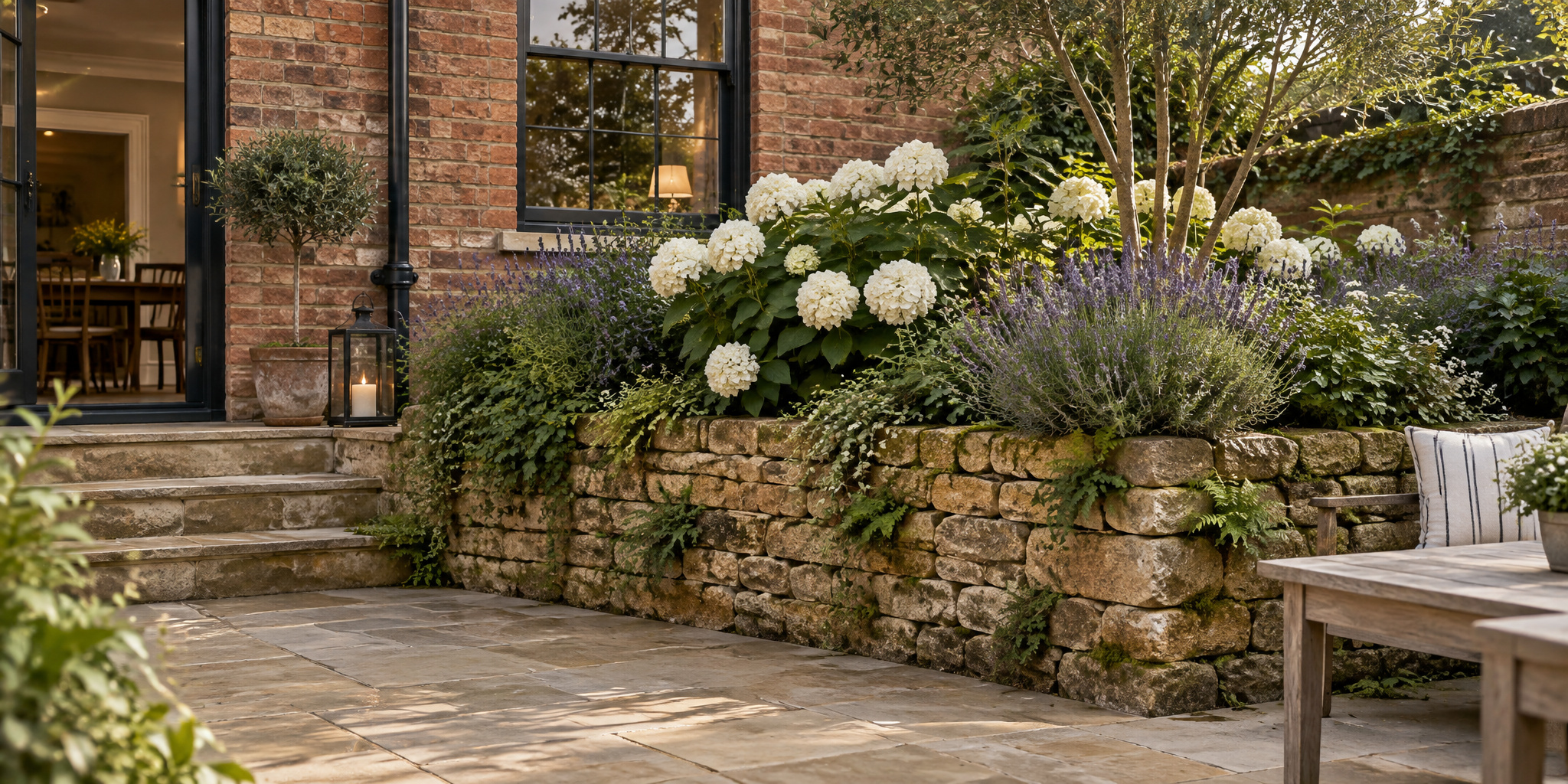

Few garden features carry as much quiet authority as a natural stone wall. It is not flashy. It does not change dramatically with the seasons. And yet, a well-built stone wall can do more for a garden than almost any other single element—structurally, ecologically, and aesthetically.
In London, where gardens are small and boundaries are close, stone walls offer something rare: permanence. They are the bones of a garden, the framework upon which everything else depends.
A Wall That Does More Than Divide
Most garden boundaries are functional afterthoughts—a fence panel, a row of leylandii, a trellis nailed to a post. A stone wall is different. It is architecture.
A stone wall can:
- Define space. It separates the garden from the street, the patio from the lawn, the productive from the ornamental.
- Create levels. In a sloping garden, stone retaining walls turn an awkward incline into usable terraces.
- Provide shelter. A stone wall blocks wind, absorbs warmth, and creates the sheltered microclimates that tender plants crave.
- Frame a view. A low stone wall can direct the eye, drawing attention to a particular planting scheme or focal point.
- Add height without bulk. Unlike a hedge, a stone wall takes up almost no ground space—a crucial advantage in a small London garden.
The Ecological Case
A stone wall is not a dead thing. It is a habitat.
The gaps between stones—particularly in a dry-stone wall—provide shelter for a remarkable range of wildlife:
- Solitary bees nest in the mortar joints and crevices.
- Lizards and slow worms bask on sun-warmed stones.
- Beetles, spiders, and woodlice shelter in the cracks.
- Mosses and lichens colonise the surface, adding texture and colour.
- Ferns establish themselves in the shade at the base.
- Birds nest in cavities and feed on the insects that live among the stones.
A stone wall is a vertical ecosystem. It supports life at every level, from the microscopic to the mammalian. No fence panel can make that claim.
The Aesthetic Argument
Stone has a quality that no manufactured material can replicate: it looks like it belongs.
Stone Ages Beautifully
A new stone wall can look a little stark. But give it a year or two, and it begins to soften. Rain darkens the surface. Lichen spreads in silver and gold. Moss fills the joints. The wall becomes part of the landscape rather than an imposition upon it.
It Ties the Garden to the House
In London, where houses are built of brick, stucco, or stone, a matching or complementary stone wall creates a visual link between architecture and garden. It makes the outdoor space feel like an extension of the home rather than a separate realm.
It Provides a Neutral Backdrop
Stone comes in a thousand shades—honey-coloured limestone, cool grey slate, warm sandstone, dark granite. Whatever the colour, it provides a calm, neutral backdrop against which plants can shine. A border of roses or salvias against a stone wall is a picture that never tires.
Choosing the Right Stone
The stone you choose depends on the style of your garden and the architecture of your house.
- Yorkstone. The classic London stone. Warm, sandy, and incredibly durable. Perfect for traditional gardens and period properties.
- Limestone. Pale and elegant, with a subtle grain. Ideal for formal gardens and light, airy spaces.
- Sandstone. Available in a range of colours from buff to grey. Versatile and relatively affordable.
- Slate. Dark, dramatic, and crisp. Suits modern, minimalist gardens.
- Granite. Extremely hard-wearing and available in grey, pink, and black. Ideal for retaining walls.
- Reclaimed stone. Salvaged from old buildings and walls. Offers instant character and patina.
Dry-Stone vs. Mortared
There are two main ways to build a stone wall, and the choice matters.
Dry-stone walls are built without mortar. Stones are carefully stacked and interlocked, relying on gravity and friction to hold them together. They are traditional, beautiful, and exceptionally good for wildlife. They also drain freely, so they do not crack in frost. The downside is that they require genuine skill to build and are best suited to low walls.
Mortared walls use lime or cement to bind the stones. They are stronger, can be built higher, and are more suitable for retaining walls. Lime mortar is preferred in older gardens because it is softer and allows the wall to breathe. Cement mortar is harder and less permeable, which can trap moisture and damage soft stone.
For most London gardens, a mortared wall with lime mortar offers the best balance of strength, durability, and ecological value.
Practical Considerations
Before building a stone wall, a few things are worth bearing in mind:
- Cost. Stone walls are expensive. The materials are heavy, and the labour is skilled. A dry-stone wall can cost two to three times as much as a fence.
- Weight. Stone is heavy. A retaining wall needs proper foundations and, in some cases, structural engineering.
- Planning permission. In most cases, a garden wall under two metres does not require permission. But if you are in a conservation area or a listed building, check first.
- Maintenance. Stone walls are low maintenance, but not zero maintenance. Pointing may need repairing, and vegetation may need clearing.
- Sourcing. Buy from a reputable supplier. Cheap stone may be thin, soft, or poorly graded, and it will not last.
The Long View
A stone wall is a long-term investment. It will outlast the fence, the shed, the patio, and probably the gardener who built it. It will weather, soften, and improve with every passing year.
In a city that changes constantly—where buildings rise and fall, where trends come and go—a stone wall is a small act of permanence. It says: this garden matters. This space is worth building properly.
And in return, it gives shelter, structure, habitat, and beauty. It asks for almost nothing and gives back for decades.
That is the case for stone walls. Not merely as boundaries, but as the quiet, enduring heart of a garden.