
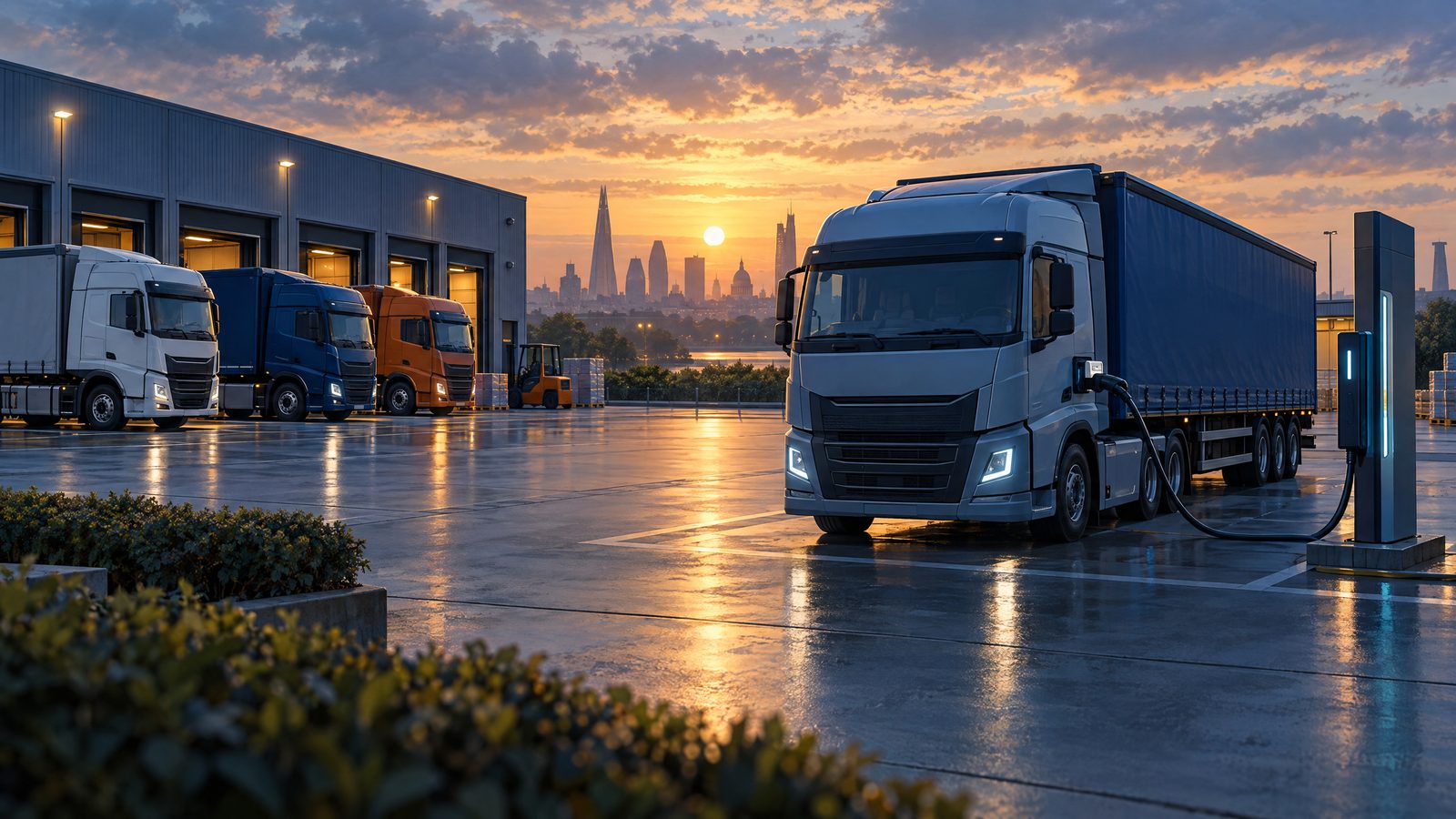

New heavy goods vehicle registrations rose in the third quarter of 2026, ending a run of eight consecutive quarters without growth. The recovery, however, came alongside a sharp fall in registrations of zero-emission trucks, underlining the uneven state of the transition in the vehicles that carry goods into cities, shops, construction sites and distribution centres.
There were 9,941 new heavy goods vehicles registered between July and September, a rise of 7.2% on the same quarter last year. It was the market’s strongest quarterly performance since the third quarter of 2023 and its first year-on-year increase since the second quarter of 2024.
The improvement needs to be read against the prior year’s low comparison point. Registrations had fallen by 14.5% in the third quarter of 2025. Across the first nine months of 2026, 28,099 new HGVs were registered, leaving the market 3.8% below the equivalent period a year earlier. A single stronger quarter therefore does not yet amount to a return to sustained growth.
Articulated vehicles accounted for much of the uplift. Registrations in that part of the market increased by 11.2% to 4,543 units, taking year-to-date articulated demand into modest growth of 2.3%. Rigid trucks also rose, although more slowly, increasing 4.1% to 5,398 units. Tractor registrations were up 12.3% to 4,453, while refuse-disposal vehicles rose 31.5% to 760 and tippers increased 19.1% to 847. Those figures point to firmer demand across several heavy-duty tasks rather than a rise concentrated in one vehicle format.
Some parts of the market continued to contract. Box-van registrations fell 11.8% to 793. That distinction matters because HGVs are bought for specific operating needs: long-distance haulage, building work, municipal collections and urban distribution do not require the same body types or operating patterns.
Regionally, England registered 8,685 new HGVs in the quarter, up 7.8%. The South East recorded the largest volume increase, with 319 more registrations than a year earlier, taking its quarterly total to 2,187. The region is a significant domestic and cross-Channel haulage area, making its movement important to the national market. The figures record new vehicle registrations, not traffic levels or the number of trucks currently operating on a particular road.
The central concern is the zero-emission segment. Registrations of zero-emission HGVs fell 50.7% during the quarter and represented only 1.1% of the new-truck market. Their year-to-date share was 1.0%, after demand fell 30.9%. The quarterly comparison follows an unusually strong period a year earlier, when zero-emission registrations quadrupled and their market share reached 2.4%, but the current figures still show how small and volatile the segment remains.
Heavy trucks present a different transition challenge from cars. Operators must match range, payload, routes, depot capacity and charging or refuelling arrangements to the work a vehicle has to perform. The new figures identify the upfront cost of vehicles and investment in depot infrastructure as continuing barriers. Existing public support through the Plug-in Truck Grant and Depot Charging Scheme reduces part of that burden, but does not remove the operational planning required by each fleet.
The industry body behind the data has called for a national infrastructure strategy and a multi-technology approach to cutting carbon dioxide from road freight. That is a policy position rather than a government decision. What the registrations establish is more immediate: new-truck buying recovered in the quarter, while the shift to zero-emission HGVs moved in the opposite direction. For a country dependent on road freight, the gap between those two trends will remain a major transport and industrial question.







