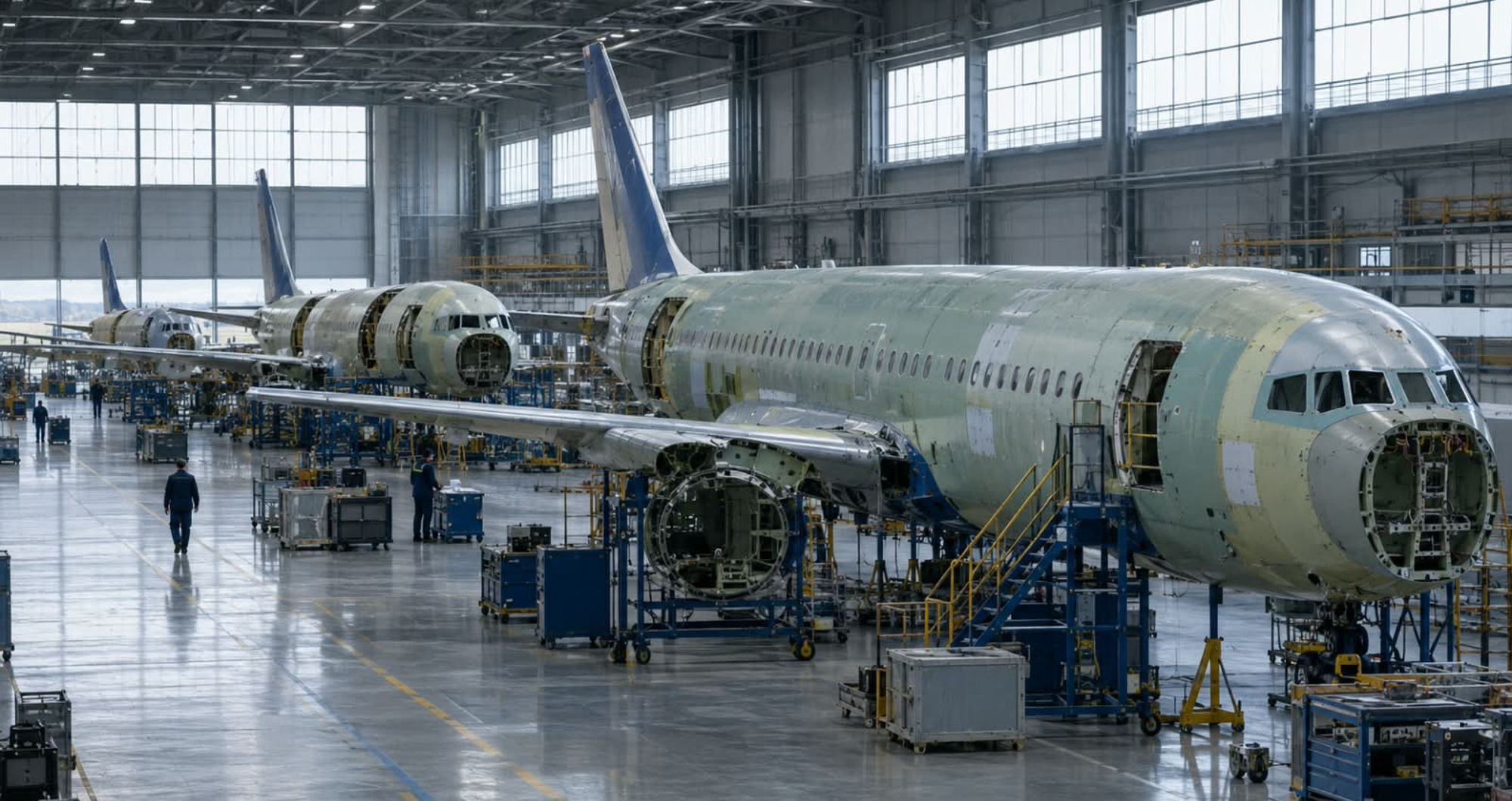

When an aircraft manufacturer misses a delivery deadline by several months, the bill does not stay inside the factory. It spreads through supply chains, customer contracts and airline schedules, and it keeps growing for as long as the delay lasts.
Engineering failures tend to dominate the headlines, and they deserve serious attention. Yet the financial damage from a long production delay can be larger, and much harder to contain, than the cost of fixing the original fault.
For the UK this is not a distant problem. Britain has one of the largest aerospace industries in the world, with Airbus designing and building wings for its commercial jets at Filton and Broughton, Rolls-Royce producing large civil engines in Derby, and hundreds of smaller suppliers spread across the country. When a delivery programme slips anywhere in the world, British firms feel it.
A fix has a price tag, a delay keeps running
An engineering mistake is expensive, but once it has been identified, its cost is largely defined. The manufacturer has to pay for redesign, testing, recertification and, in some cases, modifications to aircraft already built.
A delay works differently. It has no fixed end point, and every extra month adds new costs across the business and its customers. In fact, many production delays begin as engineering or quality problems. The real financial damage often comes less from fixing the fault itself and more from the time it takes to fix it.
How delays create compounding costs
When a delivery date slips, a manufacturer still has to pay for labour, utilities and facility overheads on the delayed aircraft. At the same time, it may face contractual penalties from customers who planned their operations around the original date.
Airlines schedule flight crews, ground staff and maintenance teams based on when they expect new aircraft to arrive. A six-month delay forces them either to carry expensive idle capacity or to reshuffle staff elsewhere. Manufacturers, meanwhile, often spend more on expedited shipping, overtime and outside consultants as they try to recover lost time.
Customer penalties and contract obligations
Aircraft purchase agreements usually set delivery dates with financial consequences for missing them. The exact terms are confidential, but compensation is commonly linked to the aircraft’s price and to the length of the delay.
A simple illustration shows how quickly this adds up. If an aircraft priced at $100 million carried late-delivery compensation of 0.5% per month, each aircraft would cost the manufacturer $500,000 for every month it was late. For an order of 20 aircraft delayed by six months, that would come to $60 million, before any other costs are counted.
Supply chain strain
Aircraft production depends on the carefully timed delivery of parts from hundreds of suppliers around the world. When a manufacturer slows production, those suppliers have to adjust their own schedules, sometimes pausing lines that were set up specifically for that programme.
Many suppliers are left holding work-in-progress inventory they cannot deliver, while still paying skilled staff to keep their facilities ready. The effect runs down to second- and third-tier suppliers, many of them small and medium-sized engineering firms, which have far less financial cushion than the large manufacturers they serve.
Airlines keep older aircraft flying
When new jets arrive late, airlines often have to keep older aircraft in service for longer than planned. Those aircraft burn more fuel and need closer maintenance attention, particularly their engines.
To keep ageing fleets safe and reliable, maintenance teams rely on aircraft borescopes for accurate inspections, which let engineers look inside an engine without taking it apart. Every extra inspection, spare part and litre of fuel adds to a cost that sits with the airline rather than the manufacturer, which is one reason delays are so unpopular with customers.
Lost orders and competitive damage
Delivery reliability strongly influences which aircraft airlines choose to buy. When one manufacturer delivers on schedule and another does not, airlines naturally lean towards the more reliable supplier for future orders.
This reputational damage can cost far more than the penalties on any single programme. Aircraft stay in service for 20 to 30 years, and airlines tend to stick with the types they already operate to keep training and maintenance simple. Losing even a small share of the market can therefore mean losing revenue for decades.
Workforce and facility pressures
Long delays also force difficult decisions about people and factories. Production lines cannot simply be switched off and restarted without high cost.
Workers on a delayed programme may have to be reassigned, retrained or, in some cases, furloughed. Experienced aerospace engineers and technicians are hard to replace, and if they leave during a slowdown, the manufacturer must recruit and train new staff when production picks up again. Facilities, meanwhile, continue to consume energy and maintenance budgets while producing less.
The bottom line
Engineering mistakes rightly receive close scrutiny, but production delays can quietly do more financial damage. Penalties, supply chain strain, extra costs for airlines, lost future orders and pressure on the workforce all build up month by month.
For the UK’s aerospace sector, which depends heavily on global aircraft programmes running to schedule, keeping deliveries on time matters as much as getting the engineering right.