
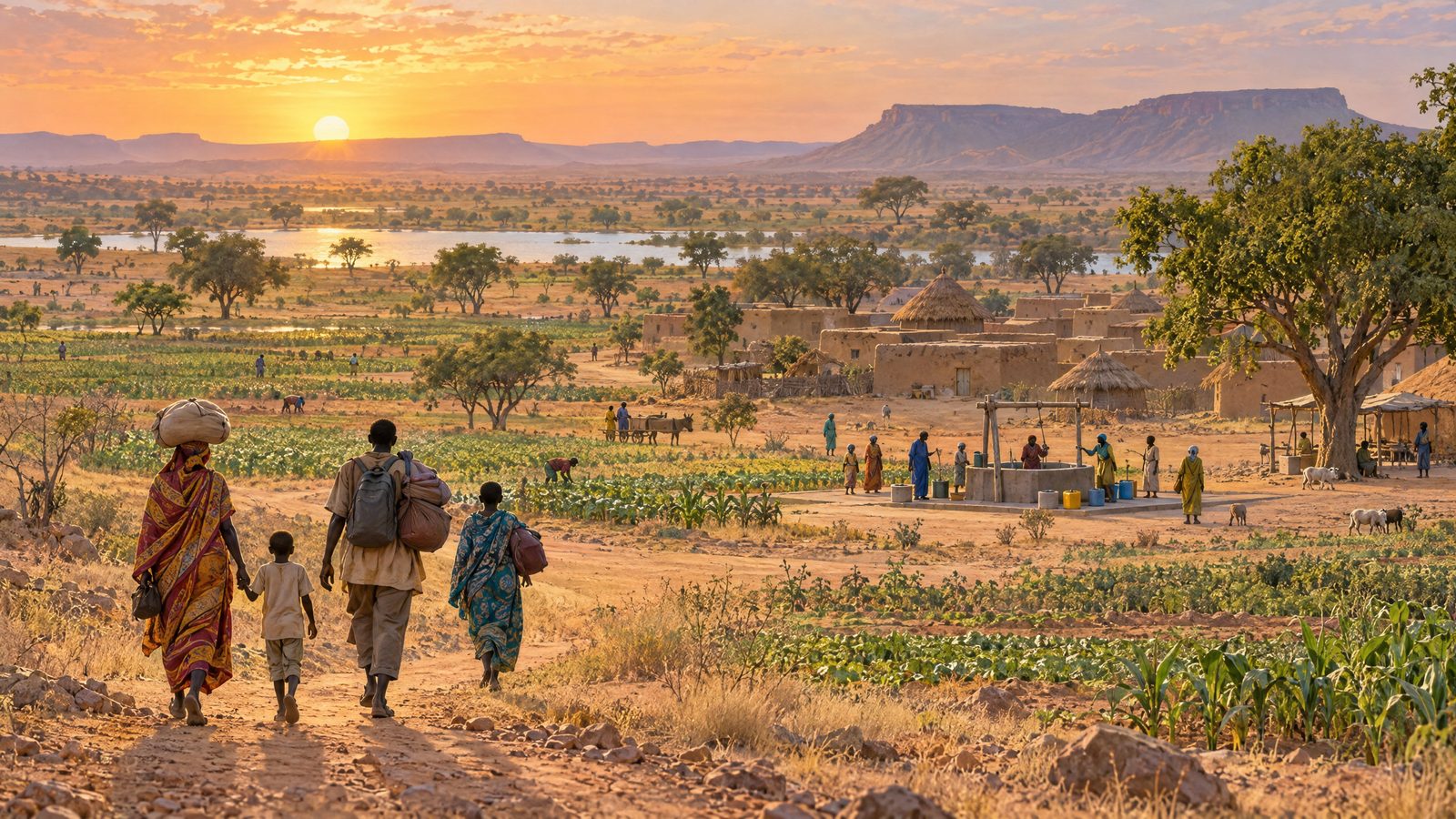

Nearly four million people are now uprooted across Burkina Faso, Mali and Niger, according to a new UNHCR assessment that calls for greater investment in protection, public services and livelihoods across the Central Sahel.
The figure includes more than 818,000 refugees and asylum-seekers. It is roughly twice the number of displaced people recorded in the region in October 2020, when there were more than 1.7 million internally displaced people and 365,000 refugees. The scale matters not only for families who have fled but also for towns and rural communities asked to share land, water, schools, health provision and work opportunities.
UNHCR identifies continued attacks affecting civilians, climate-related shocks and severe funding gaps as pressures that are forcing families to move and reducing their ability to rebuild. Drought, erratic rainfall and flooding are disrupting farming, damaging homes and infrastructure, and cutting access to water and livelihoods. These are overlapping risks rather than a claim that every displacement has one cause.
The picture in Mali illustrates the strain. Around 86,000 refugees from Burkina Faso were living in the Koro area of Bandiagara by July. More than 14,000 children and 6,000 women there were identified as being at particular risk. The refugee population is approaching the size of the local host community, increasing pressure on scarce land and water, health services and employment prospects.
Some local schemes show the kind of support the agency wants expanded. In Koro, agricultural cooperatives involving Burkinabè refugees and host-community members increased cultivated land from 21 hectares in 2025 to 45 hectares in 2026. Similar assistance in Kaya, Burkina Faso, is intended to help displaced people and host communities raise food production, reduce post-harvest losses and earn income. These projects remain small beside the regional need, but the agency says they point to the value of pairing emergency protection with routes towards self-reliance.
The crisis is also crossing borders. Nearly 500,000 Burkinabè refugees and asylum-seekers had sought safety in neighbouring countries during 2026, up from more than 300,000 at the end of 2025. Many have gone to Benin, Côte d’Ivoire, Ghana and Togo. More than 334,000 Malians and over 106,000 Nigeriens are also recorded as refugees or asylum-seekers in neighbouring states.
That movement does not automatically determine anyone’s future route. UNHCR says people may move on, sometimes alongside migrants, when safety and prospects remain unavailable. It is working with governments and partners on multi-purpose service hubs offering information, counselling, referrals and essential assistance along key routes. The purpose is to make protection and services available closer to where people are, while longer-term political efforts address insecurity.
Funding is the immediate constraint. By September, UNHCR’s Sahel response was only 27 per cent funded against a requirement of $329.6 million. The shortfall affects registration and documentation, shelter, basic services and livelihoods support. The agency is calling on governments, development partners, international financial institutions and the private sector to increase support rather than reduce it as needs grow.
The appeal is not a declaration that new money has been secured. It is a warning that durable solutions require both political engagement and practical investment in the communities where displaced people are already living. Its central point is that assistance should not be limited to short-term relief: services and livelihood opportunities must be strengthened for people forced to flee and for the host communities carrying much of the burden.







