
Universal Quantum, the quantum-computing company headquartered in Haywards Heath and Hamburg, has raised more than $100 million in a Series A funding round. The company says the financing will support development and commercialisation of its modular trapped-ion systems and expansion in several international markets.
The round was co-led by DCVC and Firgun Ventures. Other participants include Singapore-based EDBI, Artal, Integral GlobalTech, Main Sequence, Hostplus, NGS Super, IAG Capital, EdenBase, Eigenstate Holdings, SiteGround Capital and Roblox chief executive Dave Baszucki, alongside other existing and new investors. The company described it as the largest Series A raised by a UK-headquartered quantum company.
A modular route to scale
Quantum computers process information using quantum bits, or qubits. Unlike conventional bits, which represent information as zero or one, qubits can use quantum states that enable certain calculations to be approached differently. Building useful machines remains difficult: qubits are delicate, errors must be managed, and increasing the number of qubits while maintaining control is a major engineering challenge.
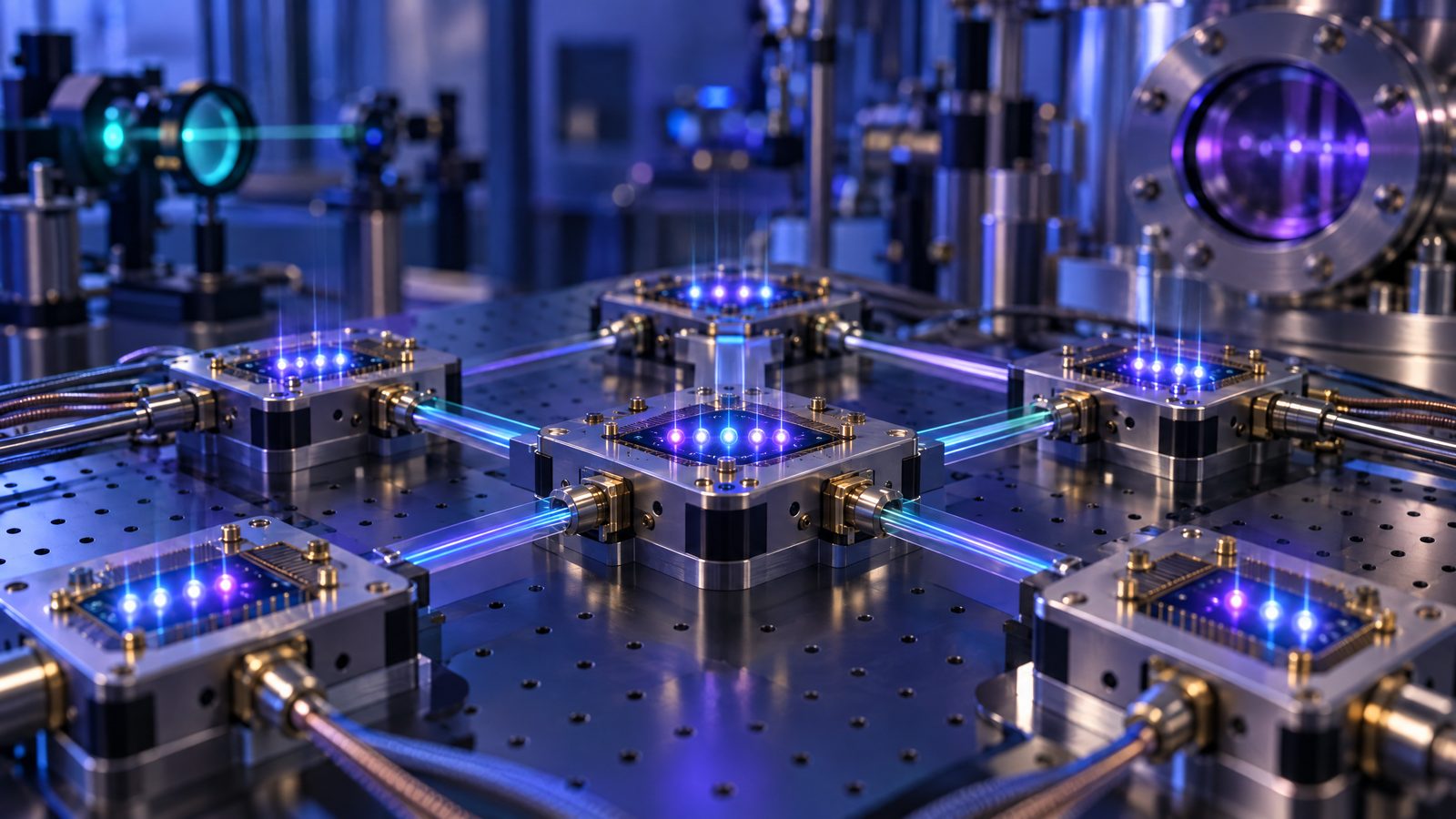
Universal Quantum’s approach uses trapped ions. In this method, electrically charged atoms are held in place by electromagnetic fields and used as qubits. The company aims to link many small quantum chips into larger systems, a modular design it says is intended to make expansion more practical than relying on a single very large device. Its plans include chiplet arrays, integrated chips and control systems. These are development goals, not evidence that a fault-tolerant, utility-scale computer is already operating.
The company says its architecture is designed to connect modules without depending on photonic interconnects or large, costly lasers and cooling infrastructure. It describes its interconnect technology as patented and says the new investment will help advance the engineering needed to build larger systems. The practical performance of the resulting machines, including their ability to correct errors at scale, remains to be demonstrated.
Funding and international plans
The financing is also intended to support a recently announced research and development centre in Singapore, described by the company as its first outside Europe. It plans further expansion in the United States and Japan, as well as across its Hamburg base. The announcement therefore combines a technical development programme with an effort to build an international operating footprint.
Universal Quantum was founded in 2018 by University of Sussex researchers Sebastian Weidt and Winfried Hensinger. Its origins lie in their work on large-scale trapped-ion computing, including a 2017 blueprint for linking quantum modules. The company says it now has operations across three continents and employs more than 100 technical staff.
The business also points to a $77 million contract with the German Aerospace Center, which it says it is currently delivering. The existence of a contract indicates a customer relationship, but does not by itself establish that the company has completed a functioning large-scale quantum computer or achieved commercial quantum advantage.
The scale of the funding round signals investor support for the company’s attempt to turn modular trapped-ion research into engineered systems. Quantum computing remains an early-stage field, and major technical questions—including reliable error correction and useful performance—are unresolved across the sector. The company’s stated ambition is to build machines capable of practical, error-corrected computing; whether its architecture can reach that point will depend on future engineering and testing.
For Haywards Heath, the announcement puts a locally headquartered technology company at the centre of a substantial international financing round. For Universal Quantum, the immediate task is to translate the capital into research capacity, hardware development and progress on its commercial contracts, while establishing the overseas operations it has outlined.