
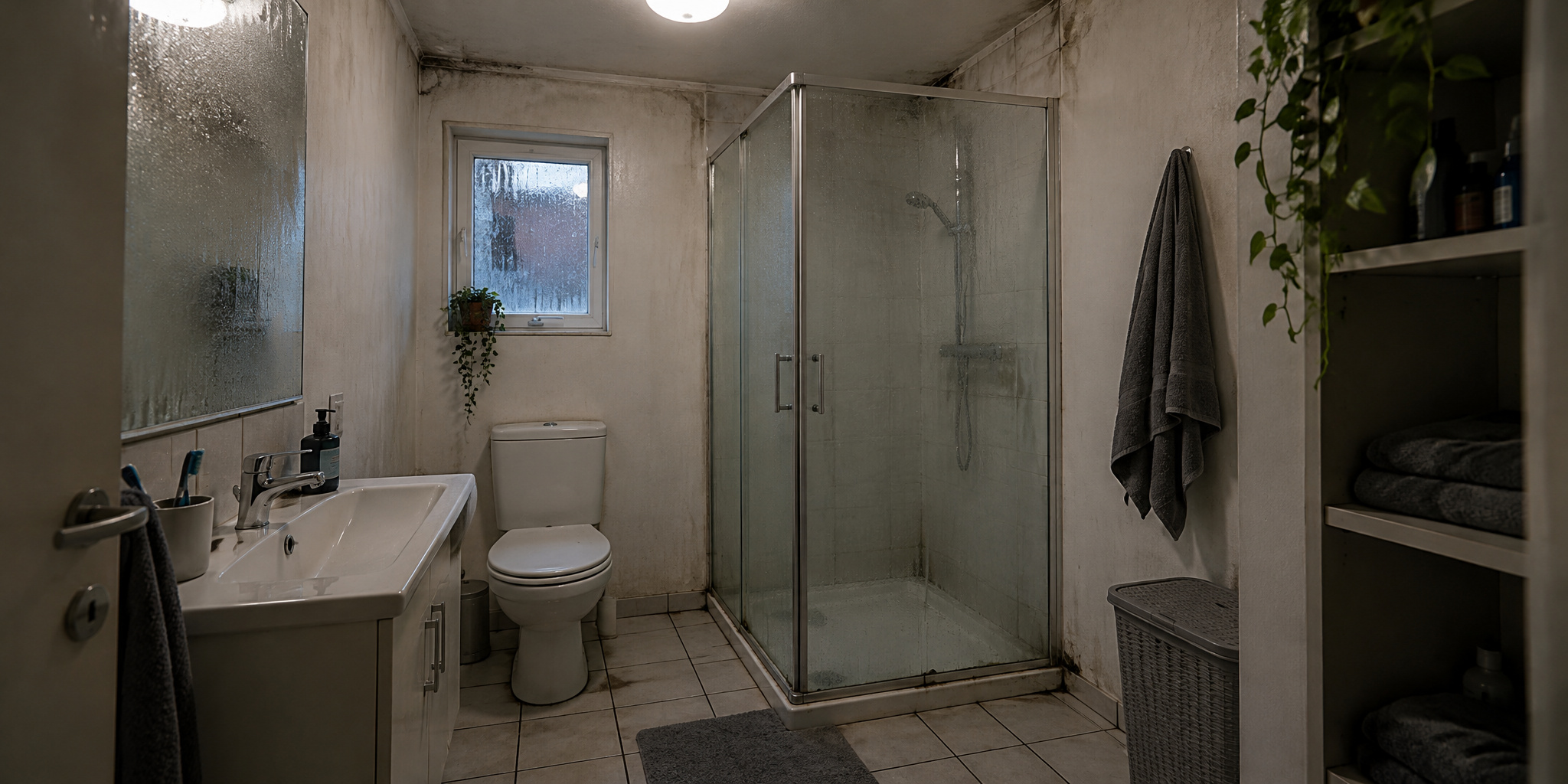

Bathroom ventilation is the least glamorous subject in home improvement. It does not feature in design magazines; it is rarely discussed by estate agents, and it is almost never the reason someone falls in love with a property. Yet inadequate ventilation is responsible for more hidden damage than almost any other defect in the home.
The consequences accumulate quietly. Mould spreads across a ceiling. Paint flakes above a shower. Grout blackens. Wallpaper peels in an adjacent room. By the time the problem is visible, the cost of fixing it is considerably higher than the cost of preventing it. If you’re having a new bathroom fitted, ventilation is an important consideration.
What Ventilation Actually Does
A bathroom produces a remarkable amount of moisture. A single hot shower can release litres of water vapour into the air, and a bath or a long soak produces more still. Without adequate ventilation, that moisture has nowhere to go.
It condenses on the coldest surfaces—mirrors, windows, tiles, and external walls. It soaks into grout, sealant, plaster, and timber. Finally it creates the humid conditions in which mould and mildew thrive. Over months and years, it causes structural damage that is expensive to repair.
Ventilation removes that moisture before it can settle. It does so in one of two ways: by extracting air from the room, or by allowing moisture-laden air to escape through a controlled opening.
The Types of Ventilation
Several systems are available, and the right choice depends on the bathroom and the building.
Extractor fans are the most common solution. They draw moist air out of the room and expel it outside, either through a wall or a duct. A fan should be sized to the volume of the bathroom and should run long enough after use to clear the air.
Intermittent extract fans run when the light is switched on, often with a timer overrun that keeps them going for several minutes after the light is turned off. This is the standard arrangement in most British homes.
Continuous extract fans run at low speed all the time, increasing when humidity rises. They are particularly effective in modern, airtight homes where natural ventilation is limited.
Heat recovery ventilation (MVHR) systems extract moist air while recovering its heat and supplying fresh air elsewhere. They are common in new builds and Passivhaus-standard properties, and they are increasingly specified in renovations.
Passive ventilation includes trickle vents, air bricks, and opening windows. These are useful but rarely sufficient on their own in a bathroom.
The Window Question
Many people assume that an opening window makes mechanical ventilation unnecessary. This is a mistake.
Windows provide ventilation only when they are open, and in winter they are rarely open for long. In a bathroom used in the morning, the window may be closed throughout the shower, and the moisture is already in the air by the time it is opened.
There is also a security consideration. Windows left open in a bathroom, particularly on the ground floor, are a risk. And in urban areas, an open window admits noise and pollution along with the air.
A window is a useful supplement. It is not a substitute for an extractor fan.
Signs of a Ventilation Problem
Several warning signs indicate that ventilation is inadequate.
Condensation on windows and mirrors that persists after use suggests that moisture is not being removed.
Mould on ceilings, grout, or sealant, particularly in corners and above the shower, is a clear indication of chronic damp.
Peeling paint or wallpaper in the bathroom or in adjacent rooms points to moisture migrating through walls.
A persistent musty smell suggests damp conditions that are not being addressed.
Damp patches on external walls or on ceilings below the bathroom may indicate moisture penetration or condensation.
Any of these should prompt a review of the ventilation system.
Common Mistakes
Several errors are routinely made with bathroom ventilation.
A fan that is too small for the room will not clear the moisture effectively, however long it runs. Also, a fan that is not ducted properly—or that vents into a loft rather than outside—simply moves the moisture somewhere else. Finally, a fan that is noisy will be turned off or disconnected, defeating its purpose. A fan without a timer overrun stops as soon as the light goes off, leaving moisture in the air.
Each of these is easily corrected, and each is worth checking.
The Cost of Getting It Right
Good ventilation is not expensive, particularly when compared with the cost of fixing the damage it prevents.
A decent extractor fan costs less than most bathroom accessories. Proper ducting and installation add to that, but the total remains modest. Running costs are minimal, particularly for a fan used for twenty minutes a day.
Against that, consider the cost of remediating mould, replacing damaged plaster, re-grouting, repainting, and addressing any structural damp. The arithmetic is not close.







