

An eCommerce product catalog with multi-million SKUs and 5% error rate is proof of 50,000 defective product records. Each of these defective records suppresses a listing, inflates return rates or corrupts a downstream PIM. It is impractical to address the dirty product data at the scale that we are talking of. Also, the cost of inaction is measurable.
In 2024, consumers returned $362 billion in merchandise from online sales. products not matching their online item descriptions leading to sizing, fit, and colour issues were the primary reasons for 45% of all retail returns.
Why is product data cleansing important for eCommerce?
Bad or dirty product data is not just an operational inconvenience. It triggers return rates, suppresses search visibility, and disturbs the navigation that shoppers use to filter results; ultimately impacting your revenues negatively. Just imagine the plight of your catalog managers. The incomplete, incorrect and missing product data problem compounds for them at each feed cycle, while running multi-supplier data ingestion pipelines.
5 Ways AI Is Transforming Product Data Cleansing
AI assisted ecommerce product data cleansing workflows are changing the entire outlook. It does not replace data stewardship but makes it scalable. The new AI approach is set to transform product data cleansing in five ways, right from reactive fixes like deduplication and validation, to proactive intelligence like continuous monitoring for addressing data failures that rule based systems alone cannot resolve.
Way 1 – AI-Powered deduplication: Beyond exact-match record consolidation
Existing deduplication systems with most eCommerce companies are designed to work on exact-string matching. It will merge two records only if product titles, SKUs, or GTINs are identical character-for-character. If we look at real-world supplier data, this threshold is too narrow.
So, the question here is that does your deduplication engine actually understand what it’s comparing? One of your supplier may list “500ml Stainless Steel Insulated Tumbler,” whereas another may enter the same product as “S/S Travel Mug 0.5L.” Your existing deduplication system using a simple fuzzy match or a hash comparison; will never be able to consolidate these records.
How fuzzy matching and entity resolution catch what rule-based systems miss?
AI backed entity resolution workflow has a completely different approach to address this scenario.
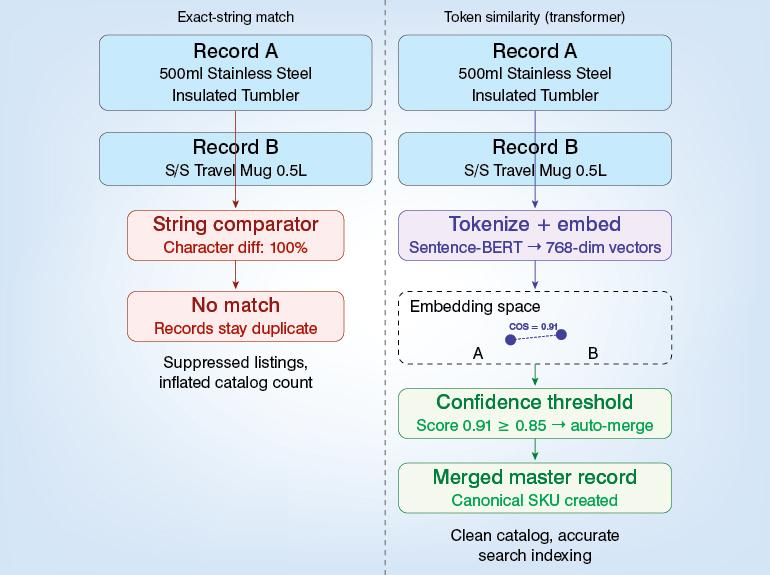 When put to production, these systems assign a confidence score to each record merge pair. Pairs with high-confidence scores merge automatically. Pairs with borderline scores are routed for human review. This ensures accuracy of product data without manual comparison at catalog scale. But even here, the human feedback loop is critical. Each human-reviewed edge case can be used as a training example to improve model’s future precision on that product category.
Way 2 – NLP-Driven attribute normalisation: Standardising product data across supplier feeds
Inconsistency in product attributes in supplier data, though not visible but is the most damaging data quality problem for eCommerce industry. One of the supplier labels a field as “Colour”, another one will use “Colour”, and the third one will embed the value in the product title string itself with no dedicated field at all. This will lead to broken search index where faceted filters will return incomplete results and stop the shoppers from narrowing by attribute and relevance.
NLP-based attribute extraction addresses this issue right at data ingestion stage. Named Entity Recognition – NER models trained using ontologies extract typed, structured values and parse unstructured titles and descriptions. A title like “Men’s Slim Fit Stretch Denim Jeans Dark Indigo, 32×30” resolves into “Gender, Fit, Fabric, Style, Colour, Waist, and Inseam” fields. Each of these fields are mapped for unit harmonisation to a canonical value.
How does canonical value mapping and unit harmonisation work at scale?
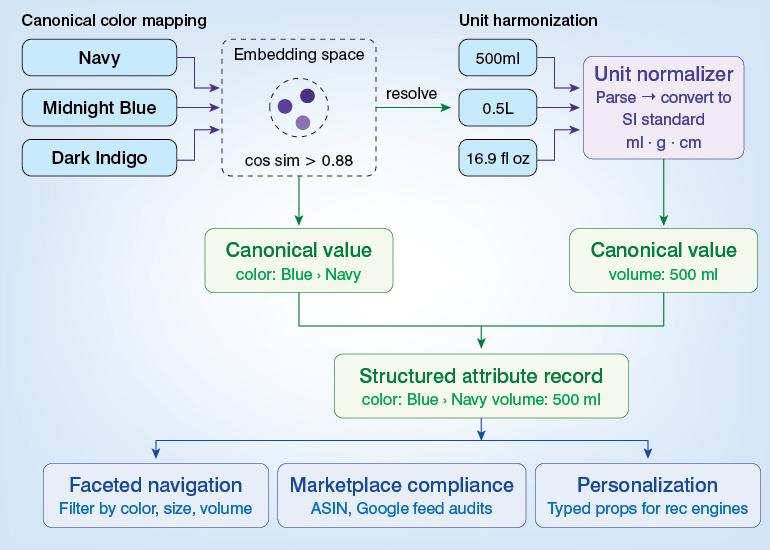 Attribute extraction is only the first step. These extracted values then should be mapped to controlled vocabulary. I.e., “Navy,” “Midnight Blue,” and “Dark Indigo” are three different strings describing the same colour node. Ai backed canonical mapping addresses this issue without manual synonym tables. Here the model learns “how to cluster” from training data.
Unit harmonisation works on the same logic. Mixed measurement formats like imperial vs. metric, weight vs. volume are made to fit a single standard. In case of cross-border catalog compliance, this is not optional. Here’s a diagram that covers both mechanisms in one flow.
Structured and consistent attributes are mandatory for downstream activities including faceted navigation, marketplace compliance checks, and personalisation algorithms. All of them depend on typed product properties, but poor quality attributes silently set them for failure.
Way 3 – ML-Based taxonomy classification: Routing SKUs to the right category at ingestion
Miscategorised SKUs do not appear in category browse paths and hence score poorly in marketplace ranking algorithms, Amazon’s ASIN compliance system, Google Shopping feed audits and also are excluded from promotional eligibility. If you have to manually classify tens of thousands of new SKUs per feed cycle, it’s a structural problem. It can never be a throughput problem. Online retailers who furnish inaccurate product data lose 86% of shoppers permanently. It is a very big loss to the revenue and brand credibility.
ML backed taxonomy uses classifiers that are trained using hierarchical product ontologies like GS1 GPC bricks, UNSPSC codes, and platform-specific category trees for assigning multi-level category paths automatically. These models are designed to give confidence scores for every single assignment, where high-confidence classifications are routed automatically and low-confidence items are routed for human review for specialists to resolve ambiguity.
What are the benefits of using Multi-Label classification for complex SKUs?
There are certain products which you cannot place in a single category. I.e., a camera bag doubles as a carry-on in photography accessory and travel gear. Forcibly fitting it into any one category will result in irrelevant placements in other category. Multi-label classifiers assign category paths across multiple nodes without creating duplicate listings.
AI taxonomy classification shifts mis-categorisation from a systemic failure to an edge case. The benefit of using Multi-Label classification for such complex SKUs is throughput. Classification that usually requires manual review for every SKU; now operates at ingestion speed. Human intervention stays reserved only for genuinely ambiguous cases.
Way 4 – AI-Augmented data validation: Catching structural errors before they reach the catalog
Schema validation is designed to catch missing mandatory fields, invalid GTIN check digits, malformed image URLs, out-of-range values (a product weight of 9,999 kg, a price of $0.00), and other such errors. These checks are necessary and work as basic data hygiene for every production ingestion pipeline. But they do not suffice today’s product attribute dynamics.
Some of these semantic errors that cause the most downstream damage include:
- Product prices are syntactically valid but statistically inconsistent with other SKUs in that category.
- Product images that passes URL validation but shows the wrong product variant.
- Product description created using accurate specifications but for a different size of the same item.
Validation process in rule-based system will pass all three above scenarios, however AI-backed anomaly detection will flag them.
Statistical anomaly detection models generate expected attribute values for every product category. Attributes or records beyond learned distribution, like a 4-gram weight for a car battery or $2 price for a power tool, are flagged for human review. At the same time, multimodal models are equipped to cross-check image content against textual product descriptions. It highlights asset-attribute mismatches which no rule set cannot anticipate.
How do validation errors train future ingestion models?
Every mistake is learning, and similarly every confirmed error in the validation pipeline is a labeled training example. The model is capable of learning characteristic signature of errors that surface in supplier feeds. This enables it to predict similar errors in upcoming ingestion cycles. Over a period, this practice will make the validation a predictive process that will flag likely errors in the supplier’s pre-submission feed before they enter the product catalog.
Way 5 – Continuous AI monitoring: Shifting product data quality from a project to a pipeline
A clean product catalog at the time of ingestion degrades due to lack of ongoing monitoring. Reasons to this includes changing prices, daily update in supplier feeds, expiring image assets, changing platform requirements and many more. It also means that one-time product data cleansing project will not help, it might reset the clock but does not resolve the underlying problem.
If a 2023 report by the IBM Institute for Business Value (IBV) is to be believed, 25% of eCommerce companies estimate losing more than USD 5 million annually due to poor product data quality, and 7% of these companies reported losses of USD 25 million or more.
AI powered monitoring is the solution to this problem. It assigns a completeness and accuracy score to every single product record against configurable thresholds. Talking of reasons mentioned above, records that fall below defined threshold like image URL that returned a 404, or a price that moved outside the expected range for that category; will be flagged for re-validation or re-enrichment.
Why should you use data quality drift detection models for pipeline integration?
Drift detection models are used to monitor the statistical distribution of product attribute values across a supplier’s feed over time. So, when a new supplier submits product data, or an existing supplier changes the title format, the drift model identifies which supplier, which attribute, and how many records will be affected, and gives a surgical alert to catalog teams to act before anomaly penetrates through thousands of records.
Embed continuous monitoring directly in the ETL pipeline for effective and efficient product data cleansing results. Using it as a post-publication audit will never help. The reason is that the model is programmed to run quality checks at the ingestion layer, the transformation layer, and the pre-publication approval stage. This arrangement converts data quality form a routine periodic cleanup task into an automated standard. It will give a catalog that maintains its integrity between major data projects. It will not allow the catalog to degrade until the next manual intervention becomes unavoidable and turn a project into a data pipeline.
Conclusion
For high-volume e-commerce businesses, poor data quality causes serious financial losses. Unresolved issues lead to suppressed listings, more returns, and broken search functions. These problems directly lower conversion rates and damage daily revenue. Using AI for product data cleansing is a sure shot solution, but only it is not used in a standalone manner.
AI has the capability to identify potential errors and flag anomalies proactively, however human-in-the-loop approach should be leveraged consciously to make final decisions. That’s the reason why successful eCommerce companies and a lot of online retailers build and use workflows that assist human judgement. They never use AI as a total replacement. This balanced approach ensures accuracy and long-term catalog success.