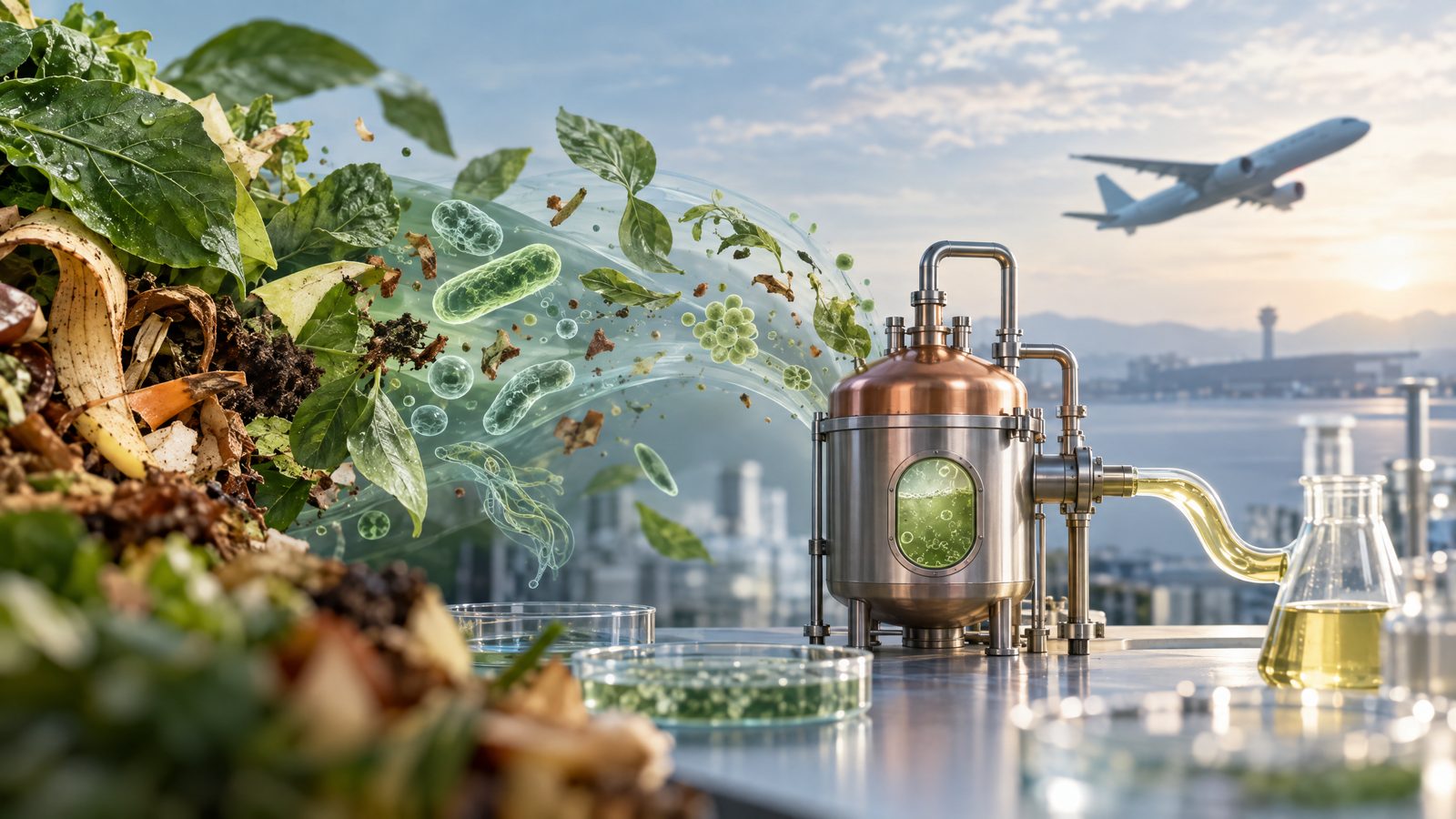

Cambridge start-up Neela Biotech has raised £2.1 million in pre-seed funding to move its waste-derived aviation-fuel technology from laboratory development towards a pilot at an existing biogas plant. The company says the trial is planned over the next two years. It has not yet demonstrated the process at pilot scale.
Turning waste into a fuel ingredient
Neela is developing an AI-guided microbial process intended to convert food, agricultural and forestry residues into fatty acids. These are potential feedstocks for hydroprocessed esters and fatty acids, or HEFA, the established route used to make much of today’s sustainable aviation fuel. HEFA processes oils and fats into fuel, but the supply of suitable waste oils is limited.
The proposed system would work alongside anaerobic digestion, the biological process that breaks down organic material to produce biogas. Biogas plants already operate at commercial scale, and Neela’s plan is to adapt existing facilities rather than build a new fuel plant from scratch. The company argues that this could reduce the capital needed for deployment and give plant operators an additional use for their sites. Those are potential advantages, not results established by a working installation.
The funding round was led by climate investor Elbow Beach, which invested £1.5 million. Ascension, Cambridge Enterprise Ventures, Ventures Together and strategic angel investors also participated. Neela says it will use the proceeds to advance the technology towards the planned trial. The company has also taken part in an airline innovation programme and received grant support, but the funding announcement does not report a completed pilot or commercial production.
A test against a demanding scale-up challenge
The opportunity sits within a sector facing pressure to find more sustainable fuel. The UK’s aviation-fuel mandate began at 2 per cent of jet-fuel demand in 2025, with the required share set to rise to 10 per cent in 2030 and 22 per cent in 2040. A mandate creates a rising policy requirement; it does not guarantee that enough eligible fuel will be available or that any particular technology will meet it.
HEFA is an established production pathway, but its reliance on waste oils and fats limits the amount of fuel that can be made from those materials alone. Neela’s approach seeks to widen the potential input base by using other organic residues. If the resulting fatty acids can be produced consistently and accepted by downstream fuel producers, they could offer another feedstock route. The company has not yet published pilot results, a production cost per tonne or evidence that the approach can compete with conventional jet fuel.
That distinction matters because laboratory conversion is only one step in the chain. A plant-scale trial will need to show that variable waste materials can be processed reliably, that the microbial output meets the requirements of later fuel production and that operations work safely alongside an existing biogas facility. The funding announcement sets out a plan to test the process; it does not establish those outcomes.
Neela’s founders developed the technology from research linked to engineering work at the University of Cambridge. Its next milestone is therefore practical as well as scientific: taking a controlled process into an operating industrial setting. The proposed pilot should help determine whether the claimed use of diverse waste streams and existing infrastructure can translate into repeatable production. Until that evidence is available, lower cost, climate benefits and commercial scale remain prospective rather than demonstrated.